Microsoft Agent 365: Why Enterprise AI Needs Intelligence and Trust
Microsoft's Intelligence + Trust framing shows why enterprise AI needs agent control planes, visibility, governance, and cost management.

Microsoft's latest AI essay is not about a new model.
That is what makes it important.
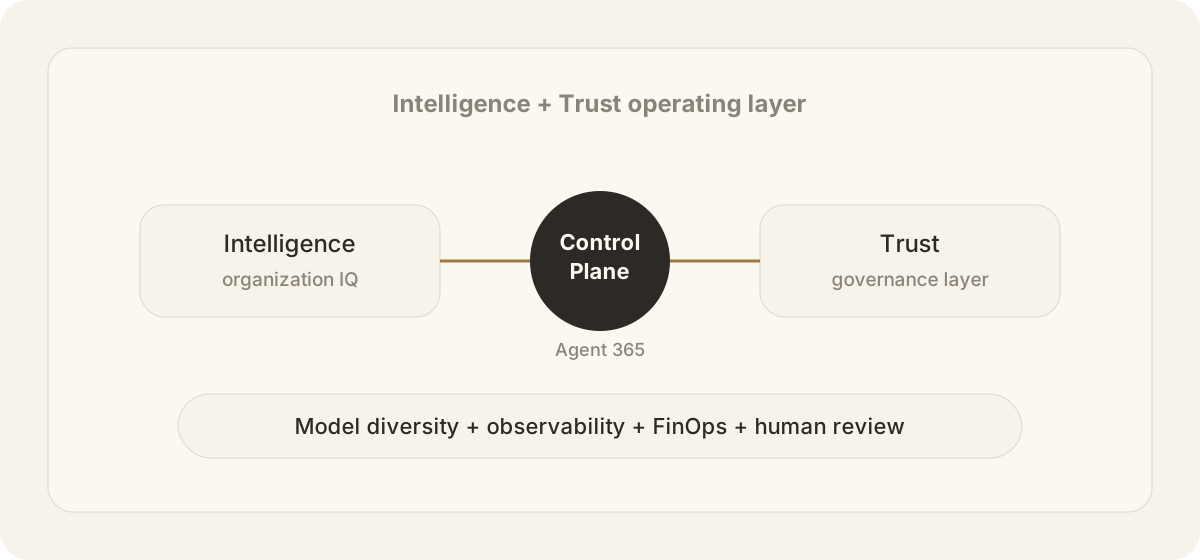
In "Achieving success with AI", Microsoft Commercial Business CEO Judson Althoff argues that the two most important elements in any AI solution are Intelligence + Trust. The piece names a shift that many enterprises are already feeling: models are becoming more available, but the system around them is becoming the real differentiator.
Microsoft's language is direct. No company should depend on one model or one model harness. Enterprises need governance, management, security, observability, and FinOps. Agent 365 is described as a control plane for observing, governing, managing, and securing agents across the organization, with cost management becoming part of that same layer.
This is a useful signal for every team adopting AI agents.
The next enterprise AI question is not only, "Which model is strongest?"
It is, "Who manages the work once agents are everywhere?"
What Microsoft is saying
The article frames enterprise AI around two requirements.
First, AI must amplify an organization's own intelligence rather than simply feeding knowledge into outside systems. Microsoft calls this "Your IQ": the semantic understanding of how an organization operates across Microsoft 365 and line-of-business systems.
Second, AI must be trusted inside the environment where it reasons and acts. That means visibility, control, governance, security, and cost management.
The details matter:
- Models are commoditizing.
- Enterprises should not depend on one model or one harness.
- Model diversity lets teams match intelligence, cost, and performance to each task.
- Agents need context upfront so they do not burn compute reconstructing structure.
- AI spending needs FinOps discipline as usage-based agents scale.
- Agent 365 is positioned as a control plane for identity, security, data governance, endpoint management, observability, and cost.
This is not a chatbot story.
It is an operating system story.
Why this matters for AI agents
Agent adoption changes the shape of AI risk.
A model that answers a question creates one kind of risk. An agent that works across files, tools, code, email, browser sessions, databases, workflows, and approvals creates another.
The moment agents can do real work, organizations need to answer operational questions:
- Which agent did the work?
- What context did it use?
- Which tools did it call?
- What did it cost?
- Which model was selected, and why?
- Which actions required approval?
- Can a human inspect, redirect, or take over?
Without that layer, AI becomes scattered execution.
With that layer, AI becomes managed work.
Cost is becoming part of governance
One of the strongest parts of Microsoft's argument is cost.
FinOps was already important in cloud computing. It becomes more important when AI shifts from predictable subscriptions to a mix of per-user licenses, usage-based inference, long-running agents, model routing, and agentic loops.
A team may not feel cost pressure when one person runs a few prompts.
It will feel it when dozens of agents run daily workflows, process documents, triage issues, analyze logs, generate reports, and retry work across multiple models.
That is why model diversity and context management are not just technical choices. They are cost controls.
The right model should do the right job. The right context should be available before the agent starts. The right human checkpoint should stop expensive or risky work before it compounds.
How this connects to Buda
Buda is built for the same direction, but from the workspace side.
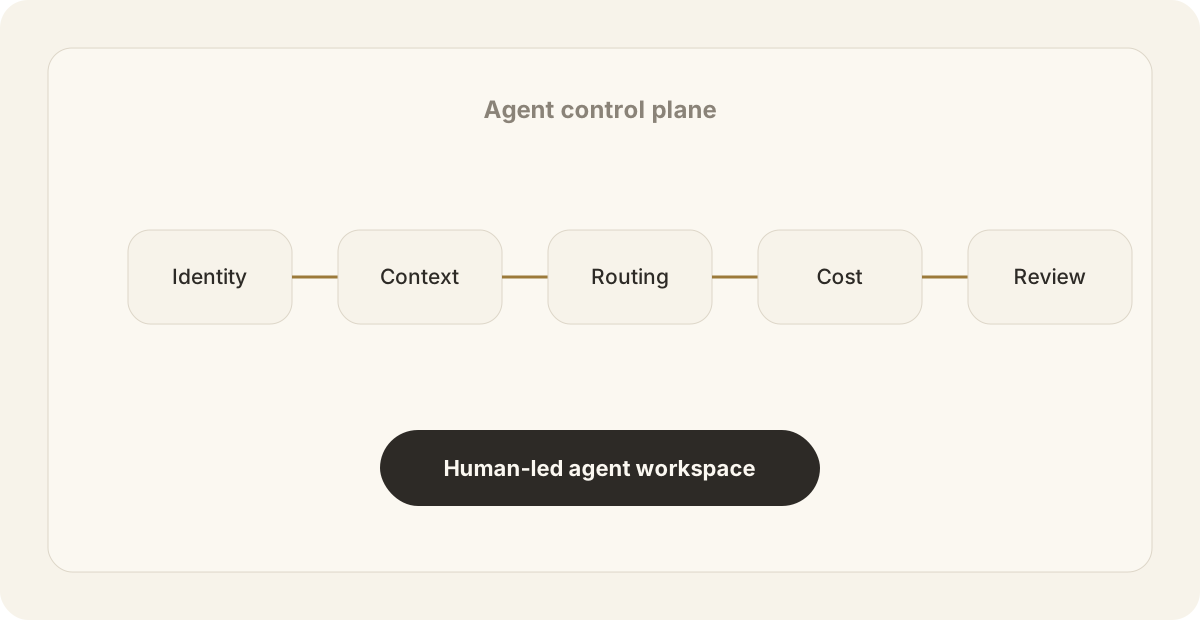
A Buda Space gives teams a shared boundary for agent work. Agents operate with files, sessions, browser context, terminal access, artifacts, channels, skills, and reviewable tool calls. Humans can inspect the work, upload context, approve sensitive steps, redirect execution, or take over.
This matters because agent management is not a single feature.
It is the environment around the work.
Microsoft's framing of Intelligence + Trust confirms a broader market shift: enterprise AI value is moving from standalone intelligence to managed intelligence. The model matters, but so does the system that routes tasks, preserves context, controls access, tracks cost, and keeps humans in charge.
For teams adopting agents, the lesson is simple.
Do not only ask whether the AI is smart.
Ask whether the work is observable, governable, and reviewable.
Start building human-led agent workflows at buda.im, or read the Buda Agent Workspace docs.