Microsoft Work Trend Index: What Advanced AI Teams in the Philippines Do Differently
Microsoft's 2026 Work Trend Index findings from the Philippines show how advanced teams share Agents, redesign workflows, and preserve human judgment.

Buying AI access is easy. Turning individual experiments into a way the whole team can use is harder.
New regional findings from Microsoft's 2026 Work Trend Index make that difference visible. Microsoft Philippines published the Philippines results on August 10, 2026. They extend Microsoft's global Work Trend Index research, whose core survey was conducted by the independent research firm Edelman Data x Intelligence among 20,000 knowledge workers using generative AI at work across 10 markets.
The research was later extended to 11 additional markets, including the Philippines. Microsoft did not disclose the standalone Philippine sample size in the regional release. The percentages below therefore describe the surveyed Filipino knowledge workers who use generative AI at work, not the entire Philippine workforce.
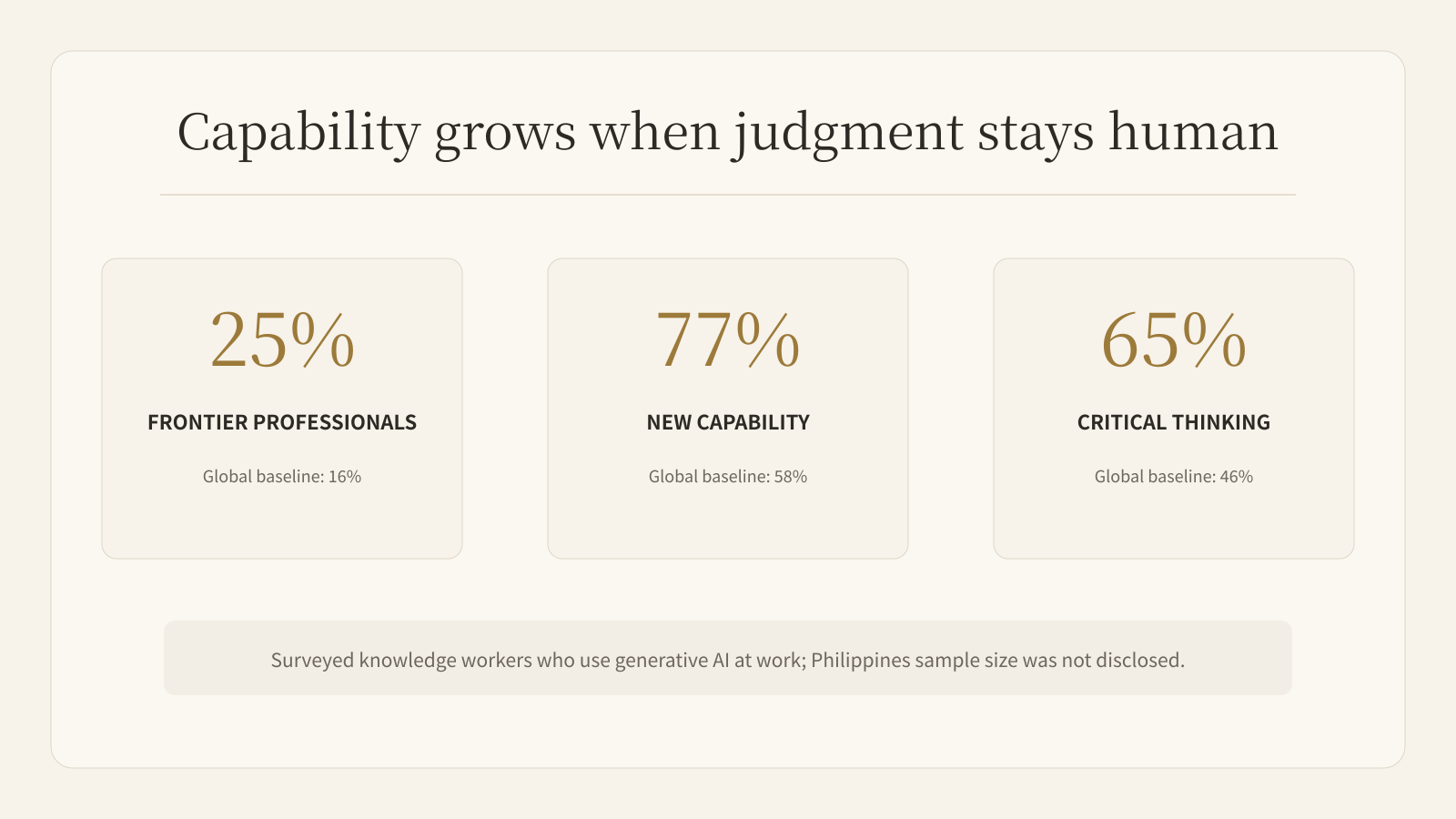
Within that surveyed group, 25% were classified as Frontier Professionals, compared with a 16% global baseline. These advanced users do more than prompt a chatbot. They use Agents for multi-step work, redesign workflows, share what they learn, and help define standards for AI-assisted output.
The most useful lesson is not that one country has found a better prompt. It is that AI capability compounds when a team turns private techniques into shared operating practice.
From Buda's perspective, that is the shift from personal AI use to managed Agent work.
Advanced AI use expands what people can deliver
Among the Filipino AI users in Microsoft's survey, 77% said they were producing work they could not have produced a year earlier. The global figure was 58%. Among Filipino Frontier Professionals, the figure rose to 86%.
This is more significant than doing the same task faster. AI can give someone enough research, analysis, drafting, or orchestration capacity to attempt work that previously required more time or specialist support.
But a wider range of possible outputs creates a new management question: which outputs are good enough to use?
Filipino respondents placed unusual weight on that question. Sixty-five percent named critical thinking as the most important human skill as AI takes on more work, compared with 46% globally. Fifty-nine percent prioritized quality control of AI output. Ninety-three percent said they treated AI output as a starting point and stayed responsible for the thinking.
The pattern is clear. Deeper use of AI does not remove people from the loop. It raises the value of people who can set direction, evaluate evidence, and own the result.
The strongest teams make AI knowledge shared
The largest operational difference appears in team behavior.
Among Filipino Frontier Professionals:
- 74% said their teams brainstorm and refine business processes together to find AI opportunities, versus 55% among other respondents
- 61% said their teams share AI tips, new Agents, and lessons learned, versus 45%
- 56% said their teams discuss quality standards for AI-assisted work, versus 43%
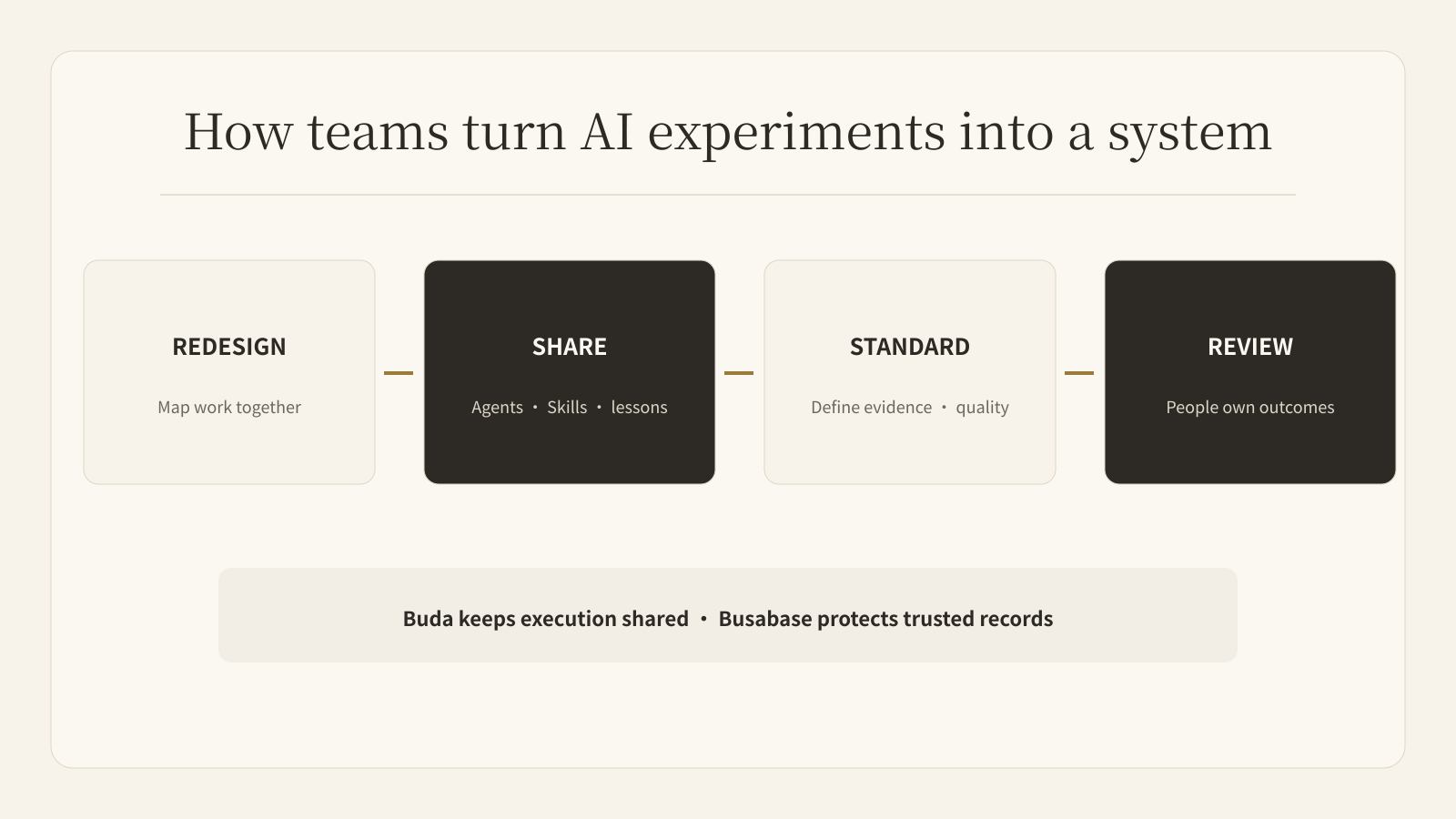
These practices convert a local success into an organizational asset.
If a useful Agent exists only in one person's chat history, the next teammate starts from zero. If the source files, instructions, tool access, handoff points, failure cases, and acceptance criteria are shared, the method can be repeated and improved.
That is the difference between a collection of AI users and a team operating with Agents.
Managers turn experimentation into an operating model
Microsoft's Filipino Frontier Professionals also reported stronger management support. They were more likely to say their managers used AI openly, set quality standards, created room for experimentation, and encouraged ambitious workflow redesign.
Yet only 35% of Filipino AI users said leadership had a clear and consistent direction for AI. That was above the 26% global baseline, but still only about one in three respondents. Microsoft describes the wider gap as the Transformation Paradox: employees are ready to change, while metrics, incentives, and operating rules continue to reward the old way of working.
Microsoft's global analysis reinforces the point. Organizational factors such as culture, manager support, and talent practices accounted for 67% of the measured importance associated with self-reported AI impact, compared with 32% for individual mindset and behavior.
These are statistical associations based on self-reported survey responses, not a causal allocation of business value. Their practical implication is still useful: training individuals without redesigning the system around them leaves much of their capability trapped.
A thousand seats are only the starting point
PLDT and Smart recently deployed 1,000 Microsoft 365 Copilot seats. The number shows that AI is moving beyond a small pilot, but a license rollout does not answer the operational questions that determine value:
- Which workflows should change?
- Which Agents and Skills should be shared?
- What evidence must accompany an output?
- Who defines and updates the quality bar?
- Which actions require human approval?
- How does a failed run improve the next one?
A team needs a learning loop, not only access to a model.
Build a shared Agent system in Buda
Buda gives teams a persistent execution layer for this work. An Agent Workspace keeps project files, instructions, tools, generated artifacts, and review decisions together. A method that works can be packaged as a Skill instead of remaining in a private conversation. Recurring work can become an Automation. People can inspect what the Agent did and retain control over high-risk steps.
The team can start with one recurring workflow:
- Map the current process and define the desired outcome.
- Mark which steps an Agent may execute and which decisions remain human-led.
- Put the required files, rules, tools, and examples in a shared workspace.
- Define evidence and acceptance criteria before running the Agent.
- Record failures and update the Skill so the next run improves.
When an output must enter a customer, finance, content, or operational system, Busabase can add a ChangeRequest between Agent execution and the canonical record. The Agent proposes the change; a person reviews the field-level diff and decides what becomes trusted data.
AI advantage compounds at the team level
Microsoft's Philippines findings capture an important transition. The next gap in AI adoption will not be between people who have access and people who do not. It will be between organizations that leave every person to experiment alone and organizations that turn those experiments into shared intelligence.
The human role remains central: choose the outcome, set the quality bar, review the evidence, and update the system. The Agent handles repeatable execution.
Start with one team workflow in a Buda Agent Workspace. Make the inputs, Agent, handoffs, quality standard, and review point visible. Once the method is shared, every successful run can make the next one better.