Microsoft CEO Satya Nadella's AI Warning: Companies May Be Paying Twice
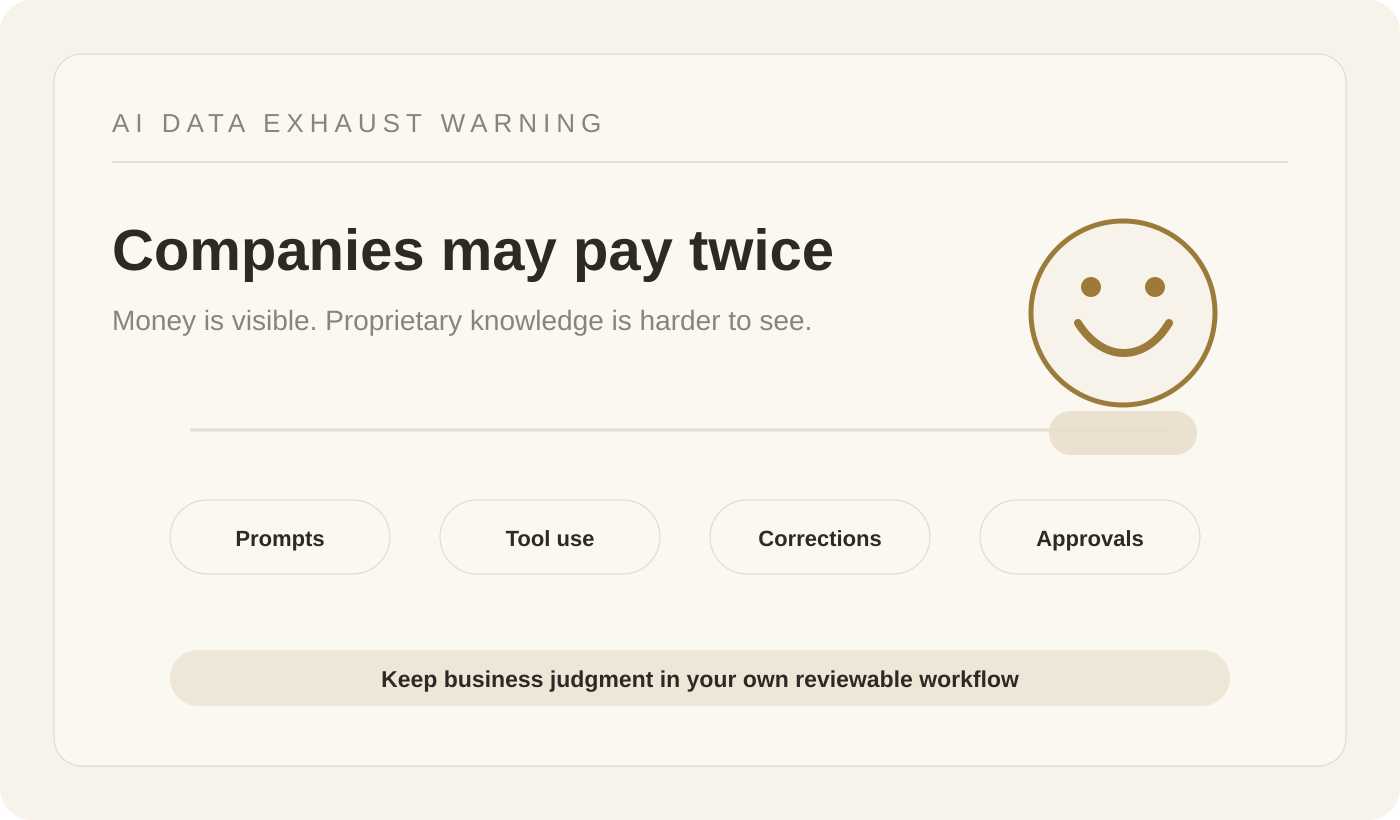
Microsoft CEO Satya Nadella warned that companies using AI may pay once in money and again in proprietary knowledge. The real issue is AI data exhaust: prompts, tool use, corrections, approvals, and business judgment.

Most companies understand the visible cost of AI: tokens, API calls, seats, and model subscriptions.
Microsoft CEO Satya Nadella's warning is about the second cost.
As reported by TechCrunch, Microsoft CEO Satya Nadella wrote that AI users may pay for intelligence twice: once with money, and again with the proprietary knowledge they reveal to make that intelligence useful.
That second payment is easy to miss because it does not look like a line item. It appears in prompts, tool calls, employee corrections, approval decisions, and the business judgment that accumulates while a team uses AI every day.
What AI Data Exhaust Means
AI data exhaust is the trail a company leaves while using AI.
It can include:
- prompts that describe customers, workflows, pricing logic, product constraints, or internal context;
- tools an agent calls and the systems it touches;
- corrections employees make when the model is wrong;
- approvals, rejections, and edits that reveal business rules;
- repeated patterns that show how a company decides what is good, risky, urgent, or wrong.
The most valuable part is often not the prompt itself. It is the correction.
When a salesperson tells an AI that a lead is not qualified, that is business judgment. When a finance manager corrects an invoice exception, that is institutional knowledge. When an operator rewrites an AI-generated customer note because the tone is wrong, that is company know-how becoming machine-readable feedback.
The Hidden Bill Is Company Learning
A company does not only consume intelligence when it uses AI. It also creates intelligence.
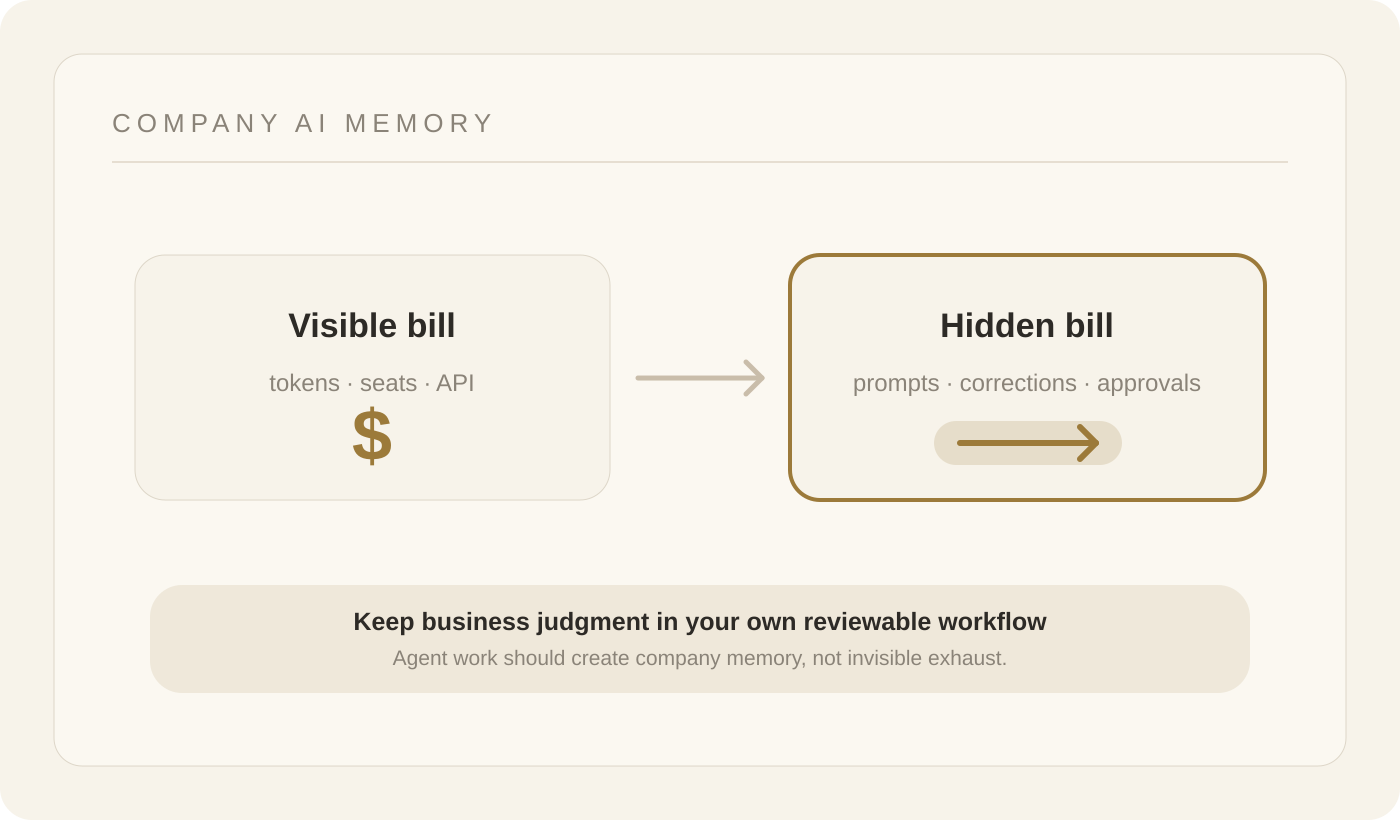
That is the core business issue. If every prompt, correction, approval, and tool trace lives only inside an external model provider or scattered SaaS logs, the company may be training someone else's system while failing to build its own learning environment.
The risk is not only privacy. It is ownership.
A company may pay for AI access, then reveal the exact proprietary context that makes the AI useful, then lose the chance to turn those corrections into its own reusable memory.
This Is Not an Argument Against AI
The answer is not to stop using strong external models.
The practical answer is to keep the company's learning layer under company control.
That means:
- keeping important business context in owned systems;
- routing work across models instead of hard-locking everything to one provider;
- capturing employee corrections and approvals as company records;
- reviewing AI-proposed changes before they enter official systems;
- making agent actions visible and auditable.
Models can change. Vendors can change. The company's judgment layer should not disappear into someone else's black box.
Why Buda Fits This Problem
Buda is built for agent work that needs context, execution, and human review in one place.
An AI Agent Workspace should not be only a chat surface. It should give teams a place to manage files, tools, sessions, channels, model routing, approvals, and reusable Skills. When agents prepare records, drafts, reports, or operational changes, the work should remain visible before it becomes official.
This matters for Microsoft CEO Satya Nadella's warning because the question is not only "which model is smarter?"
The question is: where do the prompt, correction, approval, and final business decision go after the AI task is done?
If they vanish into chat history, the company loses learning. If they become reviewable workflow records, the company builds memory.
What Managers Should Ask Before Scaling AI
Before putting AI into more workflows, managers should ask four questions.
- Which proprietary knowledge are employees putting into AI systems?
- Do employee corrections return to the company as reusable knowledge?
- Who reviews AI output before it enters customer, finance, HR, product, or knowledge systems?
- Can the company switch models and vendors without losing its workflow memory?
These questions are operational, not philosophical.
A useful AI strategy is not only model selection. It is data ownership, review design, model routing, and workflow memory.
Build managed agent workflows in the Buda dashboard, or read more about the Buda Agent Workspace.