Three supplier totals do not make a comparable quote
Check quantities, scope, freight, tax and validity before ranking prices or choosing a supplier.

Three quotes arrive with a “total.” An agent can rank them in seconds. One covers 80 units, another 100. Freight is missing from one, and a third has expired. A tidy ranking can hide the questions that matter most.
AI procurement quote comparison starts with comparability, not price order. Buyers own requirements and commercial weights. The agent organizes original terms, normalization rules and unresolved questions. The lowest displayed number is not an automatic award recommendation.
procurement workflow you can build with Buda prepares supplier research, RFQs and purchase-order drafts for procurement review. A read-only comparison of authorized quote copies is a bounded place to begin.
Freeze the requirement before comparing suppliers
This is fictional teaching data, not a purchase or a measured savings experiment. RFQ-R3 asks for 100 Model M units in one specified configuration, delivered to a named destination by November 10, 2026. The comparison cutoff is October 21, 2026, 10:00 Asia/Shanghai.
| Source | Original offer | Terms | Initial judgment |
|---|---|---|---|
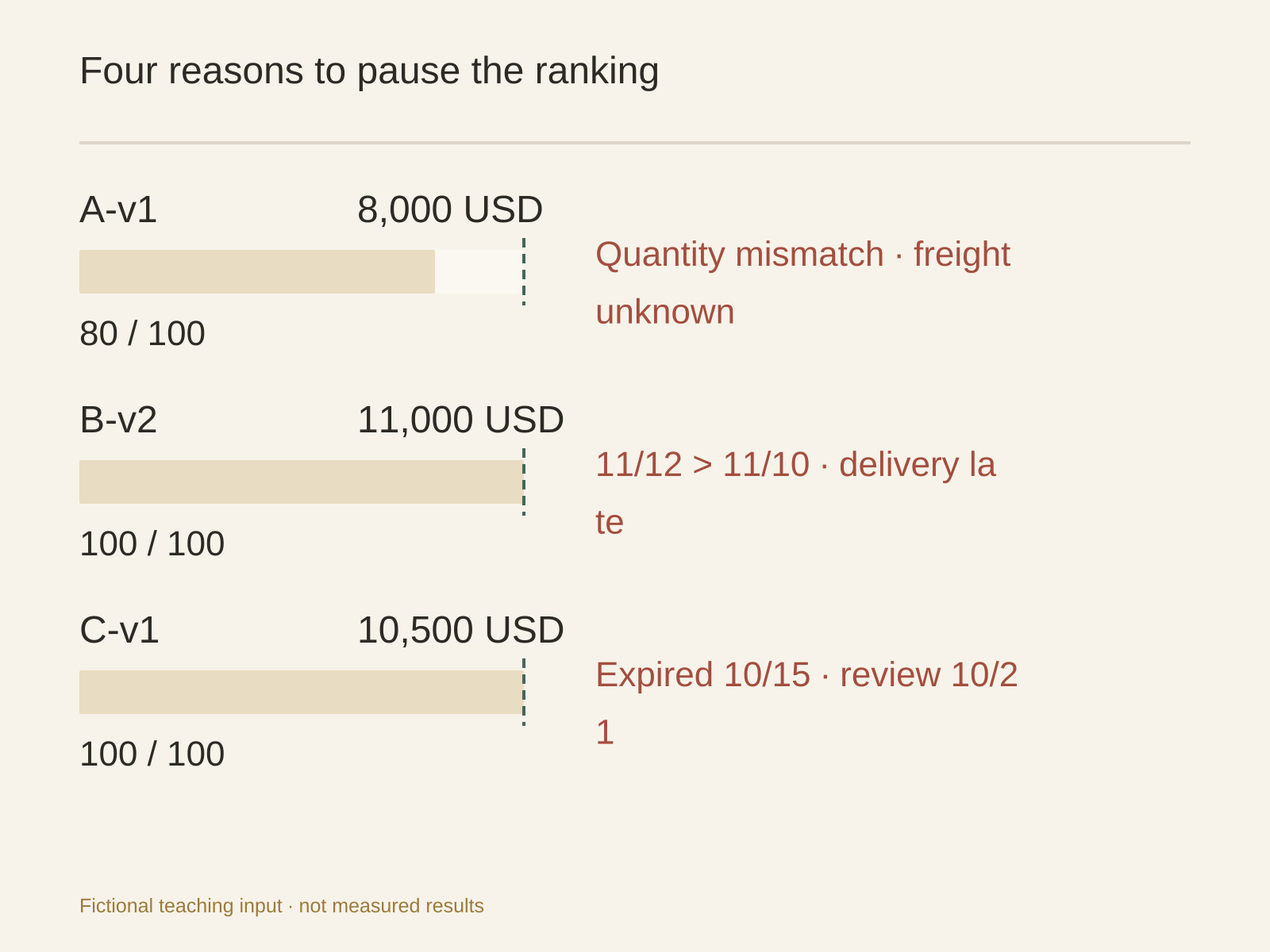
| A-v1, p1 | 80 units; USD 8,000; Model M | Dated Oct 20; valid Oct 30; freight and tax unspecified | Quantity mismatch; costs incomplete |
| B-v2, p2 | 100 units; USD 11,000; Model M | Dated Oct 20; valid Oct 31; tax/freight included; delivery Nov 12 | Product scope fits, delivery misses requirement |
| C-v1, p1 | 100 units; USD 10,500; Model M | Dated Oct 1; valid Oct 15; tax/freight included; delivery Nov 8 | Expired; request updated confirmation |
The same three quotes expose four pitfalls: a smaller quantity behind A's low total, missing freight in A, expired C and late delivery in B. None is fully cleared. Do not relax the requirement just to produce a winner.
Extract the evidence with the value
quote-evidence.csv retains supplier, document ID and version, page, source sentence, quote date, validity, field, raw value, normalized value, rule and open question.
A-v1 / p1 / quantity
Fictional sentence: “80 units, Model M, total USD 8,000”
Raw: 80 units; normalized: 80 units
Requirement: RFQ-R3 / 100 units
Conclusion: not a confirmed quote for the required quantity

A-v1 / p1 / freight
Price absent from the cost terms
Raw: null; normalized: unknown
Question: delivered freight amount and responsible party?
For real files, inspect the original before accepting extracted text. Unclear scans or cross-page tables remain pending verification; OCR guesses are not source evidence. Keep originals read-only and normalized values separate.
Unit arithmetic is not a new supplier offer
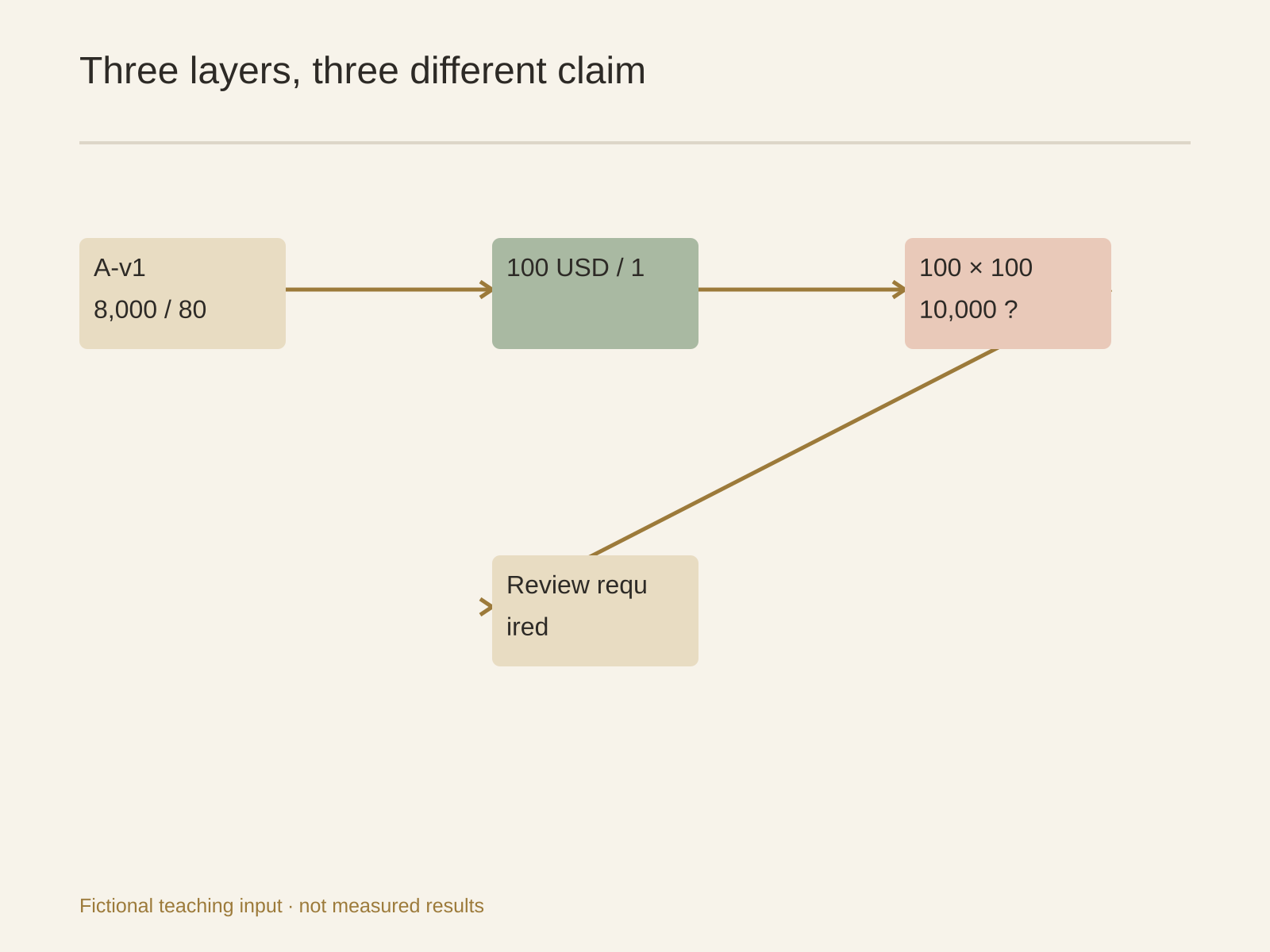
USD 8,000 divided by 80 equals USD 100 per unit. That is arithmetic on fictional inputs. It does not establish a USD 10,000 offer for 100 units: quantity tiers, minimum order, packaging or freight can change.
If the buyer requests a scenario, show USD 10,000 separately as a linear extrapolation at the same unit price, unconfirmed by the supplier. Preserve USD 8,000 for 80 units as the original quote. Do not compare the scenario as if it were B's confirmed tax-and-freight-inclusive offer.
For different currencies, retain native currency and a separate scenario using the buyer's specified rate source and date. Without that rule, do not convert. Missing tax, freight or installation stays unknown—not zero. Payment terms and warranty matter, but should not be assigned model-invented monetary penalties.
Put conditions before prices in the matrix
comparability-matrix.csv checks RFQ version, model/configuration or service scope, quantity, units, currency, tax, freight, installation, minimum order, exclusions, payment, delivery, warranty and validity.
- Comparable: consistent scope with known material costs and dates. Commercial weighting still belongs to the buyer.
- Clarification required: missing or ambiguous terms, including renewal of validity. Never assume satisfaction or free delivery.
- Does not meet requirements: an explicit conflict with RFQ-R3, such as B's delivery date. If the buyer accepts delay, record a revised requirement before rerunning—not a silent agent exception.
A can carry both quantity mismatch and freight uncertainty. Keep multiple reasons instead of forcing them into one status that discards evidence. Avoid uncalibrated “92/100” scores or fictional risk percentages.
Make the supplier questions answerable
supplier-questions.md should reference the exact requirement and quote:
- Ask A for 100-unit pricing under RFQ-R3, minimum quantity and price tiers.
- Ask A whether tax, delivery to the named destination and installation are included, and at what amounts.
- Ask B whether November 10 is feasible; otherwise request the earliest date and conditions for the buyer's decision.
- Ask C to renew validity and confirm whether price, stock and delivery still hold.
These are internal question drafts; no supplier contact occurs. When a quote changes, expire judgments dependent on that version. Keep unaffected suppliers traceable. A changed RFQ or conversion rule requires reviewing every affected row.
Draft the decision note without awarding the business
decision-note-draft.md can say no quote currently clears every condition: A needs quantity and cost clarification, B misses delivery, C needs renewal. The buyer decides whether timing can change and how to weigh payment and warranty. Do not turn the lowest number into “order from A now.”
Facts, commercial weights and final selection are different decisions. Organizing the first and exposing gaps in the second does not authorize the third. Do not report savings, commitments or execution results that do not exist.
Start with authorized copies, not production writing
Place redacted quotes, RFQ-R3 and buyer-approved rules in Buda Drive. Agent Drive and Space Drive have different sharing scopes. A dedicated Session organizes the task but does not create another file-permission boundary. Omit credentials and unrelated supplier data.
Read only the three named quotes and RFQ-R3. Preserve raw values, document/version/page and rules for every normalized field. Check comparability before price; unknown tax/freight stays unknown, expired offers need renewal, and quantity extrapolation is not a firm offer. Produce quote-evidence.csv, comparability-matrix.csv, supplier-questions.md and decision-note-draft.md. Do not send, order, sign, pay or connect production writing.
Search for and install a suitable document or data Skill in the Buda AI Marketplace. Read its method and limits before testing redacted examples; do not assume a named procurement Skill or native procurement approval enforcement exists.
How should different currencies be compared?
Keep originals. Use a buyer-approved source and date for a separate conversion scenario, excluding unconfirmed costs. Do not let the model choose a favorable exchange rate.
Is a quote valid if no expiry is given?
Keep validity unknown and request confirmation. The comparison cutoff is not the quote date; upload time is not either.
Should the lowest quote be recommended?
First establish scope, cost basis and acceptable delivery. Even then, buyers own warranty, payment and supplier-risk weights. Lowest is not an automatic winner.
What should suppliers be asked first?
Resolve qualification-changing issues: quantity, specification, included costs, validity and delivery. General company introductions can wait.
Use the four pitfalls above as proposed, unexecuted acceptance cases: the method should pause rather than manufacture a winner. A comparison is ready for discussion when a buyer can trace each judgment back to the source.