A December Contract Expiry Can Require an October Renewal Decision
Trace the notice clause, calculation rule, and delivery evidence before turning a contract date into a reminder.

A contract ends on December 31. A reminder in December looks timely until someone reads the clause requiring notice 60 calendar days earlier. The team also needs two weeks to decide whether to renew. The working deadline was in October.
Contract renewal tracking starts with an obligation, its conditions, and its source. A contract management workflow you can build with Buda supports preparing renewal calendars and obligation trackers for review. An agent can assemble the evidence; the contract owner and legal reviewer confirm interpretation and action.
Three dates on the same contract
Consider a fictional agreement A, version A-R1, page 8: “The term ends on December 31, 2026. Notice of non-renewal must be received at least 60 calendar days before that date.” For this teaching example, assume the responsible reviewer confirms simple date subtraction without an inclusive endpoint adjustment.
- Expiry: December 31, 2026.
- Proposed latest receipt date: December 31 minus 60 calendar days = November 1.
- Internal decision date: November 1 minus the agreed 14-day buffer = October 18.
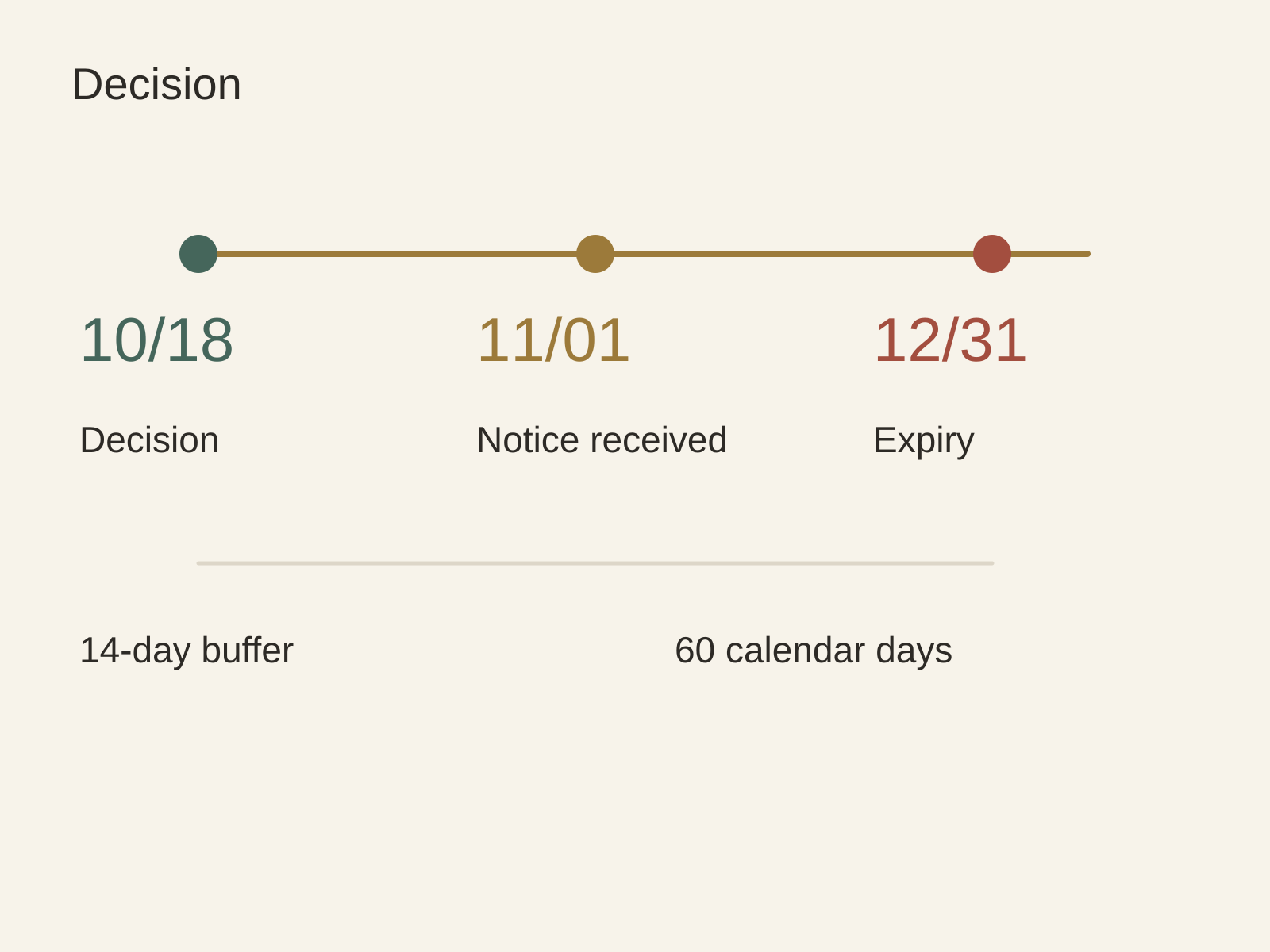
The 14 days are a fictional internal planning rule, not a contractual notice period. November 1 is a calculated candidate under the stated convention; the reviewer still checks the exact language, receipt method, timezone if relevant, and whether another provision changes the result. “Sent” and “received” are different evidence states.
Read conditions before calculating
Agreement B is another fictional example: monthly automatic renewal with a 30-day notice requirement. A cycle end date must first be established from the executed agreement and amendments. “Monthly” alone does not identify the correct next endpoint or tell you whether a notice affects this cycle or the following one. Keep the calculation pending until that endpoint and clause interpretation are confirmed.
Agreement C starts its notice window from acceptance, but the acceptance date is absent. Record an unknown trigger and ask for the acceptance record. Do not substitute invoice date, upload date, or today. If the clause uses working days without identifying the calendar, ask the owner or legal reviewer which definition governs before calculating.
An amendment can change the original notice period or recipient. Keep both quotations with their version and location, then identify the supersession question. A newer filename is not proof that a document was executed or governs this obligation.
Build the obligation register first
Use only authorized signed agreements, amendments, the internal decision rule, and the owner list. Ask for renewal-obligations.csv with agreement ID, executed version, source page, exact clause, expiry or trigger, notice condition, calendar-day or working-day rule, receipt requirement, proposed latest notice date, formula, internal buffer, decision owner, and unresolved questions.
For A, the register can carry the two arithmetic steps above. B should show a missing confirmed cycle endpoint. C should show a missing acceptance date. Blank calculation fields remain unknown, not zero days remaining or no obligation.
Then create decision-calendar.md, organized by the earliest human action rather than by expiry date. Each entry links back to the register row and source location, names the decision owner, and says what must be confirmed next. These are proposed files, not automatic changes to a contract system.
Track notice as a sequence of evidence
Keep separate states: decision pending, decision recorded, notice draft, authorized to send, sent, and receipt evidenced. A draft file or a checked box does not establish effective notice. Preserve the actual source for any receipt evidence and ask the reviewer whether it satisfies the clause. Do not invent an acknowledgement.
If an amendment or owner changes, recalculate only the affected entries and retain the earlier calculation and reason. An owner change alone does not change the contractual deadline. A changed clause may change the deadline but needs confirmation of applicability.
A useful agent instruction is: “Prepare the obligation register and decision calendar from the authorized documents. Quote each clause and location. Show calculations only where trigger and counting rule are confirmed. Separate unknowns from missing obligations. Do not send notices, amend contracts, or make legal determinations.”
Questions worth resolving before a reminder goes live
What if the acceptance date is missing?
Leave the derived deadline uncalculated. Name the missing acceptance record and the person responsible for obtaining it. A guessed date can make an incorrect reminder look precise.
Which document wins when an amendment conflicts?
Retain both versions and quotations, verify execution and scope, and route the applicability question to the owner or legal reviewer. Do not choose by file timestamp alone.
Is an email in the sent folder enough?
It proves a sending event if authentic. Whether notice requires receipt, a particular address, or another method depends on the confirmed clause. Record the evidence and unresolved delivery requirement separately.
Which holiday calendar should be used?
Use the governing definition once confirmed. Until then, identify the ambiguity and leave working-day arithmetic pending.
Turn one portfolio slice into a reviewable calendar
Keep the signed files, register, calculations, and review decisions together in the Agent Workspace. Start with a small authorized set whose clauses can be checked individually. After accepting the output, reuse the extraction method as a Skill; suitable Skills can be searched for and installed in the Buda AI Marketplace. A reliable calendar tells the owner what decision is due, what supports its date, and what evidence is still missing.