Build an Interview Kit That Connects Every Question to Job Evidence
Give the panel shared questions, observable anchors, and a clear record of what remains unverified.

Three interviewers can leave a panel with three confident opinions and little comparable evidence. One asked about campaign ideas, another explored personal style, and the third ran out of time. An AI-generated summary cannot reconstruct answers nobody asked for.
An interview preparation agent is useful earlier: connect the approved job requirements to common questions, evidence to listen for, and named interviewers. Recruiters retain the hiring decision. A recruitment workspace you can build with Buda supports reviewable interview preparation artifacts; the file workflow below is a proposed method, not a completed hiring trial.
Start with a role that has observable work
Consider a fictional operations coordinator role, JD-R1, and two fictional, de-identified resumes. Candidate A describes running a weekly dashboard and coordinating a launch. Candidate B describes documenting support procedures and investigating a delayed order. These statements are leads for questions, not verified performance.
The hiring manager approves four requirements before the agent drafts questions:
| ID | Requirement in JD-R1 | Common question | Owner |
|---|---|---|---|
| R1 | Explain a weekly metric with a traceable source | Walk through a metric that changed: where did its numbers come from? | Panelist 1 |
| R2 | Coordinate a handoff across teams | Describe a handoff that stalled and what you did next. | Panelist 2 |
| R3 | Turn repeated work into a usable procedure | Show how someone else could repeat a process you documented. | Panelist 3 |
| R4 | Escalate an unresolved exception | When did you stop and ask for a decision rather than continue? | Panelist 2 |
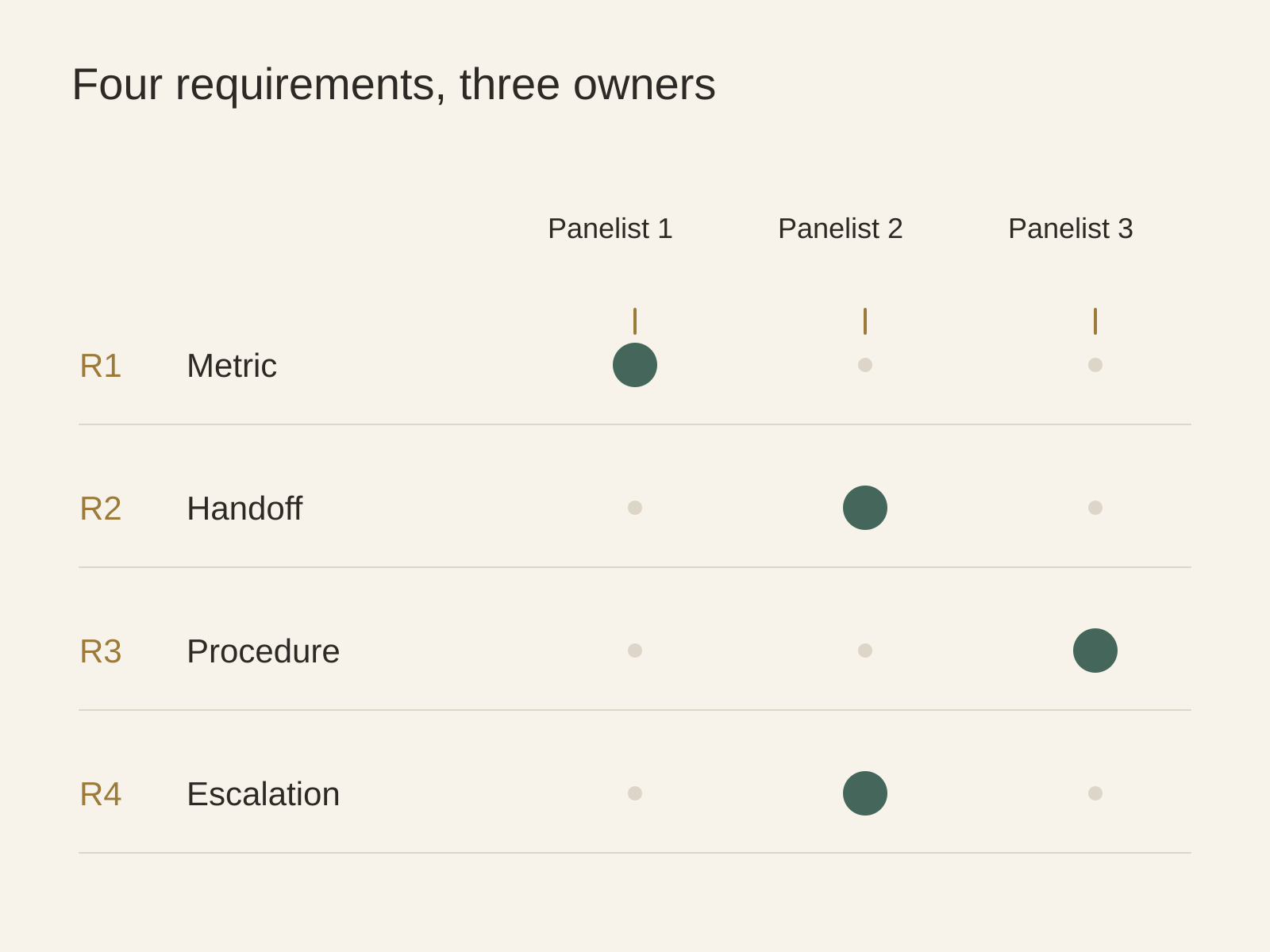
Give both candidates these core questions. Add resume-specific follow-ups only where a claim or gap needs clarification. Ask Candidate A which dashboard input they personally checked; ask Candidate B how the delayed-order investigation reached an owner. Different follow-ups should not quietly replace the common questions.
Define evidence before reading the answers
The hiring manager sets observable anchors. For R1, useful evidence might identify the source, the comparison period, a check, and how the candidate communicated uncertainty. A polished story without those elements should remain an observation needing follow-up, not become a personality judgment.
Use separate states for not asked, answer missing, answer recorded, and evidence does not meet the approved anchor. Missing material is not a zero score. The agent can organize quotations and compare them to the approved anchors; it should not infer age, health, family plans, personality, or a final ranking.
A fictional R1 answer says: “I checked the export against the order IDs and asked finance why three entries differed.” Preserve that sentence and its note location. It supports an observation about a reconciliation step. It does not prove the final metric was correct; the period and resolution still need a follow-up question. If Candidate B was never asked R1, the comparison must show not asked, not “less analytical.”
Ask for files the panel can check
First create requirements-to-questions.csv with requirement ID, JD quote and version, resume evidence and location, core question, follow-up, expected observable evidence, assigned interviewer, and a blank recording field. The source location is essential: a question should be traceable to a real role requirement.
From that mapping, prepare interview-kit.md: the four shared questions, panel assignments, individualized clarifications, and instructions for recording answers. Add coverage-check.csv to identify unassigned requirements, duplicate questions, missing notes, and conclusions without supporting quotations. These are suggested output files, not native ATS fields or automatic synchronization.
A useful instruction is: “Use JD-R1 and the authorized de-identified resumes. Draft preparation materials only. Preserve every requirement quote and source location. Keep missing evidence distinct from a negative observation. Do not rank, reject, contact, or schedule candidates.” Review the mapping before giving the kit to the panel.
A new JD changes the comparison
Suppose JD-R2 changes R3 from documenting a process to testing whether a colleague can execute it. Preserve R1 and mark the R3 question and anchor for review. The earlier answer about writing a document cannot silently count as evidence of a handoff test.
Keep the old kit, show the changed requirement, and ask the hiring manager whether candidates need the same additional question. Do not carry scores across versions without confirming that their meaning stayed the same. The version note should name the affected requirement rather than invalidate every unrelated answer.
Review disagreement at the quote level
When two panelists disagree, preserve both observations and their sources. One may be judging coordination while another is judging the quality of the metric. Ask which approved requirement and anchor each observation addresses. If the notes are incomplete, obtain a clarification or repeat the missing question through the recruiter’s agreed process; do not let the agent fill in an answer.
Practical questions
What if there is no mature scorecard?
Start from four real tasks the role must perform. The hiring manager defines what an observable answer would contain, then reviews the first question set. Avoid inventing a weighted hiring score to make the kit look finished.
What if a resume does not mention the requirement?
Mark the resume evidence as missing and retain the common question. Silence in a resume does not establish lack of ability.
What if recording or notes are incomplete?
Keep only the recoverable words with their location and mark the rest unavailable. Ask the interviewer or recruiter to resolve the gap. A fluent summary is not a replacement for missing evidence.
Reuse the preparation method
In Buda, keep the approved JD, authorized resumes, question mapping, and reviewer decisions together in the Agent Workspace. After the hiring manager accepts one kit, make its preparation steps a reusable Skill; search and install suitable Skills in the Buda AI Marketplace, or adapt your own. Reuse the method while reviewing each role’s requirements afresh. The output worth keeping is a panel that knows what to ask and what remains unverified.