Sakana Fugu Shows Why AI Competition Is Moving From Single Models to Orchestration
Sakana Fugu packages multi-model orchestration as an OpenAI-compatible API, raising new questions about routing, cost, transparency, and AI vendor lock-in.

Sakana Fugu is not just another model launch.
It is a signal about where AI infrastructure is moving.
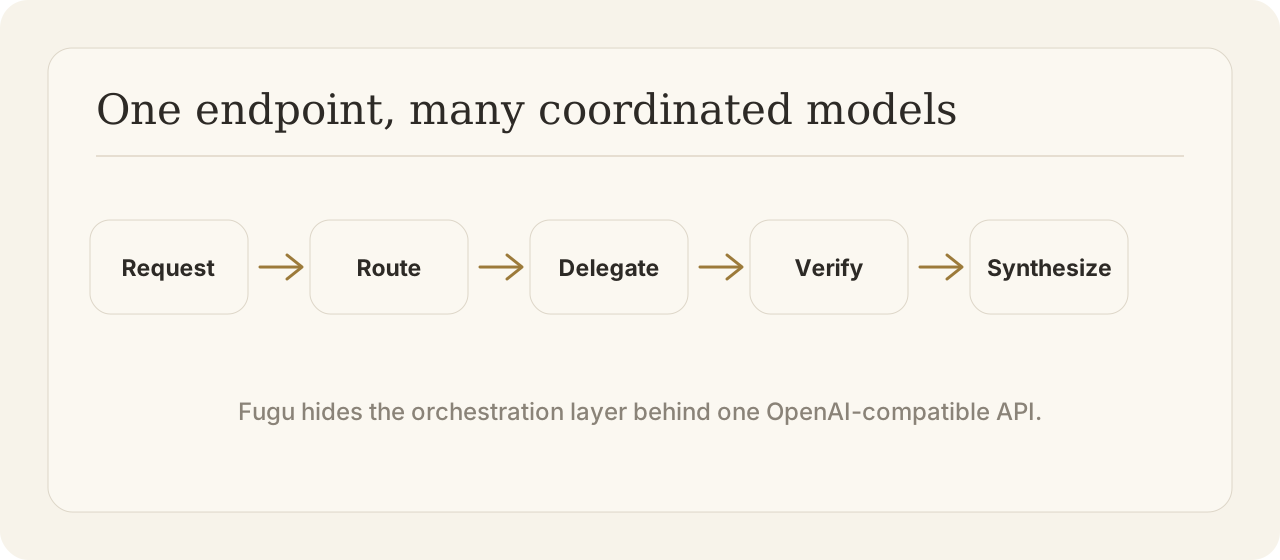
On June 22, Sakana AI introduced Sakana Fugu, describing it as a multi-agent orchestration system that behaves like a single model API. Developers send one request. Behind the scenes, Fugu can decide whether to answer directly, delegate subtasks to a pool of expert models, verify intermediate work, and synthesize the final result.
The company also launched Fugu Ultra for harder multi-step work. Both models are available through a single OpenAI-compatible API.
That matters because the enterprise AI question is changing.
For the past two years, the market asked: which model is strongest?
Fugu asks a different question: who coordinates the models when one model is not enough, too expensive, unavailable, or risky to depend on?
What Sakana Fugu is
Sakana describes Fugu as a multi-agent system that behaves like a single model. From the outside, you call one endpoint. Inside, the system handles model selection, delegation, verification, and synthesis.
The launch page frames it as “one model to command them all.” The point is not that Fugu replaces every frontier model. The point is that Fugu tries to learn when to use which model, when to delegate, and how to combine the work.
Sakana says Fugu is itself a language model trained to call various LLMs in an agent pool, including instances of itself recursively. The research lineage comes from Sakana's work on learned orchestration, including TRINITY and Conductor.
That makes Fugu different from a normal model router.
A router usually chooses one model for one request.
Fugu is closer to a conductor. It may break the task into stages, involve multiple agents, verify work, and return one answer.
Why the timing matters
The timing is important.
Sakana explicitly connects Fugu to single-vendor dependency and recent access disruption around Anthropic's Fable and Mythos models. VentureBeat also framed the launch around the same problem: if access to a top model can shift because of regulation, export controls, pricing, policy, or provider decisions, then critical workflows should not rely on one provider forever.
This is the cloud lesson returning in AI form.
Companies learned not to treat one server, one region, or one vendor as the entire continuity plan.
AI is now reaching the same point.
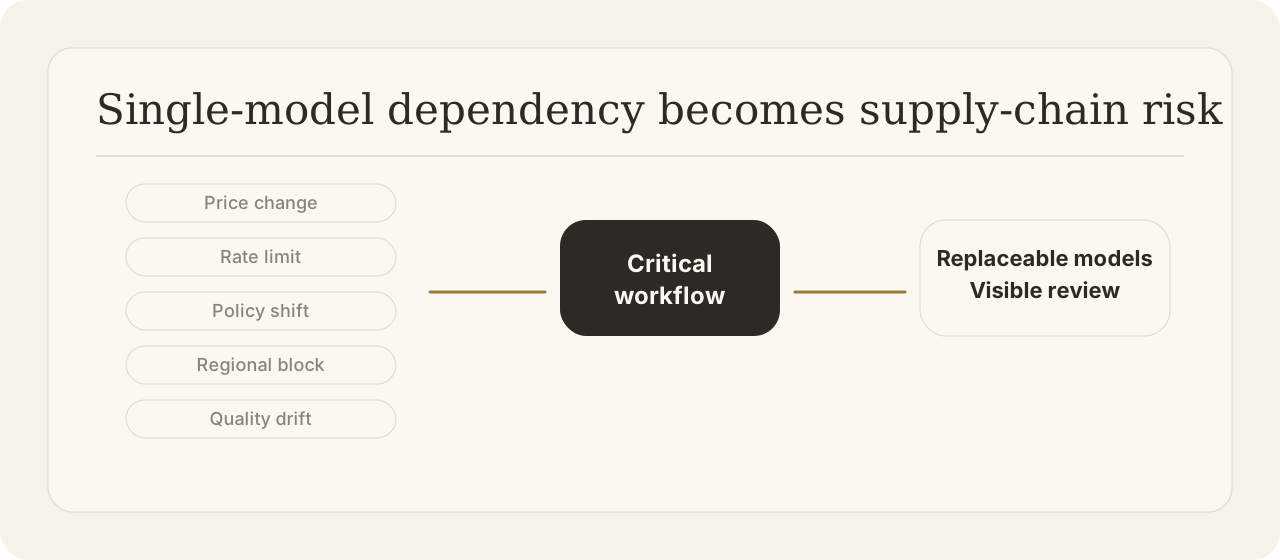
If a workflow depends on one model, the workflow inherits that model's pricing, rate limits, policy shifts, regional restrictions, outages, quality changes, and roadmap decisions.
For simple tasks, that may be acceptable.
For critical workflows, it becomes a supply-chain risk.
Model routing is not the same as orchestration
Model routing is already familiar.
A router might send simple questions to a cheap model, coding tasks to a coding model, long documents to a long-context model, and difficult reasoning to a premium model.
That is useful, but it is still mostly a one-shot choice.
Orchestration is broader. It asks how a system should decompose work, coordinate specialists, run verification, retry after failure, and decide what evidence is strong enough for the final answer.
A realistic agent workflow may include:
- a planner that decomposes the task;
- a coding model that edits or drafts;
- a verifier that checks logic;
- a tool or test run;
- a summarizer that packages the result;
- a human review checkpoint before sensitive action.
Fugu's commercial move is to hide much of that complexity behind one API.
That is attractive for developers.
It is also a governance question.
The caveats are the product story
Fugu's strengths and risks are tied together.
First, it reduces visible complexity, but routing is not fully transparent. Sakana says the exact worker models and coordination patterns are proprietary. That is understandable as product IP, but regulated teams will ask which model saw which data and how errors can be audited.
Second, orchestration can improve results, but it can also hide cost. Fugu Ultra has published pricing, and VentureBeat notes that orchestration tokens can count toward final usage. A short answer may still involve a long internal chain.
Third, benchmarks are promising, but they are not a procurement decision. Sakana's benchmark claims are useful early evidence, especially on coding, reasoning, scientific, and agentic tasks. Teams still need to test Fugu on their own repositories, documents, permissions, failure modes, latency targets, and cost limits.
What teams should learn from Fugu
The safest conclusion is not “Fugu wins.”
The safer conclusion is that single-model dependency is becoming harder to defend.
Teams should start evaluating AI systems across five layers:
-
Model quality Which models are good enough for each class of work?
-
Model replaceability Can the workflow survive if one model changes price, access, latency, policy, or quality?
-
Orchestration visibility Can the team inspect how work was routed, what tools were used, and where failures happened?
-
Cost per completed task Does the system reduce total retries and human cleanup, or only hide token spend behind a nicer interface?
-
Human review Where should a person approve, reject, or redirect the workflow?
This is where AI infrastructure becomes operational.
The asset is no longer only the model.
The asset is the workflow around the model.
How this connects to Buda
Buda is built for this shift.
An AI Agent Workspace should not lock a team into one model identity. It should preserve the team's context, procedures, skills, approvals, logs, and review habits even as models change.
That is why Buda focuses on the work layer: sessions, Drive, tools, browser and terminal execution, channels, skills, and human review.
A model can be replaced.
A workflow that has been carefully structured, reviewed, and improved should not disappear when the model underneath it changes.
Fugu points to the same direction from the model side: orchestration matters.
Buda points to it from the workspace side: orchestration must be visible, manageable, and human-led.
The next AI competition will not only be about who trains the strongest model.
It will be about who can turn many models, tools, agents, and people into reliable work.
Quick answers for teams evaluating Sakana Fugu
What is Sakana Fugu? Sakana Fugu is a multi-agent orchestration model exposed through an OpenAI-compatible API. It behaves like one model from the developer's perspective, but can coordinate multiple models and agents behind the scenes.
How is multi-model orchestration different from model routing? Model routing usually chooses one model for one request. Multi-model orchestration can decompose the work, delegate subtasks, verify intermediate results, retry when needed, and synthesize a final answer.
Why should enterprises avoid relying on one large model? A single model dependency inherits one provider's pricing, policy, regional access, rate limits, outages, and quality changes. For critical workflows, that becomes an AI supply-chain risk.
Will model orchestration become AI application infrastructure? Probably yes for complex work. As teams use more models, tools, agents, and review steps, the orchestration layer becomes the place where reliability, cost, and governance are managed.
Explore human-led agent workflows in the Buda dashboard, or read the Buda Agent Workspace docs.