Supplier Documents Are Not Qualification: Build an Evidence Shortlist
Check certificate scope, dated commitments, and missing proof against approved requirements before an RFQ.

A supplier has a certificate, a capacity presentation, and a price sheet. That still leaves the buyer’s question unanswered: do these documents support this purchase’s requirements?
A procurement workflow you can build with Buda supports preparing supplier shortlists from supplied materials for review. Start with qualification evidence before comparing quotes. The agent organizes the record; the buyer confirms entry to an RFQ and any award.
Freeze five requirements
The following is a fictional example, not a verified supplier assessment. Requirement set Q-R1 covers a component purchase reviewed on October 26, 2026. The buyer labels R1–R4 as hard conditions and R5 as a preference; the agent must not change those labels or invent weights.
| ID | Approved requirement | Evidence to locate |
|---|---|---|
| R1 | Delivery to the named region | Specific destination and service coverage |
| R2 | Certificate covering component X, valid at delivery | Product scope and expiry in the certificate |
| R3 | Delivery by November 30 | Dated, scoped delivery commitment |
| R4 | At least 1,000 units per month for this product | Comparable capacity basis and verification |
| R5 | Price sheet valid through November 5 | Explicit validity date |
Three suppliers, three different questions
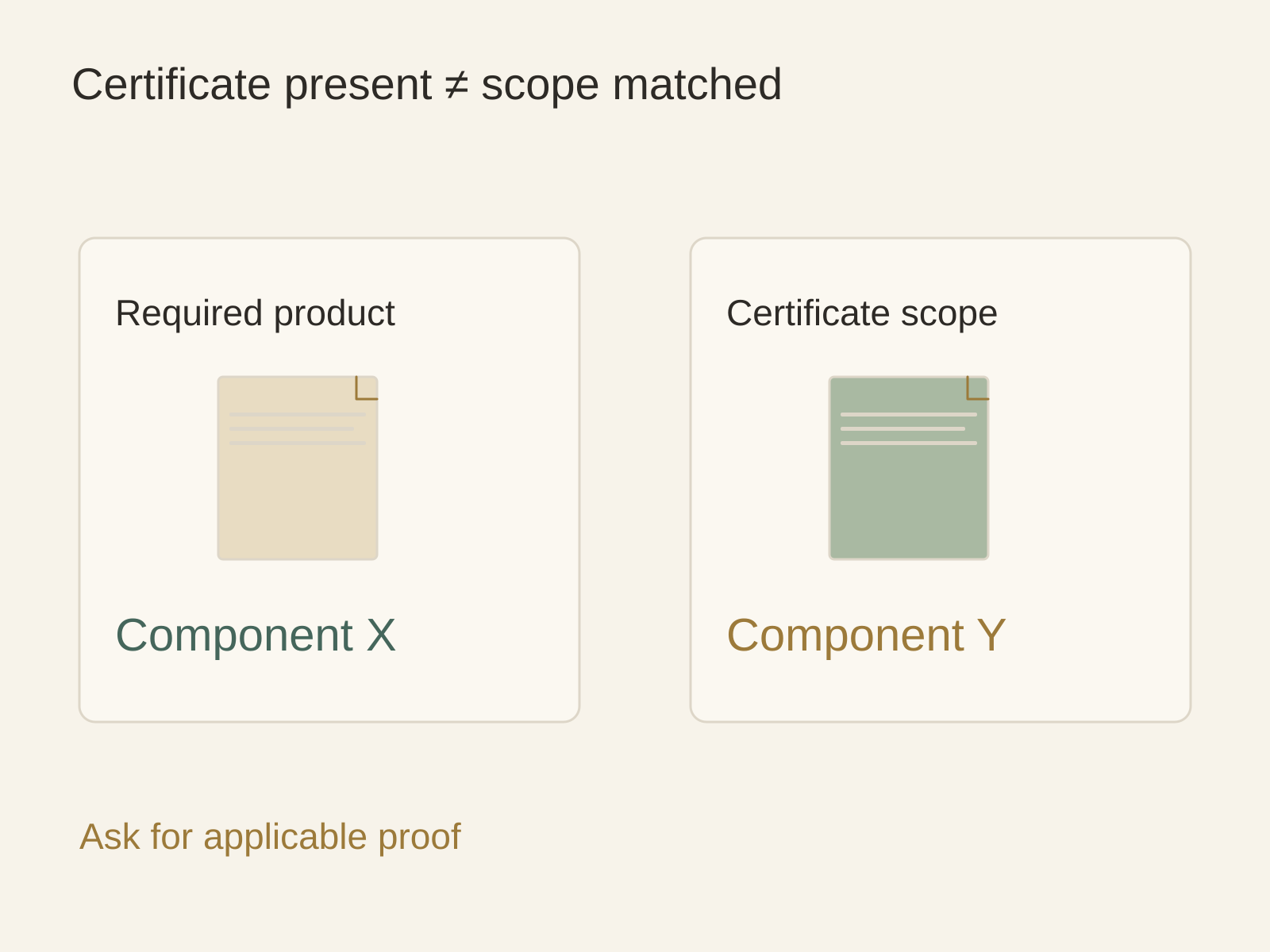
Supplier A’s certificate covers component Y, not X. Its document is present and in date, but does not support R2. Keep the exact scope quotation and ask for applicable certification. Under the fixed rule, the supplied certificate does not satisfy the condition; that is more specific than “supplier unqualified in every respect.”
Supplier B provides a certificate for X that remains valid at the proposed delivery. Its price sheet expired October 20. Record the stale price evidence separately from qualification. Since R5 is a preference here, the buyer decides whether to seek an update; the agent should not quietly make it a hard exclusion.
Supplier C says delivery is “estimated for November” and advertises “2,000 units per month.” Neither statement proves a November 30 commitment for this purchase. The capacity is a supplier claim until its product, period, facility, allocation, and verification are understood. Ask for a scoped commitment and comparable capacity evidence.
Assume the other fields are supported only where their supplied quotations actually show it. Do not fill the entire matrix with checks because one brochure looks complete. A missing certificate, an expired certificate, and a certificate for another product are three different states.
Build the shortlist from evidence rows
In supplier-evidence-matrix.csv, create one row per supplier and requirement. Preserve requirement ID and hard-condition/preference label, source quote, page, version, supported or unresolved state, expiry, missing proof, and the person to obtain it. Mark supplier statements as statements, not independent verification.
Then write shortlist-review.md with three separate views: supported candidates for buyer review, candidates needing evidence, and explicit conditions not supported by the supplied documents. State the reason for each. Missing evidence is not a confirmed failure; an affirmative scope mismatch is not merely an empty field.
A useful instruction is: “Compare only Q-R1 with the authorized supplier files. Retain quotes and locations. Do not change conditions or weights. Separate unknown, expired, mismatched scope, and supplier claims. Prepare a review shortlist; do not send an RFQ, negotiate, or award.”
Refresh the affected evidence
If A supplies a new certificate, recheck scope and validity and retain the old row. If B renews its price sheet, update that preference’s evidence without treating it as a new supplier. If C confirms a delivery date, the capacity question may still remain open. A new upload resolves only the requirement it actually supports.
Buyer questions
Does missing proof mean rejection?
No. Name the missing evidence and its owner. The buyer decides whether to request it or stop considering the supplier under the approved process.
What makes a certificate relevant?
Its product and activity scope, validity at the required time, and applicability to the supplier and purchase. Possessing a certificate alone is insufficient.
Can two capacity figures be compared directly?
Only with comparable product, time period, facility, availability, and verification basis. Keep self-reported figures labeled and ask about capacity reserved for other orders.
When can an RFQ begin?
When the buyer confirms that the requirements for that stage are sufficiently supported or explicitly accepts an exception. A generated shortlist is a proposal, not sourcing authorization.
Keep the qualification method reusable
Store the approved requirements, authorized sources, matrix, and buyer decisions in the Agent Workspace. Accept one shortlist by checking its evidence rows, then reuse the method as a Skill. Search for and install appropriate Skills in the Buda AI Marketplace, or adapt your own. The next buyer should see both why a supplier is being considered and what still needs proof.