The AI Programmer Myth
LLMs lower the cost of execution, but they cannot replace system judgment or business trust. Learn how to move from executor to agent manager.
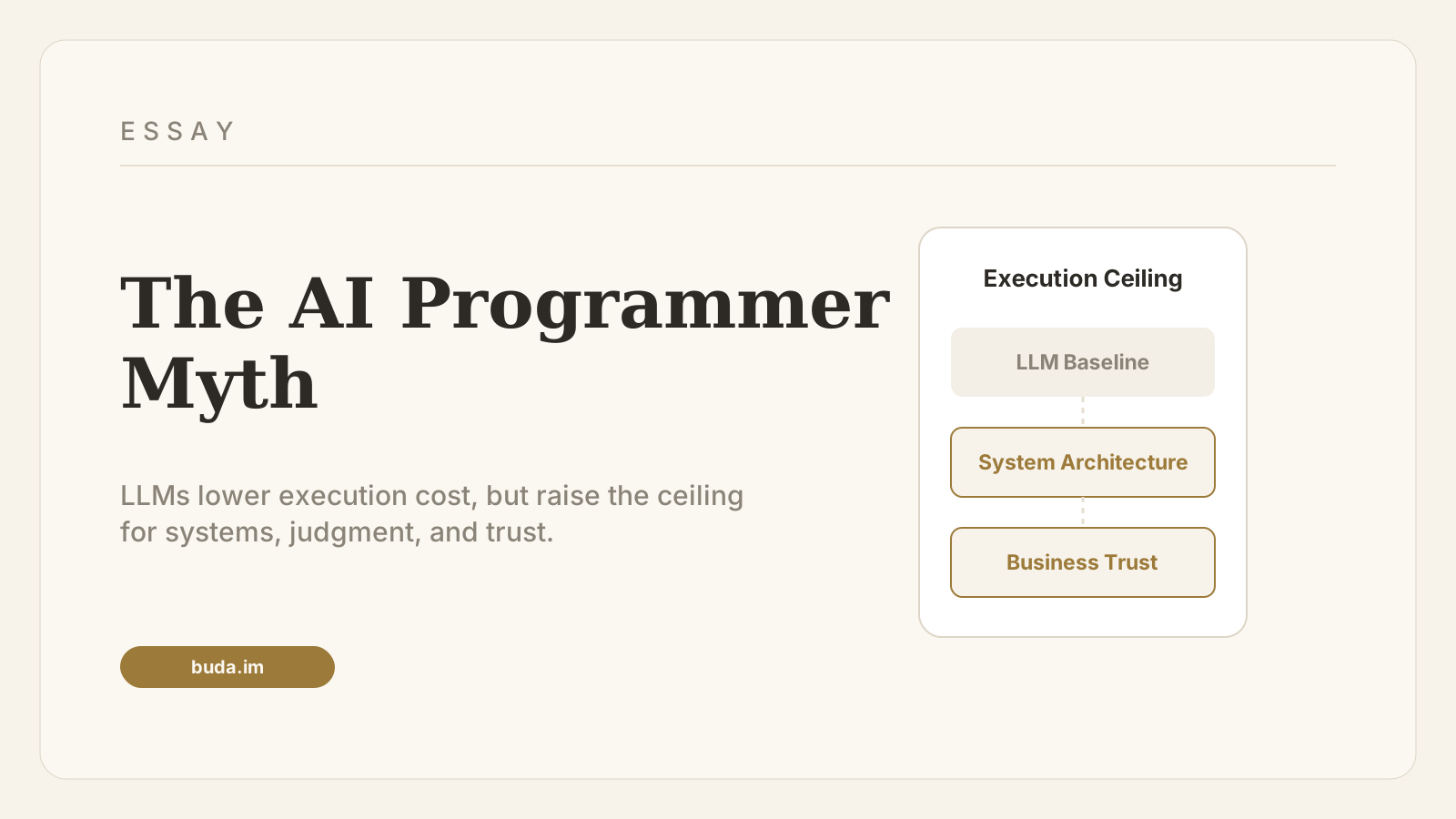
A common narrative has taken root in the tech industry: "Large Language Models are so good at coding now that anyone with a prompt can become a full-stack engineer."
If your experience with AI is limited to running isolated toy demos on your local machine, this illusion is easy to buy into. However, when enterprises attempt to deploy AI into actual production environments, the harsh reality shatters this romanticism.
In this paradigm shift driven by LLMs, we must fundamentally reevaluate the boundary between human and machine labor.
The Technical Debt AI Cannot Fix
Without a doubt, AI is exceptionally efficient at generating code snippets. You can have an LLM spit out a simple automation script in a minute. But when you drop that code into a real-world business system, the cracks begin to show.
Complex microservice communications, sporadic network failures, and decades of accumulated technical debt—code that relies entirely on an LLM "guessing" its way through these enterprise edge cases will instantly collapse.
This reveals a truth often overlooked: AI has pushed the "floor" of coding execution into the basement, but simultaneously raised the "ceiling" of complex system architecture.
If a team lacks a deep grasp of underlying architecture and the ability to refactor the bloated code LLMs sometimes generate, "enterprise deployment" is just an empty buzzword. While entry-level coders may face the risk of replacement, engineers who truly understand deep system architecture are becoming more indispensable than ever amid the rise of AI R&D Automation.

The Business Truth: IQ Cannot Replace EQ
This disruption isn't confined to programmers. The "process experts" in a company—those whose daily routines consist of matching data, filling out template presentations, and writing formulaic weekly reports—are facing the exact same predicament. When mechanical execution is entirely leveled by machines, what competitive advantage do humans have left?
The answer lies in "business trust."
No matter how high an AI's IQ is, or how fast it processes data, it can never provide emotional intelligence (EQ), nor can it build genuine business trust between people.
One of the greatest misconceptions in enterprise management over the past few decades has been treating highly-paid talent like "machines"—judging them by who types fastest, who makes the fewest errors in a spreadsheet, and who can stay awake the longest. We have forced living humans to compete on the most mundane, mechanical tasks.
The proliferation of AI is the exact antidote to this workplace alienation. By delegating procedural tasks to machines via Agent Workflow Optimization, human energy can finally be liberated.
From Executors to Managers
The future organization should not hire humans to do what machines excel at.
For core teams, the biggest daily drain should not be drowning in meaningless system approvals, data shuffling, and document retrieval. Since machines have already achieved a dimensional advantage in "compute and stamina," enterprises should confidently strip away this labor.
This is the foundational logic of building an AI-native organization: Offload the grueling, process-heavy execution to a cluster of backend AI agents.

When the friction of execution is completely removed, you can push your core employees to the business frontline. Let them interact deeply with clients, uncover genuine pain points, provide the emotional value machines cannot, and build unbreakable business trust.
In this era, stop competing on execution speed. Learn to Manage an AI Cluster, and invest human intellect in areas machines can never touch. That is the true moat for individuals and enterprises alike.
Start building your AI agent team and unleash your organization's true value. Learn more about enterprise applications at buda.im.