Future of Work: Managing AI Agents Instead of Human Teams
How the corporate organizational structure is shifting from managing headcounts to managing digital labor, flattening hierarchies and redefining leadership in the Agent Era.
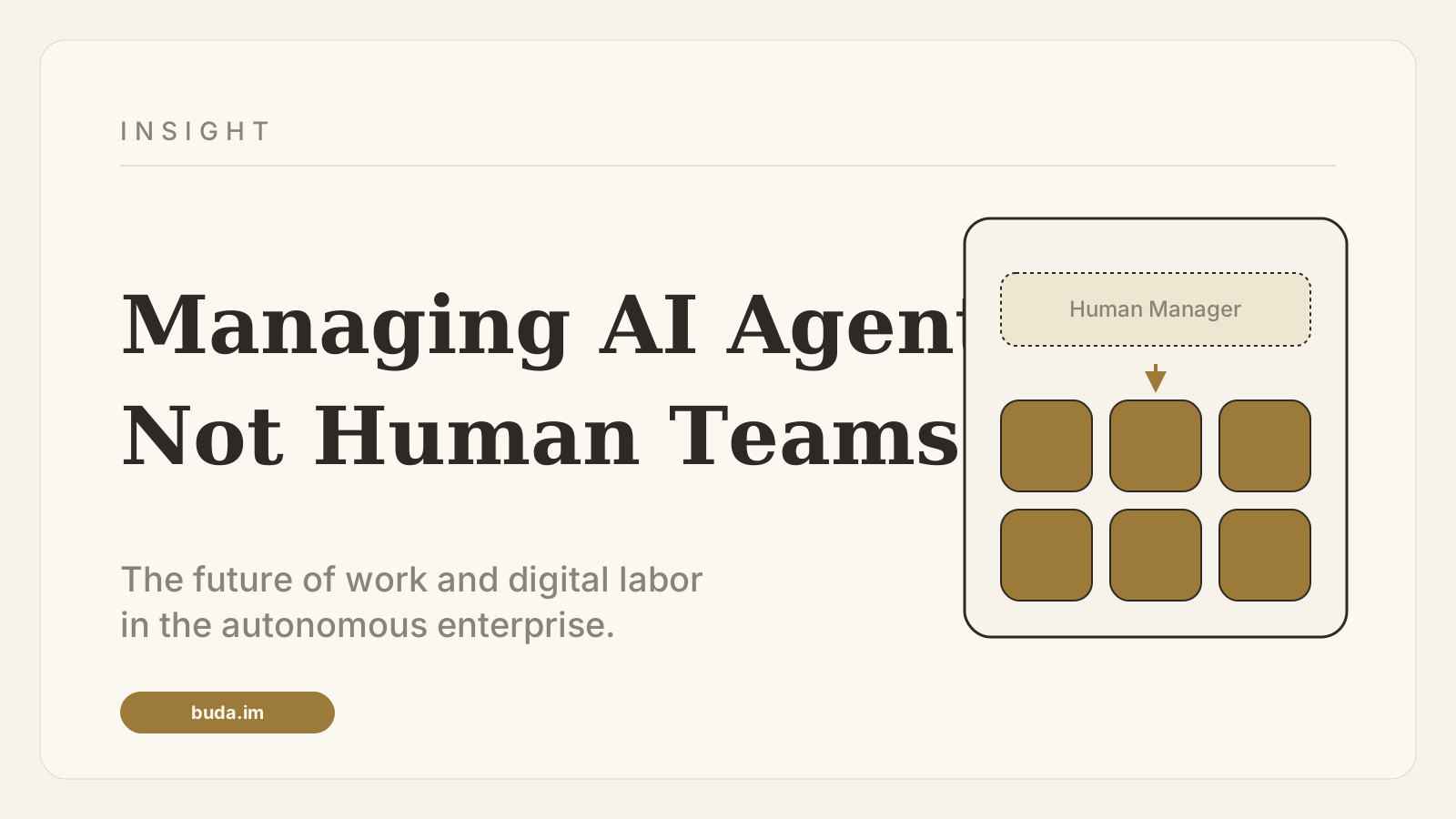
For decades, the standard path for a company to scale its impact was simple: hire more people. A manager's success was often measured by the size of their headcount.
However, as AI capabilities shift from simple text completion to autonomous execution, a profound organizational transformation is underway. The central question for enterprise design is no longer "How do we structure our human workforce?" but rather "How do we organize humans to effectively manage AI clusters?"
In this guide, we will break down the ongoing evolution of the modern enterprise, the shift from managing people to managing "Digital Labor," and how you can prepare your organizational structure for the inevitable future of work.
The 4 Stages of Organizational Evolution
As AI Agents become highly capable digital workers, corporate structures are experiencing a massive compression. We are moving away from deep, multi-layered hierarchies toward flat, highly leveraged teams.
Stage 1.0: The Traditional Headcount Model Companies scale by adding layers of execution. Leaders hire VPs, who hire Directors, who hire Managers, who oversee large teams of individual contributors. The friction is incredibly high, and communication overhead often outpaces actual production.
Stage 2.0: The Human-Machine Hybrid (Current State) Companies begin deploying AI for core execution. A smaller group of human managers now oversee "AI Clusters." The foundational work—data processing, baseline coding, drafting documents—is handled by AI Agents. Human employees transition from executors to reviewers and editors.

Stage 3.0: The Direct AI Leadership The middle management layer is completely flattened. Business leaders no longer need managers to oversee executors. Instead, they directly issue commands to an army of AI Agents: "Draft a marketing plan for the new launch," "Triage these customer support tickets," or "Analyze this financial report."
Stage 4.0: The Autonomous Enterprise An extreme, yet entirely plausible, future where an AI CEO or advanced orchestration system manages the day-to-day operations of the company, while the human founders simply define the high-level objectives and review the final profit margins.
Why the Urgency? The Cost of Clinging to "Headcount"
If your company's primary strategy for growth is still "adding more hands" and "building more processes," you are on a collision course with companies that are actively building Digital Labor.
As we explored in Accountability in the Agent Era, when AI Agents take over the execution layer, the human's role fundamentally changes. Employees are no longer valued for their ability to grind through repetitive tasks. They are valued for their ability to:
- Define clear objectives.
- Review and judge AI outputs.
- Continuously optimize the AI's standard operating procedures (SOPs).

The gap between a company managing 500 human executors and a company of 10 people managing 5,000 AI Agents is not just about cost—it is about organizational efficiency and execution velocity.
Actionable Guide: Transitioning to AI Cluster Management
You do not need to wait for Stage 4.0 to start flattening your organization. Here is how you can begin shifting your team's focus from manual execution to AI orchestration today:
- Audit the Execution Layer: Identify the highly repetitive, process-heavy tasks in your team (e.g., daily reporting, data entry, initial code reviews, lead qualification).
- Build Your First Agent: Use Buda to create a dedicated Agent for one of these tasks. Distill your business logic into its instructions. (See our Skill Distillation Guide for how to do this).
- Elevate Your Team: Reassign the humans who previously did this manual work. Make them the "Commanders" of the new Agent. Their new job is to review the Agent's output, fix its mistakes, and refine its prompt.
- Scale the Cluster: Once one Agent is running smoothly, duplicate the process. Build a specialized Agent for design, one for copy, and one for outreach.
The future of management is not about how many people sit under you on an org chart. It is about how effectively you can orchestrate an intelligent, tireless cluster of digital labor. Start building your AI workforce today at buda.im.