NVIDIA GTC Taipei 2026: Why Every Company Will Become an AI Agent Company
NVIDIA GTC Taipei 2026 showed that agents are becoming enterprise infrastructure. Buda explains why every AI agent company needs human-led agent management.

At NVIDIA GTC Taipei 2026, Jensen Huang described agents as a foundational computing pattern for the next decade. NVIDIA’s own live coverage framed the shift clearly: agents are becoming an enterprise runtime, supported by AI factories, agent toolkits, secure runtimes, local AI systems, and new PCs built for personal agents.
That infrastructure story matters.
But it also raises the next question.
If every company will run agents, who will manage them?
Infrastructure makes agents run
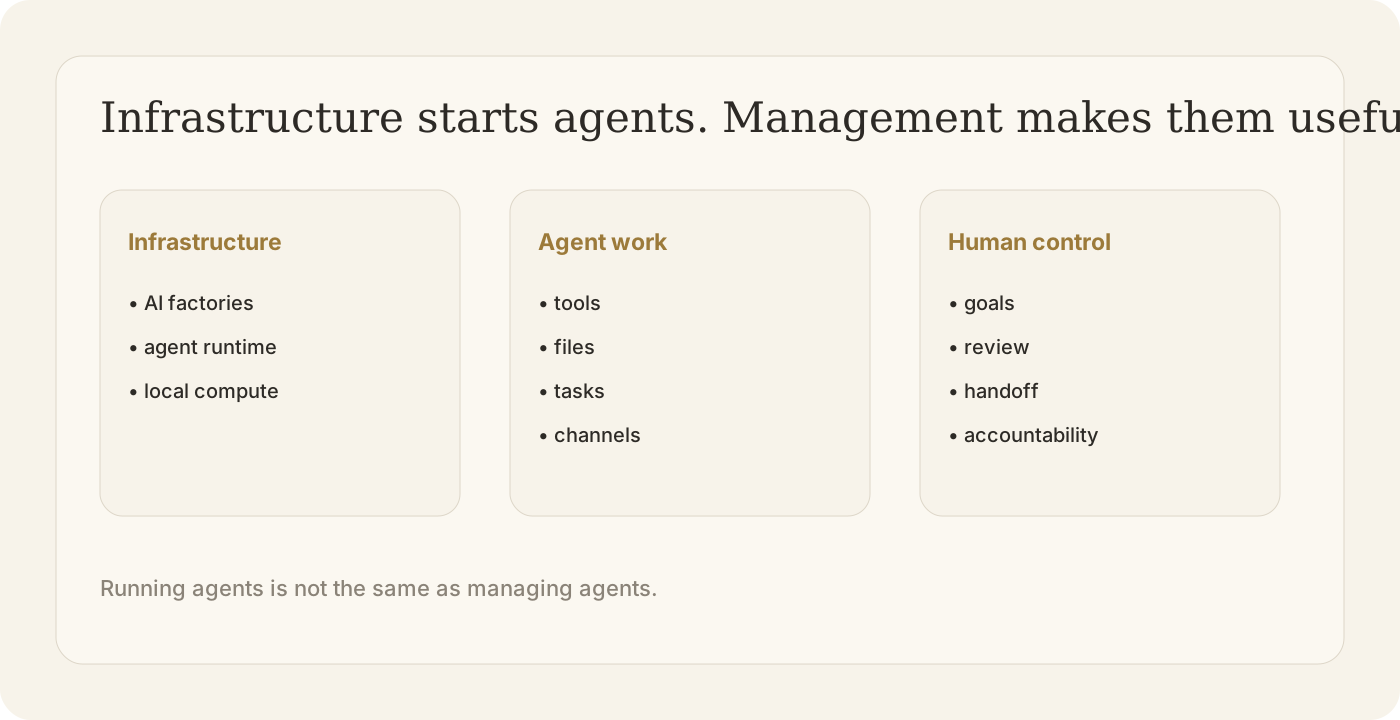
NVIDIA’s keynote focused on the stack that makes agentic AI possible: AI factories, Vera Rubin systems, agent runtimes, NVIDIA Agent Toolkit, OpenShell, local DGX systems, RTX Spark PCs, and agent-ready skills.
This is the “run” layer.
It answers questions like:
- How do we generate more tokens per watt?
- How do agents run continuously and securely?
- How do they access tools and skills?
- How do enterprises deploy agents across cloud, on-premises, PCs, and edge devices?
These are real infrastructure problems. Without compute, networking, storage, security, and runtime support, the agent era cannot scale.
But once agents enter company workflows, another layer appears.
Running agents is not the same as managing agents.
Agent companies need human control
A company does not need “many agents online” as an end in itself.
A company needs agents that serve shared goals.
That means someone must answer:
- Who gives an agent its objective?
- Which files can it read or write?
- Which tools and channels can it use?
- Who reviews its output?
- Who can take over at a critical moment?
- How do multiple agents share context instead of creating new silos?
- How does the company audit what happened after the work is done?
These are not GPU questions. They are not only model questions.
They are organizational questions.
This is the layer Buda is built for.
Agents as a company, not agents as noise
It is easy to imagine agents as upgraded automation scripts.
One agent writes content. One agent researches. One agent codes. One agent handles support.
Useful, yes. But not enough.
A real company is not a pile of isolated workers. It has goals, roles, files, permissions, processes, handoffs, review standards, and accountable owners.
Agents need the same structure.
If each agent is just a separate chat window, the result is not an AI company. It is AI noise.
One agent finds a source, another cannot see it. One agent creates a file, another cannot use it. One agent makes a decision, and no human can explain why. One agent calls a tool, and no one can audit it later.
The point of agents as a company is not simply having more agents.
The point is coordinating many agents around the same human intent.
Buda’s structure: Space → Agent
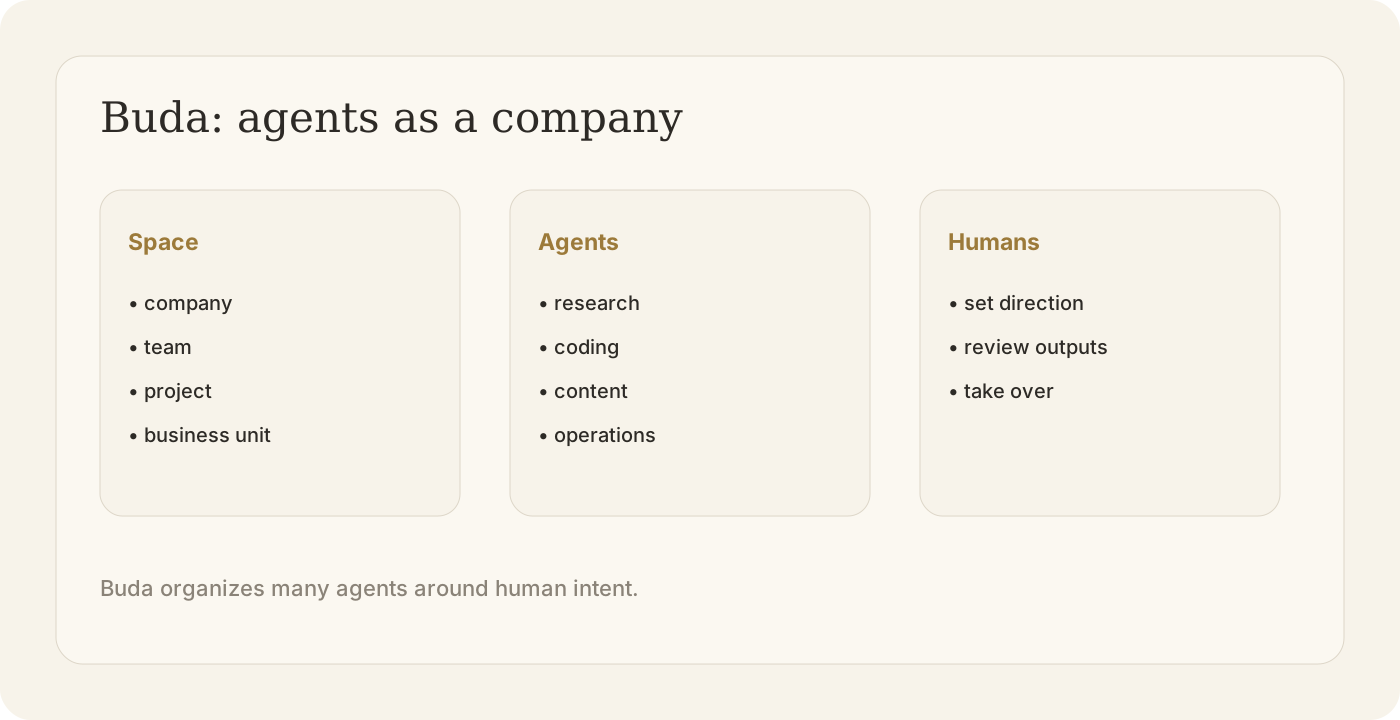
Buda organizes agent work through a simple product structure: Space → Agent.
A Space is like a company, team, project, or business unit.
An Agent is an AI worker inside that Space.
This matters because it moves agents out of isolated chat boxes and into an explicit organizational boundary.
Inside a Space, a team can create different agents for research, content, engineering, operations, support, data analysis, or any custom workflow. They can work with shared files, skills, sessions, browser tasks, terminal execution, artifacts, automations, and channels.
Humans do not disappear.
Humans move up a layer: setting direction, assigning tasks, reviewing outputs, and taking over critical actions.
That is the Buda interpretation of agents as a company.
Not an unmanned company.
A human-led company with AI execution capacity.
Why human control becomes more important as agents get stronger
It sounds counterintuitive, but stronger agents make human control more important.
A weak agent can only make small mistakes.
A strong agent can read more files, call more tools, execute more code, access more systems, and communicate through more channels.
So the important question is not only whether the agent can finish a task.
It is whether the agent is working toward the right human goal, inside the right boundary, with the right review mechanism.
This is why Buda’s basic stance is simple:
AI executes. Humans judge.
We are not building AI to replace human direction. We are building a workspace where humans can manage stronger AI.
Agents need a workspace, not only a chat box
Many AI products still treat agent work as conversation.
A user asks. The model answers. Sometimes it calls a tool. Sometimes it creates a file. But the work still feels like a one-off exchange.
Companies do not run that way.
Companies need persistent context, files, task states, cross-tool execution, review history, and team handoff.
That is why Buda gives agents a real workspace:
- Drive for files, research, and intermediate outputs;
- Terminal for commands and code execution;
- Browser for web work and page operations;
- Skills for reusable methods;
- Sessions for traceable task history;
- Channels for external communication surfaces;
- Human-in-the-loop review so people can inspect and take over.
This is not a more complex chatbot.
It is a place where agent work can be organized.
Private deployment and enterprise adoption
As agents enter internal company workflows, private deployment becomes more important.
Agents may touch internal documents, customer data, repositories, financial data, business systems, private knowledge bases, and internal communications.
At that point, enterprises care about more than model intelligence.
They care about data location, permission boundaries, behavior logs, integration with existing systems, and whether the agent workspace can run in their own environment.
Buda supports private deployment for teams that want to bring multiple agents into internal workflows while keeping human review, permissions, and operational boundaries clear.
The next layer after agent infrastructure
NVIDIA is helping make large-scale agents technically possible.
The next challenge is making them organizationally useful.
Every company may run agents. But the real question is whether those agents are organized, visible, auditable, and aligned with human goals.
That is why Buda exists.
Not to build another chat window.
To help humans operate their own agent company.
Start building human-led agent workflows at buda.im, or learn more about the Buda Agent Workspace. For private deployment or enterprise agent workspace discussions, contact the Buda team.