AI Saves Workers 11 Hours a Week. Why Isn't the Company Faster?
AI output gets faster while context, review, and rework keep the organization from moving with it.

AI can finish a draft in seconds and still leave the company with more work.
Someone has to find the right files. Someone has to explain which version is current. Someone has to check a polished answer against the source, carry context into the next tool, and repair whatever reaches the next team incomplete.
The model was fast. The workflow was not.
At Buda, we think this distinction matters more than another benchmark. AI output is an intermediate state. The organization gains speed only when that output can move through context, execution, judgment, and feedback without people rebuilding the system around it every time.
Personal speed is not organizational speed
The Glean Work AI Index 2026 gives the productivity gap a useful scale.
Among the 6,000 full-time digital workers surveyed in the United States, United Kingdom, and Australia, 87% said they use AI at work and 75% said it makes them more productive. Workers estimated that AI automation saves them roughly 11 hours a week.
Yet only 13% said AI had significantly improved their organization's performance and outcomes.
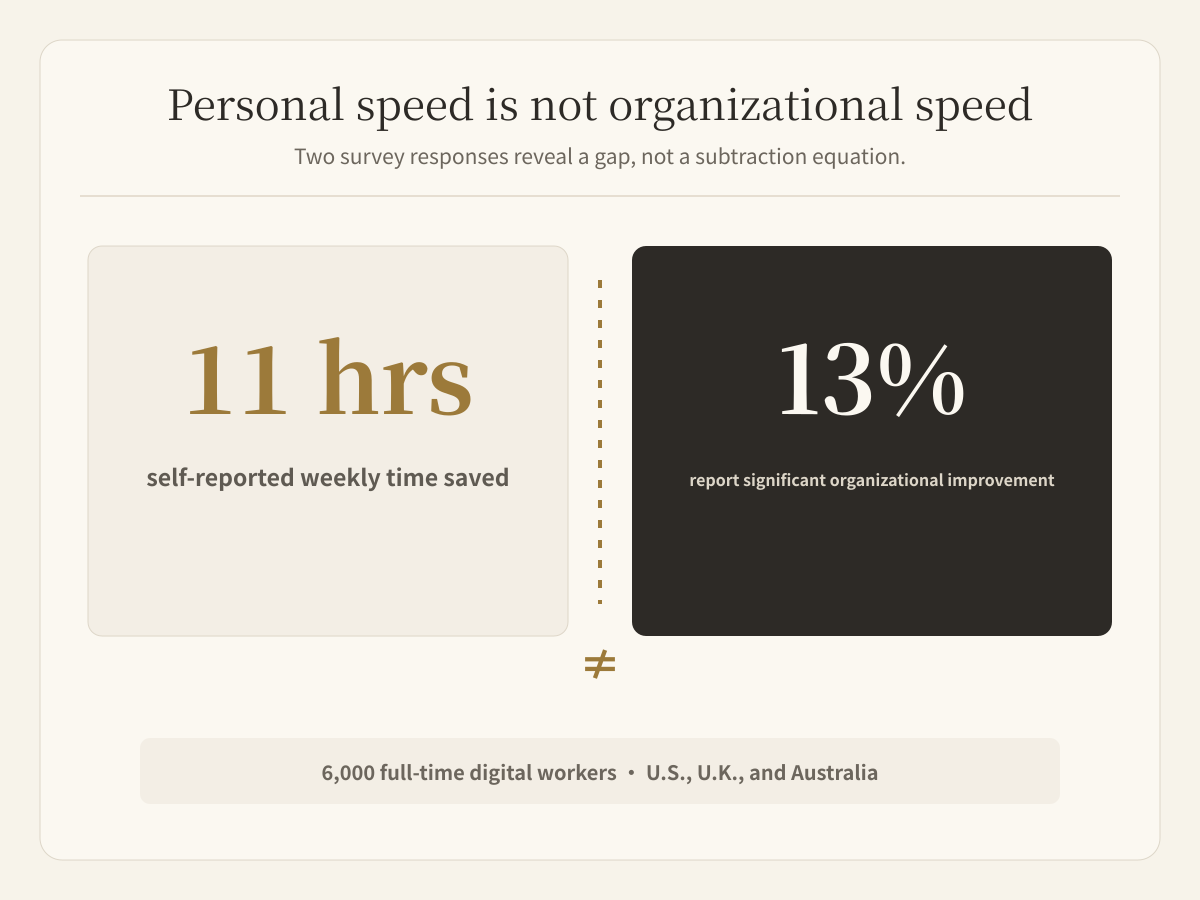
The figures describe different things. The 11 hours are self-reported savings, while the organizational result is another survey response. The study was fielded from December 2025 to January 2026, focuses on digitally intensive workers, and comes from an enterprise AI vendor. It is evidence of a gap, not a universal causal measurement.
The operational question is still hard to avoid: if individuals feel much faster, where does the advantage disappear before it reaches the company?
It disappears between generation and usable work.
The missing cost is the work around AI
Glean calls this hidden labor botsitting: supplying missing context, supervising output, debugging errors, rerunning prompts, cleaning up downstream problems, and moving intent between disconnected tools.
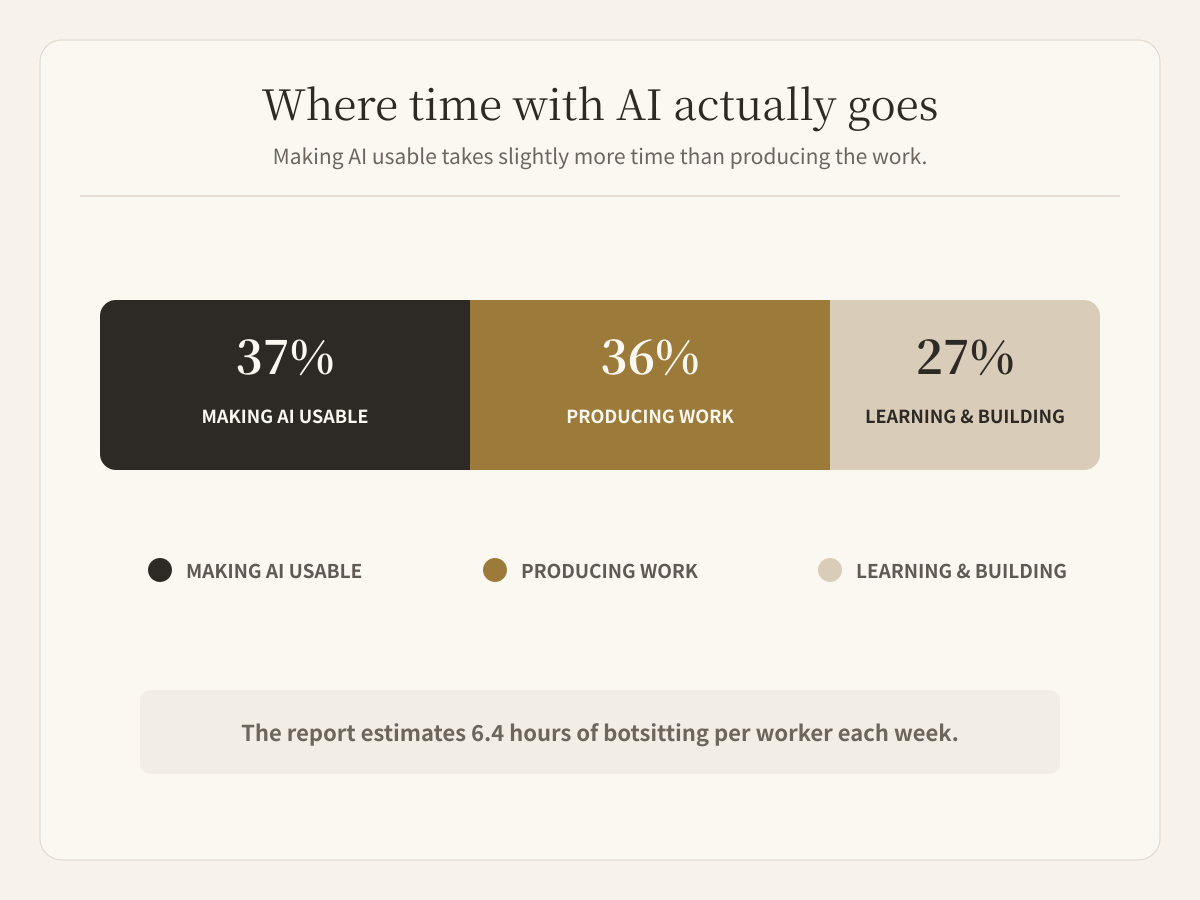
The report estimates 6.4 hours of botsitting per worker each week. Across all time spent interacting with AI, the study divides the activity this way:
- 37% making AI usable;
- 36% producing work with AI;
- 27% learning tools and building agents.
That does not mean every minute of review is waste.
Checking a contract, financial model, customer promise, or public article is real quality control. Adding domain judgment that no model could infer is useful work. A responsible team should not try to automate those minutes away.
The waste is repetitive reconstruction: pasting the same background again, finding the same approved file again, comparing three outputs because none carries the full context, and fixing an error that should never have entered the next stage.
Four taxes sit between an answer and an outcome
The estimated 6.4 hours break down into four kinds of labor:
- 2.3 hours feeding AI context;
- 2.2 hours supervising output;
- 1.7 hours debugging, reprompting, or changing models;
- 0.2 hours cleaning up and switching tools.
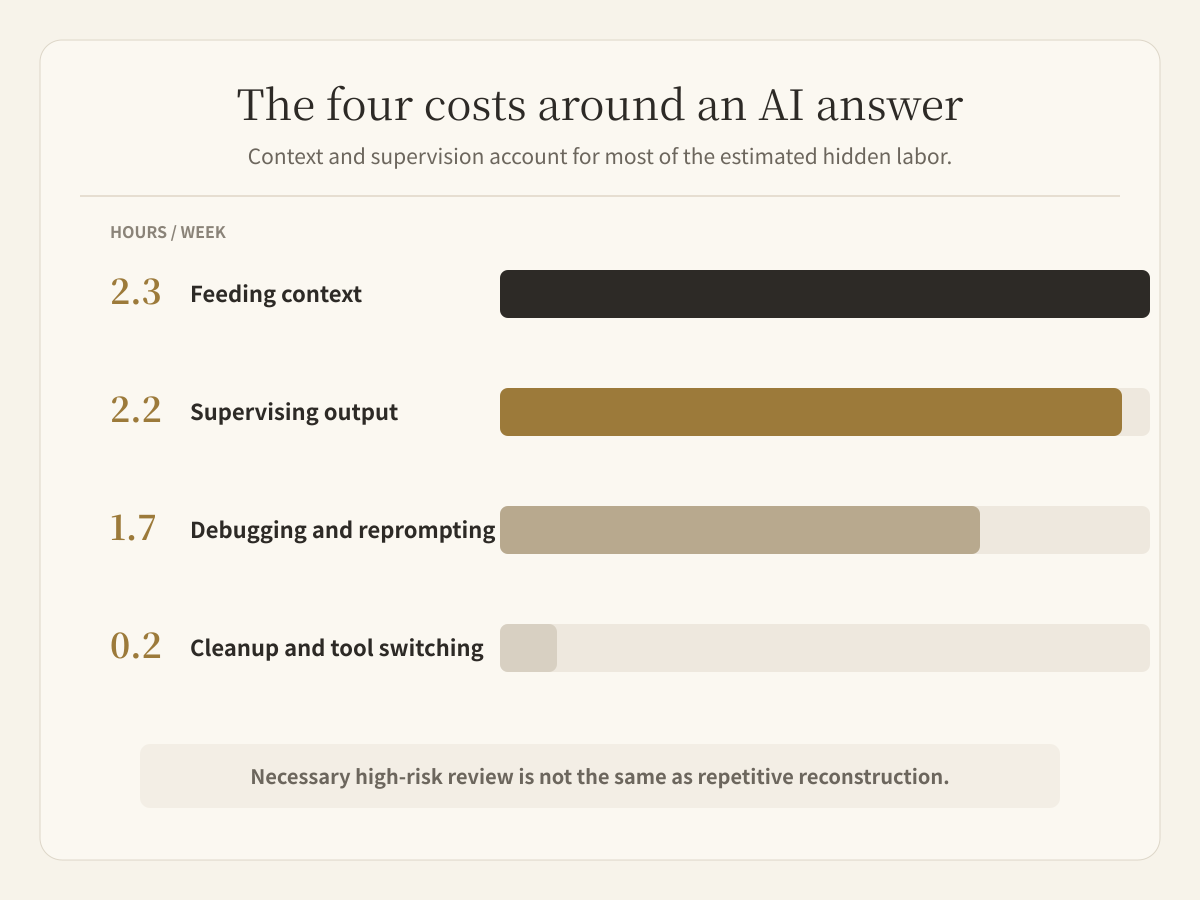
The largest item is not typing a better prompt. It is reconstructing the situation around the prompt.
A model may have access to a folder and still not know which spreadsheet is approved, whether “Q3” means this year or last year, which customer promise overrides the template, or what exception the team agreed to yesterday.
Files are not context by themselves. Context includes authority, recency, relationships, constraints, and the current state of the work.
Without that structure, the worker becomes the integration layer.
Tool access does not remove the toggle tax
The report found that 77% of AI users move among multiple tools each week, 33% use four or more, and 60% rerun the same prompt across tools because the first answer was not good enough. More than half said important information needed for their work was inaccessible from their AI tools.
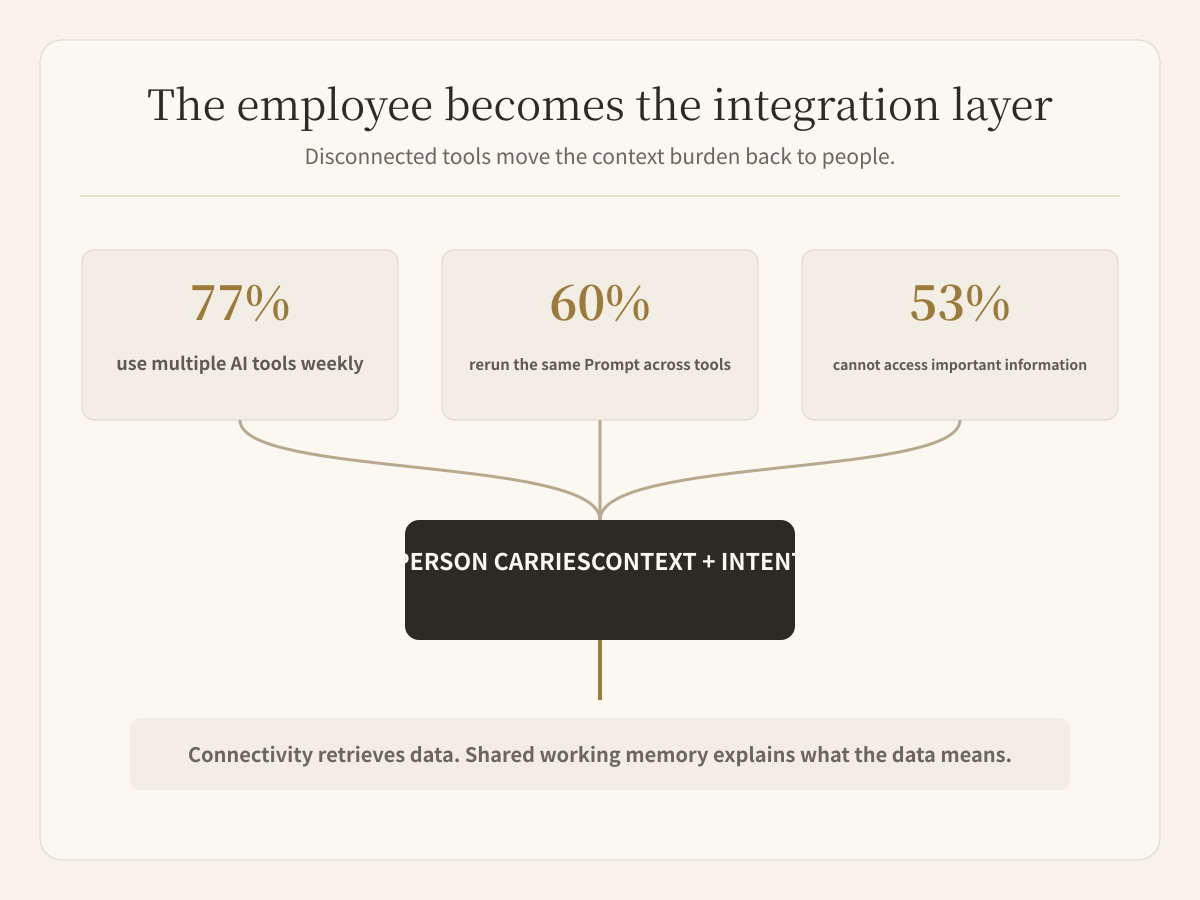
Connectivity helps, but a connection is not the same as shared working memory.
An API or MCP server can let an Agent retrieve data. It does not automatically explain which record is canonical, which method the team has validated, how a decision should be escalated, or what “done” means for this task.
When every tool begins from a blank interaction, the employee must carry intent between them. The company may count several AI activities while one person quietly rebuilds the same context across the chain.
Polished output makes judgment easier to skip
Bad knowledge work used to carry visible warning signs: a rough structure, a broken sentence, an unfinished table. AI removes many of those cues.
An answer can be fluent, complete, and wrong at the same time.
The report says 69% of AI users admitted to at least one behavior involving unverified or poorly understood AI work. Forty-one percent said they sometimes deliver AI-generated work they could not explain if asked. Seventy-seven percent had corrected or redone AI-assisted work in the previous month.
The answer is not permanent human surveillance. It is explicit review design.
Teams need to decide before execution:
- which source is authoritative;
- what result is acceptable;
- which claims require verification;
- what the Agent can execute without interruption;
- what must stop for human judgment;
- who owns the final outcome.
Review should follow risk. A public-information summary and a payment instruction should not pass through the same gate.
Replace repeated prompting with an execution system
The productivity gap closes when the method survives the conversation.
A working AI system needs five layers:
- Persistent context: the Agent can return to the same sources, decisions, and current state.
- A reusable method: successful steps become a Skill or workflow instead of private Prompt history.
- Visible artifacts: people can inspect the files, research, calculations, and drafts produced during execution.
- Risk-based review: humans enter at defined decision points, not after every harmless action or after the damage is done.
- Outcome feedback: what passed, failed, or required rework changes the next run.
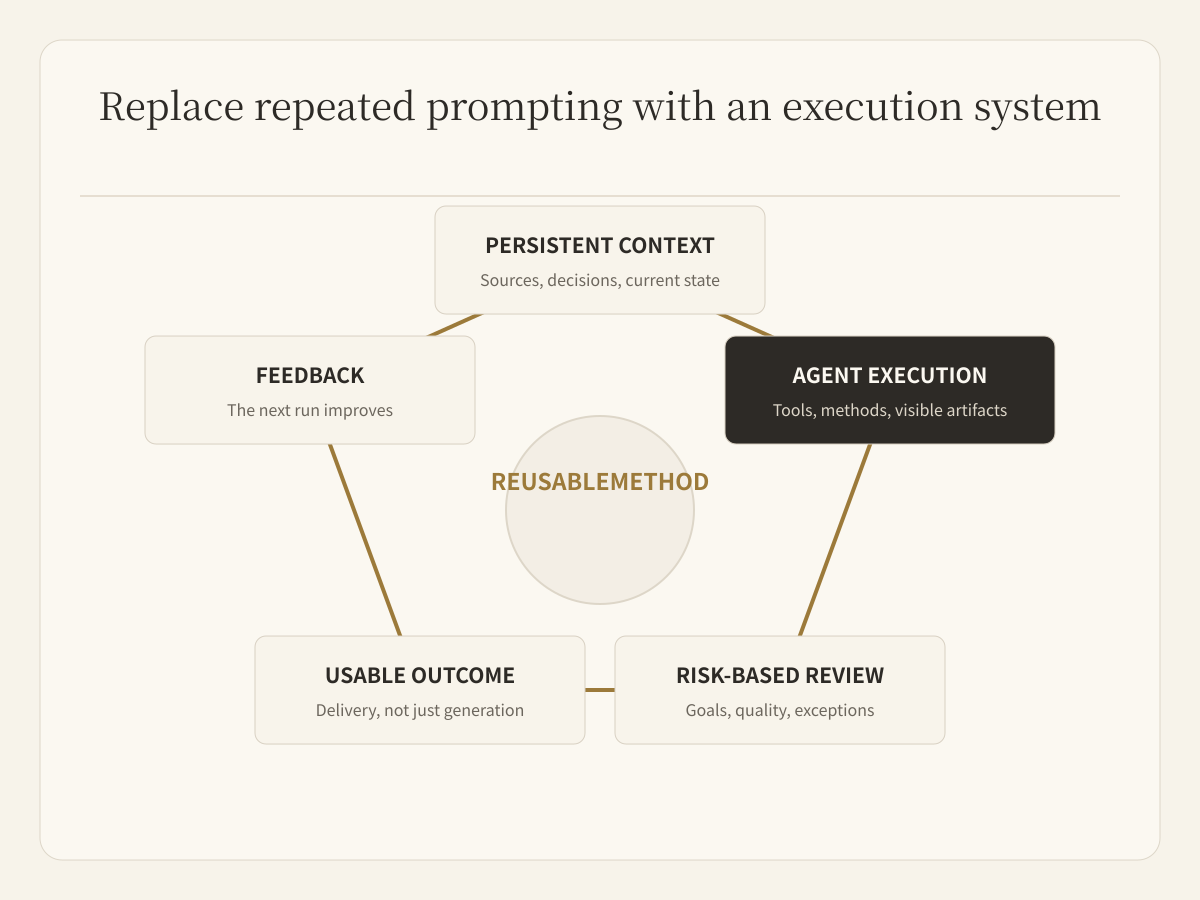
This is also why the right adoption metric is not seats, Prompts, Tokens, or even hours claimed as saved.
Measure first-pass acceptance, time spent reconstructing context, downstream rework, exception rate, and whether another person can run the same method without starting over.
Buda is built for the work after the Prompt
Buda keeps the parts of a real task together.
Sources and operational context live in Drive and Memory. The Agent works inside a persistent Agent Workspace, where conversations, files, tools, and artifacts remain visible. Once a method works, it can become reusable Skills and Automations instead of another set of instructions trapped in one person's chat history.
The Agent handles execution. People keep the goal, quality bar, exceptions, and final decision.
This is the same operating principle behind removing unnecessary work before automating it: do not make an old workflow faster until the team knows which work is worth keeping. Then give the remaining work enough context, structure, and review to become repeatable.
Start with the task that creates the most rework today. Run it in the Buda dashboard, keep the context with the work, and measure whether the next person receives a usable result rather than another polished draft to repair.