AI copy still sounds generic? Build an editorial feedback loop for brand voice
Turn accepted examples and precise edits into reusable writing rules, then test them on material the agent has not seen.

The product facts are correct, yet the draft sounds like every other software company. The editor asks for a warmer tone. The next draft adds enthusiasm but loses the calm, specific voice the brand actually uses. More adjectives have not solved the editing problem.
Brand voice becomes usable when an agent can see which sentences work, which do not, and why. Give it evidence of editorial choices, keep factual constraints separate, and test the resulting rules on a new example before reusing them.
Replace “professional and friendly” with observable choices
Start with audience, purpose and boundaries. Who is reading? What do they need to decide? Which promises must the copy never make? Then describe writing choices: name the action before its benefit; use concrete verbs; attach evidence to consequential claims; avoid invented personal experience.
The marketing workflow describes brand context and editor review. The practical work is to turn those materials into instructions that can be inspected, rather than assuming that uploading a guide guarantees every sentence will fit.
Build a small, annotated sample set
Choose three accepted pieces and two rejected examples you are authorized to use. Keep read-only copies of originals. Annotate individual sentences: what action the verb names, how the evidence supports the promise, which exaggeration was removed, and how the sentence serves the audience.
Use four suggested files in Drive: brand/voice.md, approved-examples.md, negative-examples.md and feedback-log.csv. These paths are a proposed organization, not a built-in brand-training feature. Redact customer material and do not mix confidential examples from different brands.
Calibrate on one fixed brief
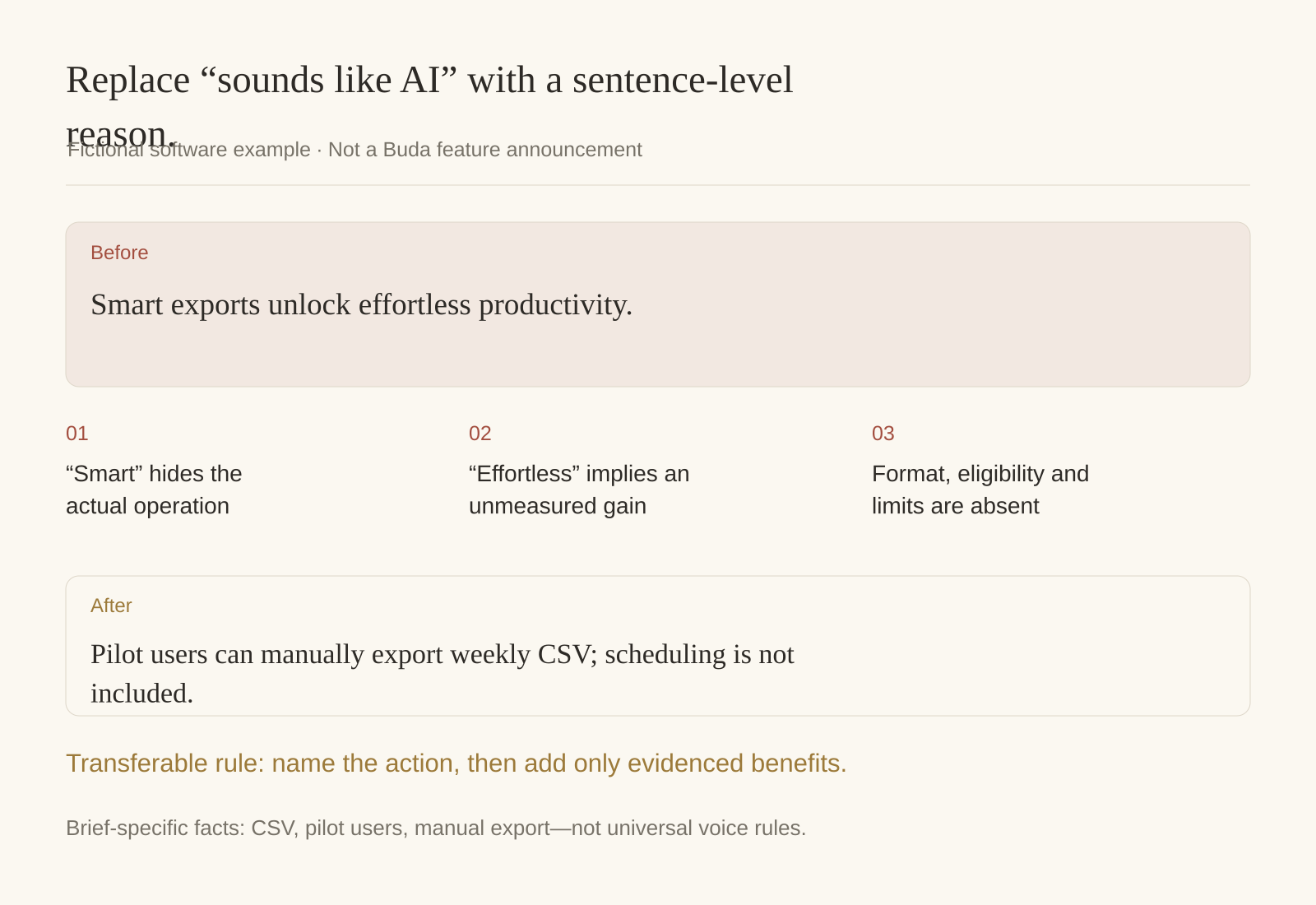
The following is a fictional B2B software example, not a Buda announcement. Its fixed facts are: pilot users can manually export a weekly report as CSV; scheduling is not included. The audience is operations managers who need a file for their regular review.
Rejected draft: “Meet the revolutionary reporting experience that transforms your operations. With intelligent exports, your team can unlock effortless reporting and focus on what truly matters.”
An editor can give four precise notes. S1: “revolutionary” asserts significance without evidence; replace it with the concrete action. S1: “transforms” implies an outcome the brief does not establish. S2: “intelligent exports” hides the actual format and eligibility. S2: “effortless” suggests measured ease and omits manual work. These notes concern both voice and unsupported promises; facts take priority when they conflict with style.
Revised draft: “Pilot users can now export the weekly report as CSV. Open the report, choose export, and review the file before sharing it. Export is manual; scheduled delivery is not included.”
The revision is deliberately modest. It demonstrates a direct tone without inventing an efficiency gain. A full exercise can ask for two roughly 300-word drafts from the same fact sheet, then compare sentence IDs rather than asking for “more premium” copy.
Record the edit, its reason and its scope
A feedback row needs a draft version, sentence ID, issue category, before and after, rationale and reviewer decision. For example: v1 / S2 / vague capability / intelligent exports / manual CSV export / name the real action / accepted.
Do not promote every one-off edit into a universal rule. “Use CSV in this sentence” belongs to the brief. “Name the action before adding a benefit” may transfer to other work. Keep product truth, campaign preferences and durable voice rules in separate sections.
Use a held-out example before saving a rule
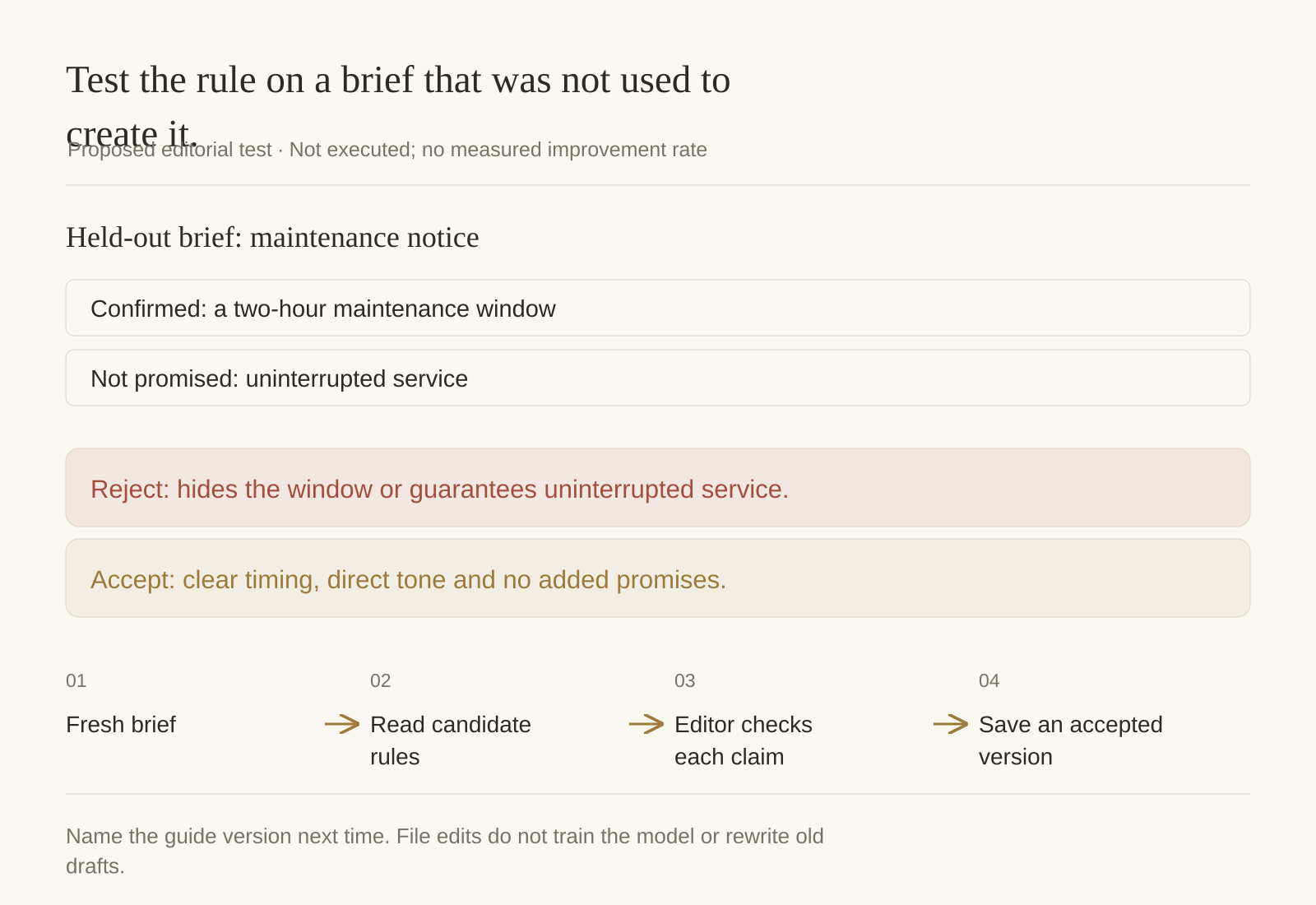
Hold back one authorized sample or create a fresh fictional brief that was not used during calibration. For instance, a maintenance notice with a confirmed two-hour window and no promise that service is unaffected. Ask for a draft using the proposed rules. Reject a pleasant rewrite that hides the maintenance window or claims uninterrupted service.
Judge four dimensions: recognizable voice, concrete language, trustworthy promises and audience fit. Use qualitative anchors such as “names the actual action” or “adds an unsupported guarantee,” not invented accuracy percentages. This is a proposed editorial test; no experiment or improvement rate has been measured here.
Save accepted rules, then explicitly read them next time
After review, update the guide with a version, sample dates, accepted rule and its exception. Retain the previous guide. At the next task, tell the agent which version to read; updating a file does not itself rewrite existing drafts or prove that another session has consumed it.
Buda memory is file-based: improving the materials is not training the underlying model. Verify that useful chat feedback was written into the intended file instead of assuming that it became durable memory.
For repeat work, capture the accepted process as a Skill. In Buda AI Marketplace, search for a relevant writing Skill, read its listing and instructions, and install it if it fits. If none fits, author your own. Do not assume a particular brand-voice Skill exists or that installation approves its outputs.
Read the approved facts and brand/voice.md version specified for this task. Draft for the named audience. Preserve factual conditions. Return sentence-level uncertainties and proposed edits separately. Do not update the guide or publish. Suggest reusable rules only after showing the before/after and why they transfer.
Editorial decisions that should stay human
Can the agent write like a founder? Use authorized examples to describe diction and rhythm. Do not invent first-person experiences or opinions. Use first person only for an explicitly commissioned, attributable voice and verified source material.
How should several brands share a team? Keep separate guides, examples and output folders; use separate agents or Spaces where their access and working context require separation. A folder name alone is not a permission boundary.
When should the examples change rather than the model? If feedback says only “more premium” or examples contradict one another, repair the guide first. If a held-out draft still violates an explicit rule, inspect whether the task read the correct version before changing several variables at once.
Begin by asking the agent to annotate five approved and rejected examples and propose candidate rules. The editor accepts the rules and the final draft; the agent handles the comparison and revision work. A multi-channel fact map can complement this loop when the same product update is later adapted across channels.