One Product Update, Three Channels: Rewrite the Message Without Changing the Facts
Give each audience a different path through the same confirmed capabilities and limits.

A product team confirms an update. The content team then needs a website blog post, a social update, and a customer email. Blog readers want to understand how it works; social readers need to grasp the change quickly; existing customers need to know whether they can use it and what to do next. One release note rarely serves all three needs on its own.
An AI agent can turn the same source material into drafts for different channels. The challenge is to change the presentation without changing the product facts. Removing an eligibility condition to save space, or expanding a specific feature into a bigger promise, can make three drafts describe three different products. Multi-channel writing needs both audience-specific structure and a clear connection between each claim and its source.
Shorter copy can make a bigger claim
A product update says that selected users can export a report as CSV. The blog explains the export steps. A social draft says “all your reporting, automated.” An email invites every customer to use a feature available only to selected users. The copy is consistent in tone but inconsistent in meaning.
This is a fictional teaching example, not a Buda feature announcement. It shows why AI content repurposing needs more than a request to shorten the original. Channel structure may change; availability, capability, and limitations must stay attached to the claim.
Prepare a fact sheet that every task can read
Before drafting, collect confirmed changes, eligible users, required conditions, limitations, source dates and URLs, and terms your team must not use. Assign short IDs such as F1 and F2. Leave unresolved facts blank and name the owner who can resolve them. Keep the brand voice guide separate so a preference for confident writing cannot override the source.
For the fictional export example: F1 is manual CSV export; F2 is availability for selected pilot users; F3 is no scheduled export. “Automated reporting” and “available to everyone” would change these facts. A file with these rules is an editorial input, not a technical fact-lock or automatic verification system.
Write three task cards, not three word limits
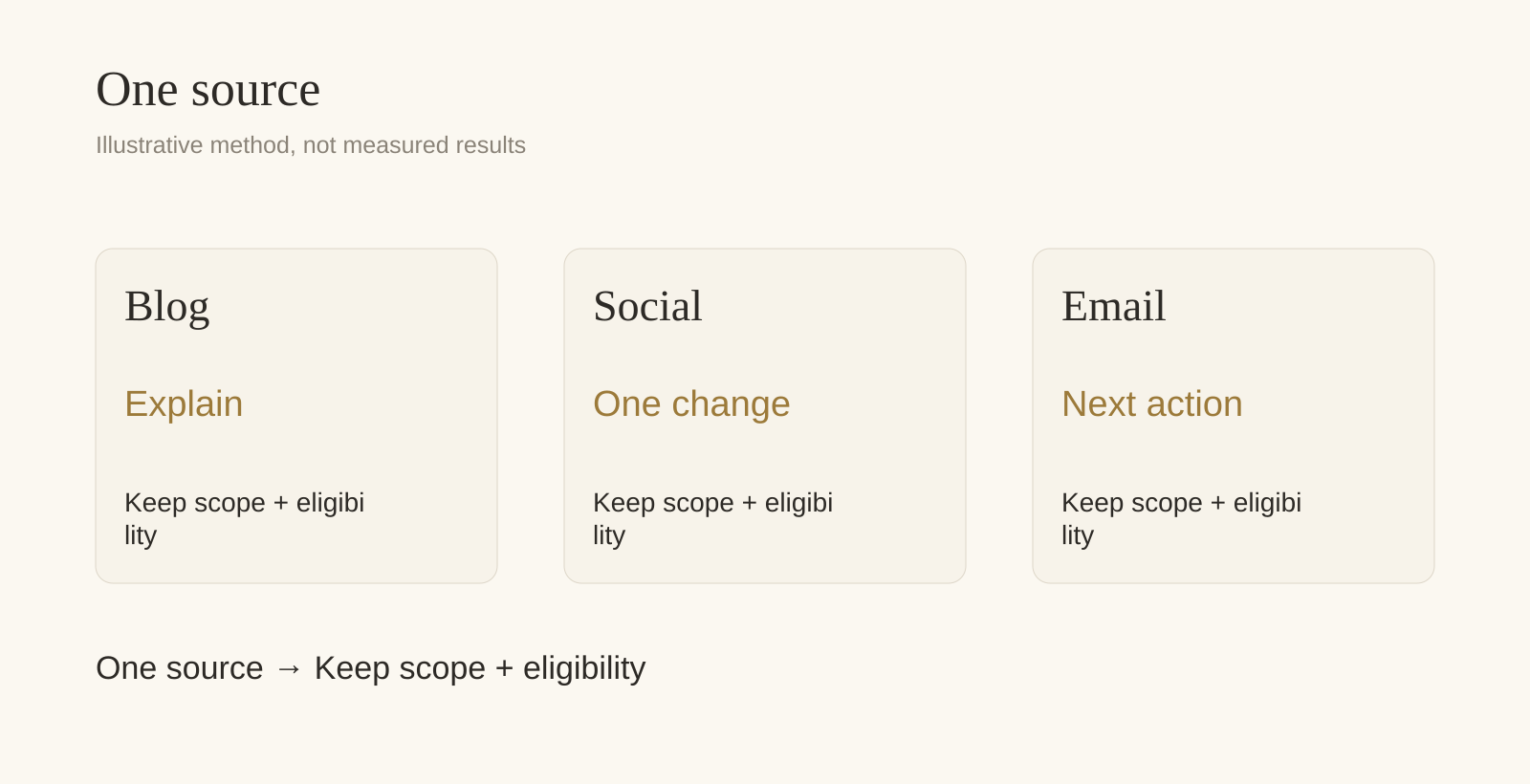
Blog: answer how the change works, when it is useful, what steps are needed, and where the boundary sits. Open with the user problem, then explain the mechanism.
LinkedIn or X: choose one change a reader can understand without opening the blog. Keep the essential condition next to the claim. An accurate short version could say: “Pilot users can now export a report as CSV, without rebuilding the data in a spreadsheet.” Do not imply scheduling or broader availability.
Customer email: identify who should act, what they can do next, and which instruction to follow. The fictional version might say: “If your team is in the pilot, open the report and choose CSV export.” Send eligibility and recipients for review; a draft does not authorize delivery.
These are different arguments, not one paragraph trimmed to three lengths.
Use separate sessions with shared source files
The marketing workflow supports preparing content for several channels from product and brand context. Agents and Claws recommends multiple sessions under one agent for related writing jobs, rather than a separate agent for every channel.
Create one session per draft and explicitly refer to the same fact sheet and brand guide in Drive. Use paths such as updates/export-v1/facts.md, brand/voice.md, and separate output folders for blog, social, and email. Session context separates conversations; it does not create separate Drive storage.
Read the approved fact sheet and brand guide at the specified paths. Draft for this channel and audience only. Preserve eligibility, conditions, and limitations beside the relevant claim. Leave unresolved items visible. Return the draft and a mapping from each factual sentence to its fact ID. Do not publish or send.
Review the claims, not just the voice
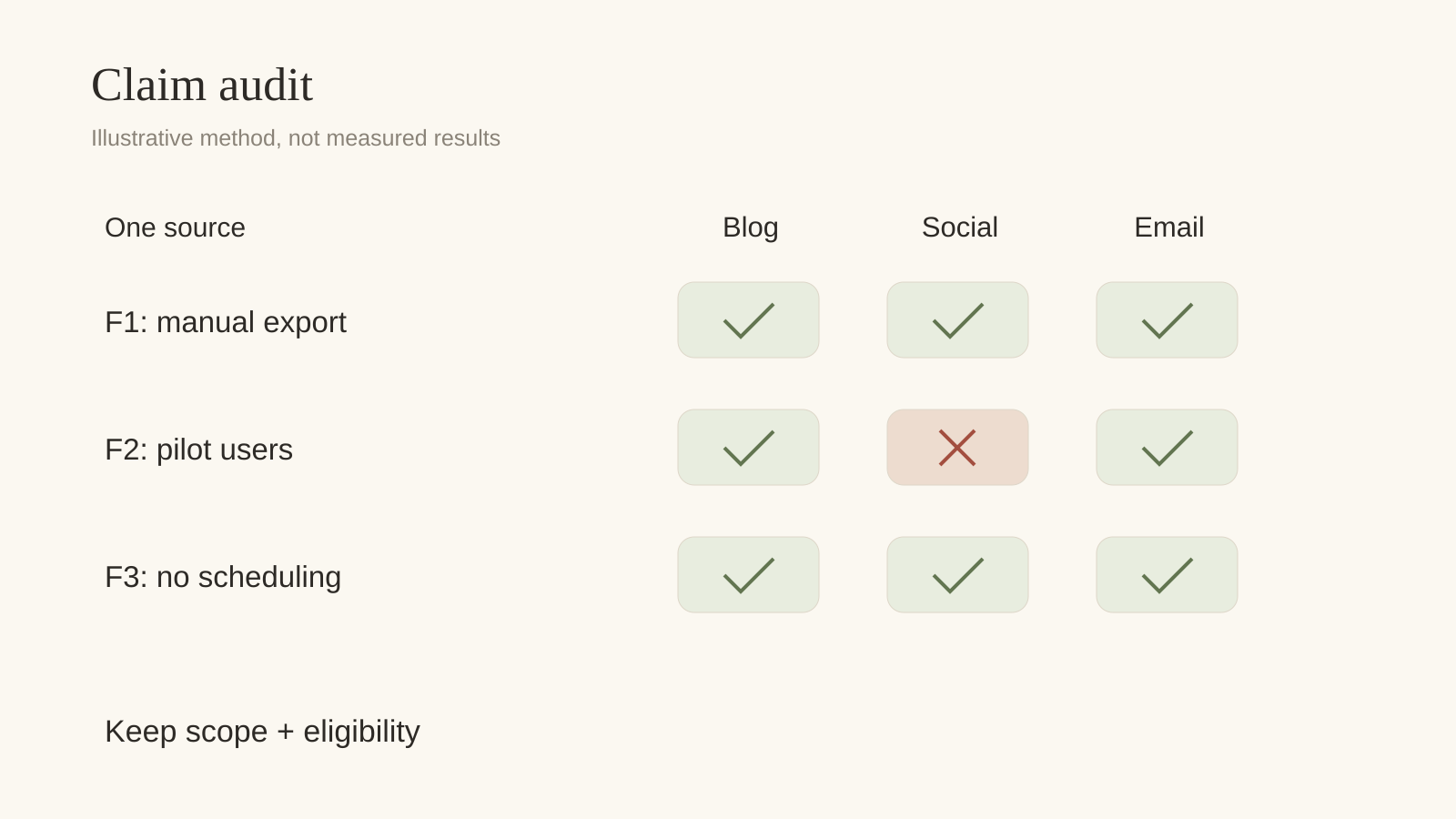
Ask for a mapping from fact ID to the corresponding sentence in each draft. Mark each as retained, missing, or changed. In the fictional example, the blog may retain F1–F3 while the social version omits F2 and the email changes F2 to universal availability. That identifies two precise edits.
Reject “all reporting, automated” because it changes manual export into a broader automation promise. Replace it with the concrete export action. Reject an email CTA aimed at every customer; narrow it to eligible pilot users. “Make the copy more accurate” is weaker feedback than pointing to the sentence and its source fact.
The editor also decides whether a valid claim fits the audience. A social teaser may be accurate yet offer no understandable benefit; a long email may bury the one action a customer needs.
Update the source first when the product changes
If pilot access expands, revise F2 in the source sheet, retain the previous version, and ask the agent to list all sentences that rely on F2. Rewrite those passages across the three drafts, then compare the old and new text. A source edit alone does not guarantee every saved draft has been reread or updated.
Keep the revision sequence visible: source version, affected drafts, edited passages, reviewer decision. After approval, move each draft into its actual publication workflow. This preparation method does not automatically post to a platform or send email. The publishing pipeline article addresses the broader production chain; this claim mapping helps its outputs stay faithful to the source.
Practical decisions for a small content team
Does every channel need an agent? Use separate sessions when role, tools, and files remain shared. Create a separate agent when those responsibilities or boundaries genuinely differ.
How can short copy retain a limitation? Put the decisive condition beside the benefit: “Pilot users can…” If the condition makes the promise hard to understand, narrow the promise rather than hiding the condition behind a link.
Which drafts need revision after a product change? Use the fact IDs to list affected passages, then review the rewritten claims and CTAs in every corresponding draft.
For a repeatable method, search Buda AI Marketplace for relevant Skills, install and read one before using it, or create a custom procedure if none fits. Start with one confirmed update and three reviewable drafts. Let the editor choose the framing; let the agent carry out the structured writing and comparison.