Buda vs Amazon Q Developer in 2026: Route the Work Before You Migrate
Map Amazon Q Developer’s current surfaces, Kiro transition, and the workloads that may need a persistent cross-functional Agent workspace.

Buda vs Amazon Q Developer in 2026: Route the Work Before You Migrate
Amazon Q Developer is not disappearing in one switch, and Buda is not a drop-in replacement for its coding or AWS expertise. A useful comparison in 2026 starts with a map: which Amazon Q surface does each workload use today, where is that surface going, and does the work remain developer-owned after the migration?
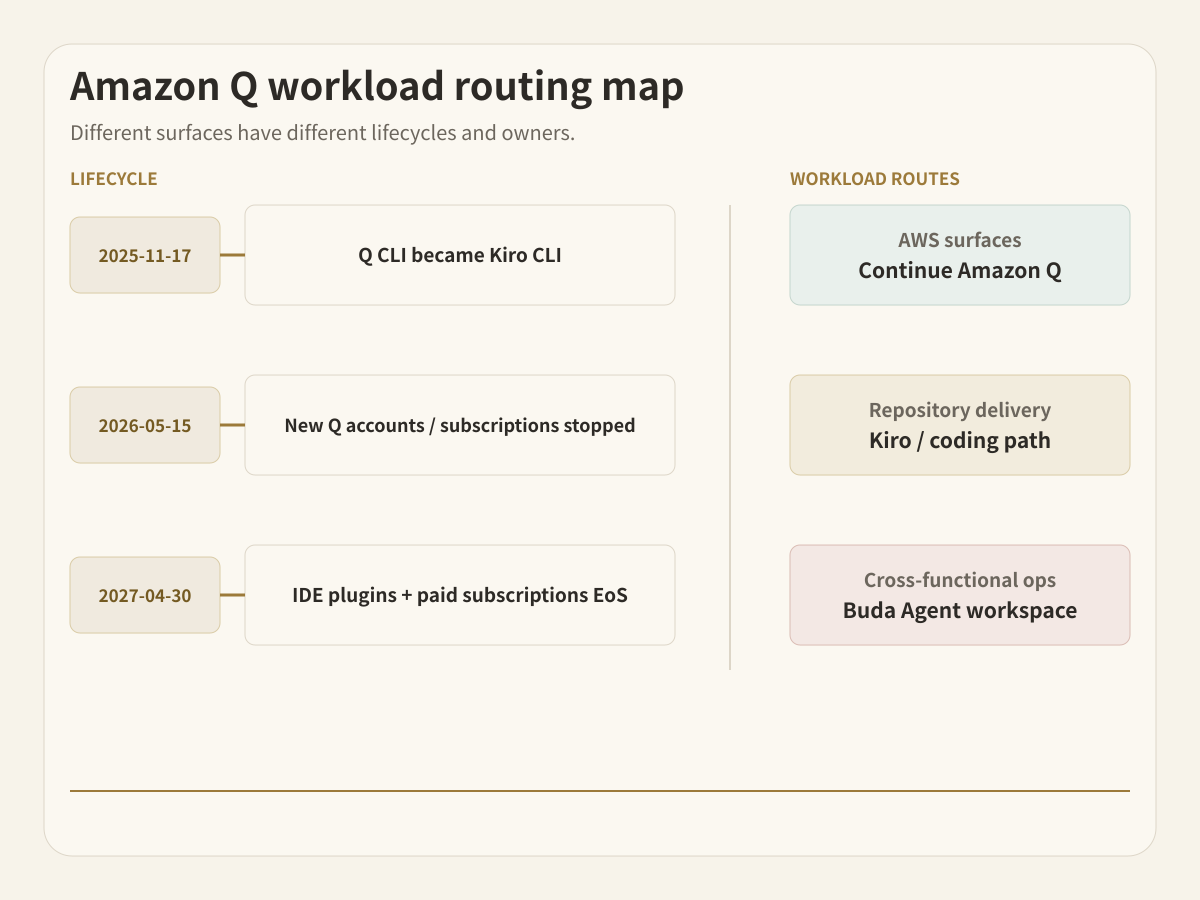
AWS has already moved the Q CLI into Kiro CLI. New Q Developer accounts and subscriptions stopped on May 15, 2026. Amazon Q Developer IDE plugins and paid subscriptions are scheduled to reach end of support on April 30, 2027. Yet Amazon Q in the AWS Management Console, AWS first-party websites and mobile app, and Amazon Q Developer for Slack and Microsoft Teams are explicitly outside that sunset.
That creates at least three routes, not one: continuing AWS assistance, a Kiro or other coding environment for repository work, and a managed Agent workspace when the workflow extends into persistent cross-functional operations.
Migration is a surface map, not a vendor verdict
The label “Amazon Q Developer” currently covers several jobs:
- AWS architecture, resource questions, troubleshooting, and guidance in AWS surfaces;
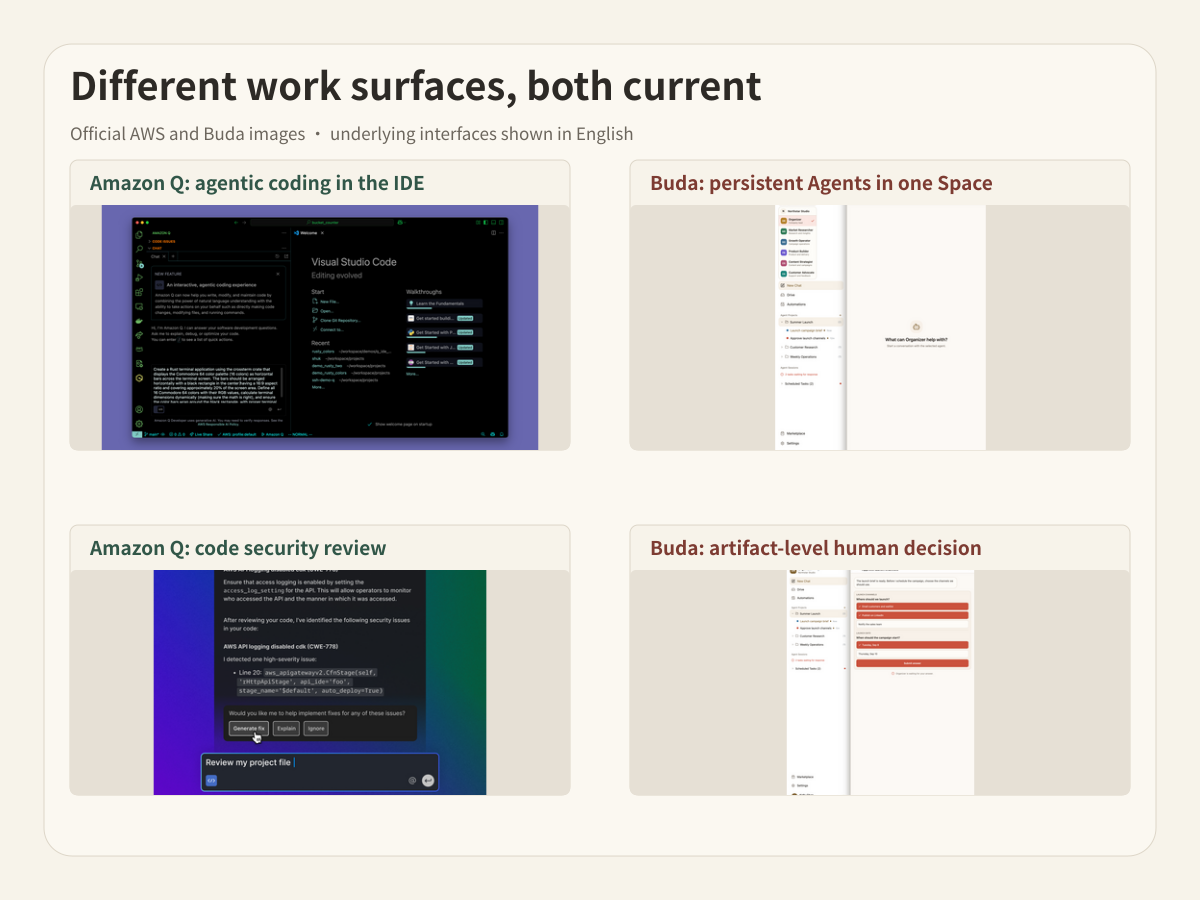
- agentic coding in IDEs with workspace context, local file changes, shell commands, code review, security scanning, and MCP;
- repository workflows through GitHub and GitLab integrations;
- communication through Slack and Microsoft Teams;
- application transformation and modernization capabilities.
These surfaces do not share one lifecycle. A company that says “we use Amazon Q” may actually have six different dependencies owned by different teams. Replacing the brand as one line item would mix AWS operations, software delivery, collaboration, and business workflows into one migration project.
Build a workload register first. For each use, write down the current surface, owner, files or systems reached, subscription dependency, review object, migration deadline, and expected destination.
Put four dates on the migration board
November 17, 2025: Q CLI became Kiro CLI
AWS's User Guide history records that the Q CLI became Kiro CLI on November 17, 2025. The command-line path is therefore already a Kiro decision. Do not plan a future migration to “another Q CLI”; inventory Kiro CLI configuration, authentication, agents, rules or steering, prompts, MCP servers, and scripts instead.
April 30, 2026: AWS announced the transition
AWS announced that Amazon Q Developer IDE plugins and paid subscriptions would reach end of support on April 30, 2027. The announcement also positioned Kiro as the path for agentic coding, inline chat, terminal integration, MCP, specifications, hooks, steering, custom subagents, and other development work.
May 15, 2026: new account and subscription creation stopped
New Q Developer Free Tier accounts through Builder ID IDE plugins and new Q Developer subscriptions through the AWS Console are no longer accepted. Existing subscriptions can continue to add users, and existing customers retain IDE plugin access during the transition window. This is a purchasing constraint now, not a future footnote.
April 30, 2027: defined surfaces reach end of support
The IDE plugins, paid subscriptions, and code transformation delivered through that subscription path reach end of support. AWS recommends Kiro for IDE migration and AWS Transform for relevant modernization work.
The date does not mean all Amazon Q Developer capabilities stop. AWS specifically says the AWS Management Console, AWS first-party experiences, AWS Console Mobile App, and Amazon Q Developer for Chat Apps in Slack and Microsoft Teams are not impacted.
Preserve what Amazon Q Developer is genuinely good at
A migration article becomes misleading if it treats Amazon Q Developer as old autocomplete. Current official product and User Guide materials document substantial capabilities:
- AWS-grounded answers about architecture, resources, best practices, documentation, support, and operations;
- IDE chat, inline completions, multi-file code generation, debugging, optimization, and code upgrades;
- agentic coding that reads and writes local files, produces diffs, runs shell commands, and reports progress;
- workspace context, project rules, conversation history, and customizations;
- security vulnerability scanning and code review;
- MCP in IDE and former Q CLI surfaces, with tool permission levels and governance controls;
- integrations with GitHub, GitLab, AWS Console, and chat applications.
That is not the same product job as a cross-functional Agent workspace. Buda should not claim to replace AWS expertise, IDE code generation, code scanning, or a Kiro migration.
Route three workload families separately
AWS architecture and operations
Examples include asking about an AWS resource, investigating an operational issue, reading AWS documentation, checking cost or security guidance, and using Amazon Q in the Console or first-party AWS experiences.
These workloads have a clear reason to remain in the continuing Amazon Q surfaces. The context is the AWS account, resource, policy, or service. Moving them to Buda merely because an IDE plugin has an end-of-support date would discard the strongest part of the product fit.
Repository-first software delivery
Examples include implementing a feature in an IDE, generating tests, reviewing code, running a shell command, applying workspace context, or connecting MCP tools to a coding session.
These workloads need a coding-path decision. Existing users can plan a controlled migration from Q Developer IDE plugins to Kiro, or evaluate another coding environment. The Buda vs Kiro comparison covers a separate purchase decision: software specifications and repository delivery versus a persistent team operating runbook. The AI coding assistants guide is a better shortlist when coding is the primary work object.
Buda can keep files, Git work, Terminal sessions, and reviewable outputs, but it is not an IDE plugin replacement and should not be evaluated by code-completion parity.
Cross-functional recurring operations
Examples include a weekly competitive report that touches AWS release notes, a repository, customer feedback, a document, and manager approval; or an incident follow-up that becomes a customer update, internal runbook, and scheduled prevention check.
This is where Buda becomes relevant. The workflow needs named persistent Agents, shared Space and Drive context, Browser/Terminal/Git access, long-running sessions, permissions, channels, Automations, and a final artifact review. The team is no longer choosing only a coding assistant; it is assigning durable business work.
Use a workload-routing decision tree
Ask four questions for each workflow:
- Is the authoritative context an AWS account or first-party AWS surface? Keep the task with continuing Amazon Q capabilities unless another AWS tool has explicitly replaced it.
- Is the authoritative output a repository change? Route the migration through Kiro or another coding environment and preserve code review in the repository.
- Does the work cross functions, systems, and several days? Evaluate a persistent Agent workspace rather than stretching an IDE session into an operating process.
- What must a person accept? A code diff belongs in repository review. A customer response, report, campaign, or operational decision needs an artifact-level business owner.
| Workload | Primary owner after routing | Why |
|---|---|---|
| AWS resource question in Console | Continuing Amazon Q surface | AWS context and first-party integration remain central |
| IDE agentic coding | Kiro or another coding environment | The repository and developer loop remain the work object |
| Code review/security finding | Repository and security workflow | Findings and fixes need engineering acceptance |
| Cross-system weekly operation | Buda Agent workflow | Requires persistent context, multiple tools, schedule, and artifact review |
| Business decision using an accepted code or AWS artifact | Buda or existing business system | The work has moved beyond implementation into accountable operations |
Buda is an alternative at a different layer
For Amazon Q Developer alternative, there are two distinct search intents hiding behind one phrase.
If the user wants a new IDE assistant, code generator, AWS-aware coding agent, or replacement for Q Developer plugins, Buda is not the direct answer. Kiro and other coding products should be compared on repository and development behavior.
If the user wants to reduce dependence on a local developer surface and coordinate several cloud Agents across files, research, code, business systems, schedules, and human review, Buda is an alternative operating layer. A Buda Space can hold multiple named Agents. Drive provides shared material. Each Agent has a persistent work environment and sessions. Skills make procedures repeatable; Automations provide timing; permissions and review keep business acceptance with people. Exact capabilities vary by plan.
Build a migration register, not a blanket replacement plan
For every Amazon Q usage, capture:
| Field | What to record |
|---|---|
| Surface | Console, IDE plugin, former Q CLI/Kiro CLI, GitHub/GitLab, chat app, transformation |
| Owner | Developer, platform team, cloud operations, security, or business function |
| Current dependency | Builder ID, Pro subscription, IAM Identity Center, AWS account, local files, repository, MCP |
| Lifecycle | Continuing, already moved to Kiro, transition until April 30, 2027, or requires separate confirmation |
| Destination | Keep in Amazon Q, move to Kiro/coding tool, move to Buda, or retain two systems |
| Acceptance | Diff, security finding, AWS action, report, customer message, or management decision |
Do not infer lifecycle from a marketing page or old install guide. Use the current AWS announcement, User Guide, document history, account status, and actual team configuration.
A combined boundary can be cleaner than a forced replacement
An engineering team can keep AWS resource and coding work in the appropriate AWS/Kiro surfaces, then promote accepted artifacts into Buda for recurring cross-functional execution.
For example, a Kiro or Amazon Q workflow can produce an approved architecture decision record, tested script, pull request, or security report. After engineering review, Buda can use that accepted artifact as input to a release checklist, customer communication, training update, or weekly operating report.
The handoff needs one artifact, one owner, and one explicit acceptance event. Without those, two Agent systems only duplicate context and permissions.
Questions teams ask during this transition
Is Amazon Q Developer shutting down completely?
No. AWS has announced end of support for Amazon Q Developer IDE plugins and paid subscriptions on April 30, 2027. AWS Console, first-party AWS experiences, the AWS Console Mobile App, and Amazon Q Developer for Slack and Microsoft Teams are explicitly not affected by that sunset.
What happened to Amazon Q Developer CLI?
AWS's User Guide history records that Q CLI became Kiro CLI on November 17, 2025. Treat command-line development as a Kiro migration and verify configuration paths, authentication, agents, rules, prompts, and MCP settings.
Can Buda replace Amazon Q Developer's coding capabilities?
Not directly. Buda is not positioned as an IDE code-completion or AWS expertise replacement. Its value is a persistent multi-Agent workspace for work that crosses tools, files, functions, schedules, and business review.
Which teams should evaluate Buda during the migration?
Teams whose Q usage has expanded beyond repository delivery into recurring research, operations, content, sales, customer communication, or management reporting should evaluate Buda. Teams that need only IDE coding should prioritize the coding-tool migration.
Run a 30-day routing pilot
Choose one workflow that crosses AWS, a code repository, a document, and a business deliverable. Route each step to the system that owns its authoritative context. Keep code review in the repository. Keep AWS resource actions in an AWS-controlled surface. Move only the cross-functional orchestration and accepted artifacts into a persistent Agent workspace.
Measure duplicate context, permissions requested, unresolved ownership, handoff delay, and review time. The result will tell you whether the team lacks a coding assistant, an AWS assistant, or an operating environment for multiple Agents.
Explore the Buda AI Agent Workspace, review persistent Agent roles, install procedures from the Skills Marketplace, and verify current plan boundaries in the Buda Docs.