Buda vs Kiro: A Software Spec Is Not a Team Operating Runbook
Kiro structures software delivery across IDE, CLI, Web, and Mobile. Buda carries work across business roles and review.

Buda vs Kiro: A Software Spec Is Not a Team Operating Runbook
A feature request can look deceptively complete once requirements, design, tasks, code, tests, and a pull request exist. Kiro is built to make that software chain explicit. The harder question begins at the handoff: which evidence should product, support, content, and operations receive, and who accepts each result?
This comparison follows one feature through that boundary. It does not score two generic agent platforms feature by feature.
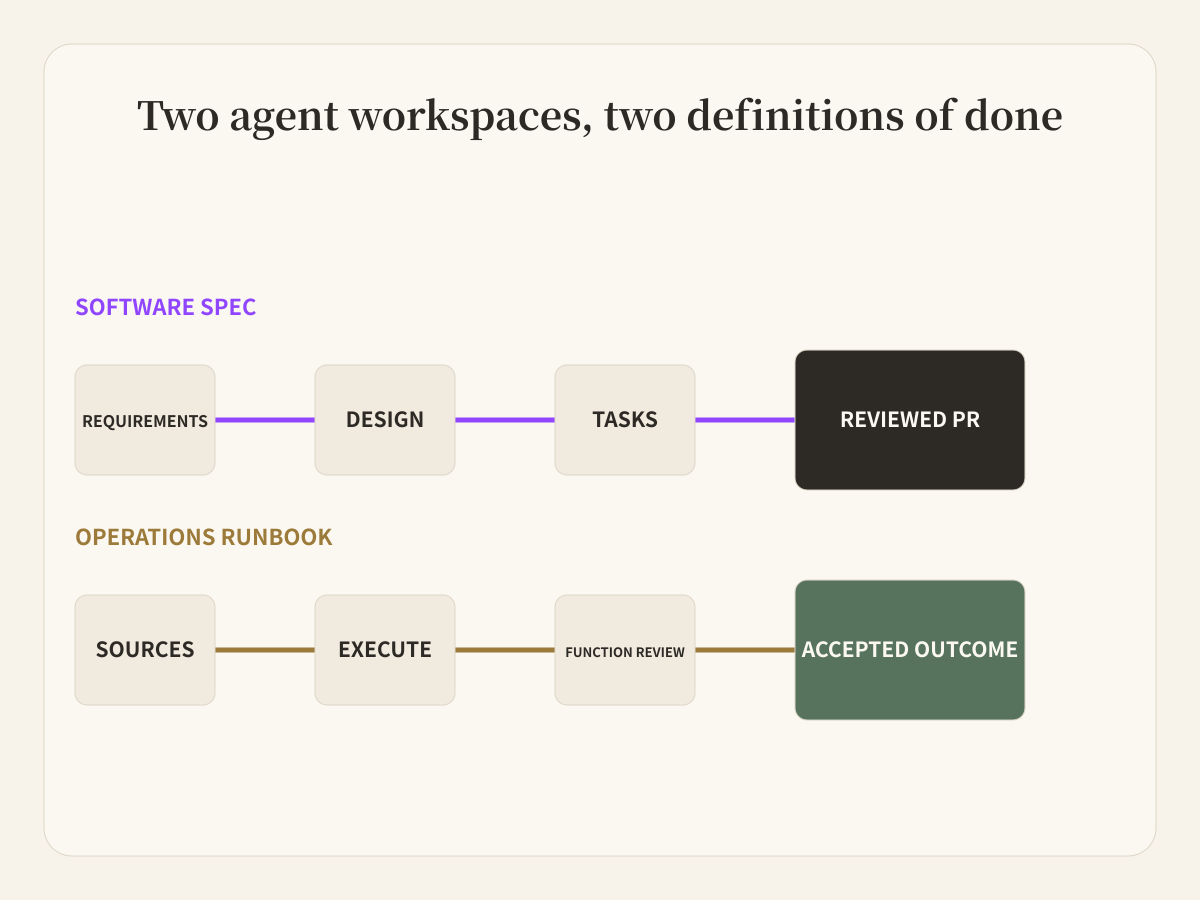
Follow one feature through Kiro
Kiro describes itself as a unified agent harness across IDE, CLI, Web, and Mobile. Project configuration in the repository can carry steering, specs, custom agents, hooks, permissions, MCP servers, and Skills between those surfaces. Its IDE and CLI normally work against a local codebase; Kiro Web and Mobile can use cloud sessions in managed sandboxes.
Kiro Web supports collaborative, Spec, and autonomous modes. It can plan, modify code, and open a pull request or merge request. Kiro explicitly says it does not merge automatically: a person reviews the result before it reaches the default branch.
That is a capable cloud development system. Calling Kiro IDE-only, single-agent, or without human review would be inaccurate.
A Kiro Spec formalizes feature or bug work through three files: requirements, design, and tasks. Requirements capture stories and acceptance criteria. Design records architecture and implementation decisions. Tasks become executable units, including parallel waves when dependencies allow.
This structure answers an engineering question: how does an idea become a change that can be reviewed and merged?
It is strong because the artifacts remain close to the repository. Steering and hooks can enforce project conventions. Permissions gate tool calls. The resulting branch and pull request preserve implementation evidence.
Mark the exact handoff
Now consider a launch after the pull request is accepted. The company still needs to decide:
- which product behavior is safe to announce;
- which screenshots and help articles match production;
- which customers or internal teams need an update;
- which operational check should run tomorrow and next week;
- who accepts each deliverable.
These tasks may use repository evidence, but their primary objects are not requirements.md, design.md, tasks.md, or code. They are briefs, source files, browser findings, approved messages, reports, and scheduled follow-ups.
That is where Buda's Agent Workspace becomes relevant. Each Agent has a persistent Drive and cloud computer with chat, browser, terminal, files, Git, and preview surfaces. Agents can receive work from Channels, use reusable Skills, and run through Automations. The responsible person reviews the visible artifact rather than inheriting an engineering session.
The engineering definition of done might be: tests pass, acceptance criteria are met, review is complete, and the pull request is merged.
The operating definition of done might be: the documentation reflects production, support language is approved, launch assets are verified, the owner accepts the package, and scheduled checks are assigned.
Neither definition should silently absorb the other. When they are separated, developers do not become the approval desk for every business artifact, and non-engineering agents do not receive unnecessary repository authority.
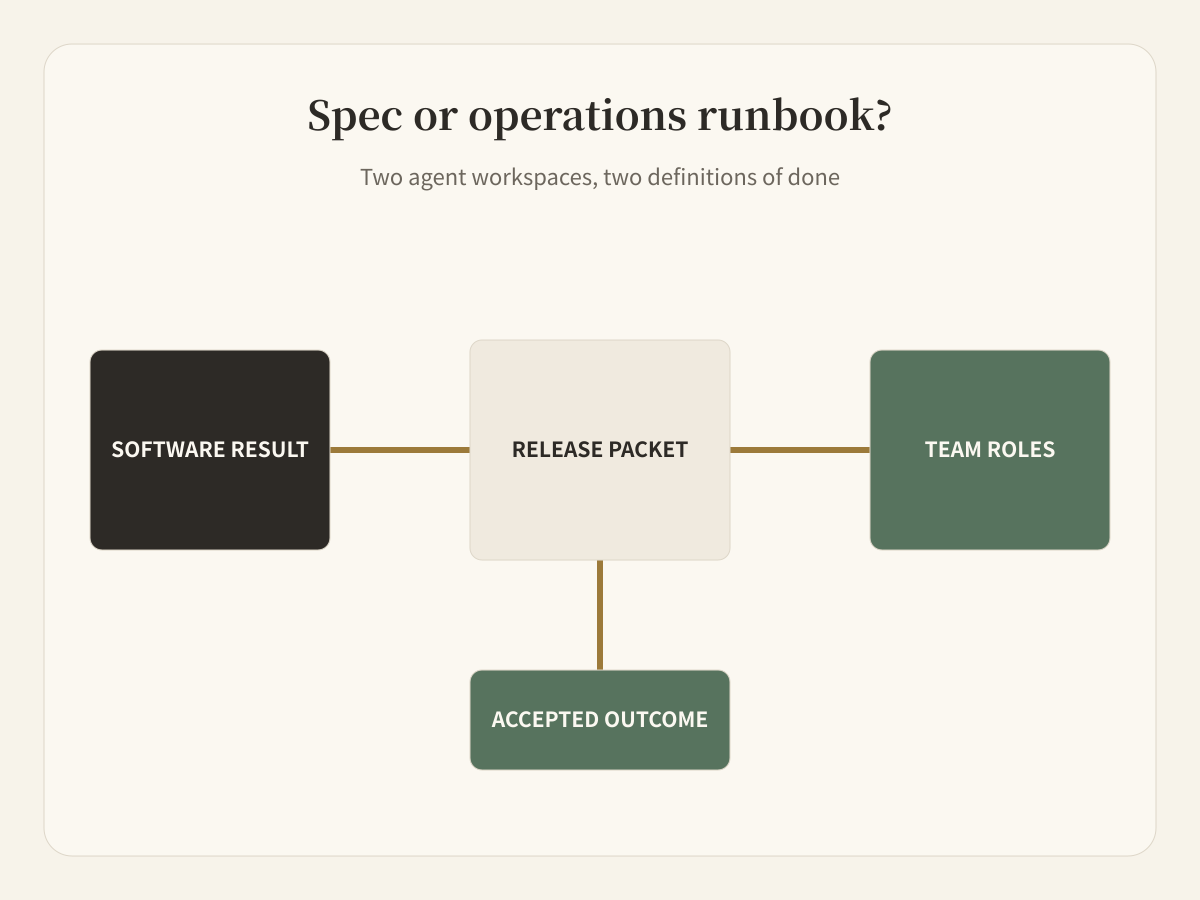
Inspect the release packet field by field
Do not hand Buda an unstructured chat transcript. Export a compact release packet:
- link to the accepted pull request and commit;
- shipped behavior and acceptance evidence;
- known limits and affected audiences;
- approved source screenshots or files;
- downstream owners, review rules, and dates.
Kiro can remain responsible for software evidence. Buda agents can use that evidence to prepare documentation, support material, launch coordination, and scheduled checks. People approve each domain in the system where its artifacts are visible.
Record where every artifact belongs
| Decision | Kiro | Buda |
|---|---|---|
| Primary lifecycle | Idea to reviewed software change | Request to reviewed business outcome |
| Core artifacts | Requirements, design, tasks, branch, PR/MR | Sources, working files, reports, content, operational packages |
| Context anchor | Repository and .kiro/ configuration | Persistent Agent Drive, Sessions, Skills, Space resources |
| Execution surfaces | IDE, CLI, Web, Mobile, local or cloud sandbox | Cloud workspace with browser, terminal, files, Git, Channels |
| Human gate | Tool permissions and review before default-branch merge | Functional review before consequential downstream action |
| Natural owner | Developer or software team | Named owner in product, content, support, operations, or management |
Kiro is the direct fit when Specs, steering, hooks, code intelligence, local or cloud execution, and pull-request delivery are the center of work. It also supports custom agents, sub-agents, MCP, Skills, permissions, and scheduled Web automations. Teams should evaluate its plan availability, repository provider requirements, regional constraints, and the surface-by-surface availability tables in the official docs.
Buda is the better operating home when different agent roles need to persist across days, work with non-code files and websites, receive requests from messaging Channels, and return distinct artifacts to distinct reviewers. The boundary is organizational continuity, not “more autonomy.”
Questions specific to a Kiro rollout
Is Kiro only an IDE coding assistant?
No. Kiro documents one harness across IDE, CLI, Web, and Mobile, plus cloud sessions, custom agents, sub-agents, MCP, Skills, hooks, permissions, and automations.
Does Kiro support cloud agents and human review?
Yes. Kiro Web runs in managed sandboxes and can open pull requests or merge requests. Its documentation says changes are reviewed before reaching the default branch and Kiro does not merge automatically.
Can Kiro handle work beyond coding?
Its agents can search the web, call tools, and automate tasks. The practical decision is whether the accepted output and responsible reviewer live in the software-delivery lifecycle or in another business function.
Do not let “merged” mean “launched”
Start with one release. Let Kiro prove the software change. Let Buda coordinate the operating work that follows. Keep permissions narrow, handoffs explicit, and people accountable for acceptance.
Explore the Buda Agent Workspace