Fable 5.2 API migration: first call, preserved thinking, and session recovery
Check tool changes, compaction, and saved conversations before moving long-running agents.

After Fable 5.2’s release, the first step depends on how you use Claude. In a chat product, you generally select a model in the interface. Connecting it to your own application, script, or Agent means making API requests and having the application manage conversation history and tools.
For developers already using Fable 5.1, the upgrade is attractive: standard API rates are 20% lower, and the publisher reports faster output. The immediate step is to change the request’s model identifier to claude-fable-5-2 and see whether the existing task still completes.
A single question is relatively easy to check. A multi-turn Agent also reads earlier messages, calls tools, and carries reasoning forward into later requests. Fable 5.2 checks the context behind that historical reasoning. If the application changes system instructions, the tool list, or old messages along the way, a later call can return a 400 error.
Acceptance therefore needs to follow the work from a new conversation into real execution: confirm access first, then tool loops, persistence, and restart recovery. Checking each path avoids mistaking one successful call for a working long-running integration.
Confirm access with a fresh conversation
Use a Claude Platform API key with access and store it in ANTHROPIC_API_KEY. API usage belongs to the API account; a chat subscription should not be treated as API credit. Install or update the official Python SDK and set the model and effort explicitly.
import anthropic

client = anthropic.Anthropic()
response = client.messages.create(
    model="claude-fable-5-2",
    max_tokens=4096,
    output_config={"effort": "high"},
    messages=[{
        "role": "user",
        "content": "Explain when a SQL join can duplicate aggregate totals."
    }],
)
for block in response.content:
    if block.type == "text":
        print(block.text)
This illustrates the request structure; the call produces the actual answer. Check the returned model, text blocks, usage, and stop_reason. An output-limit stop requires an adjusted budget or task, rather than an acceptance claim. The example executes no tools or business writes.
The model directory lists claude-fable-5-2 as the Claude API ID. Other providers have their own identifiers, access, and regional conditions. Access on one platform does not establish access on another.
Make effort explicit
The Fable 5.2 API default is High, with adaptive thinking always on. The launch description’s Medium default for Claude apps and Claude Code refers to different entry points. Set the API value explicitly so defaults do not distort a migration comparison.
Effort influences thinking, visible text, and tool calls; it is a behavioral signal rather than a hard budget. max_tokens is the hard output ceiling, including reasoning and answer text. Leave room at High and above, use SDK streaming for long work, and measure the budget. Do not carry forward a thinking-disabled configuration to turn off Fable’s reasoning.
Persist what was sent and returned
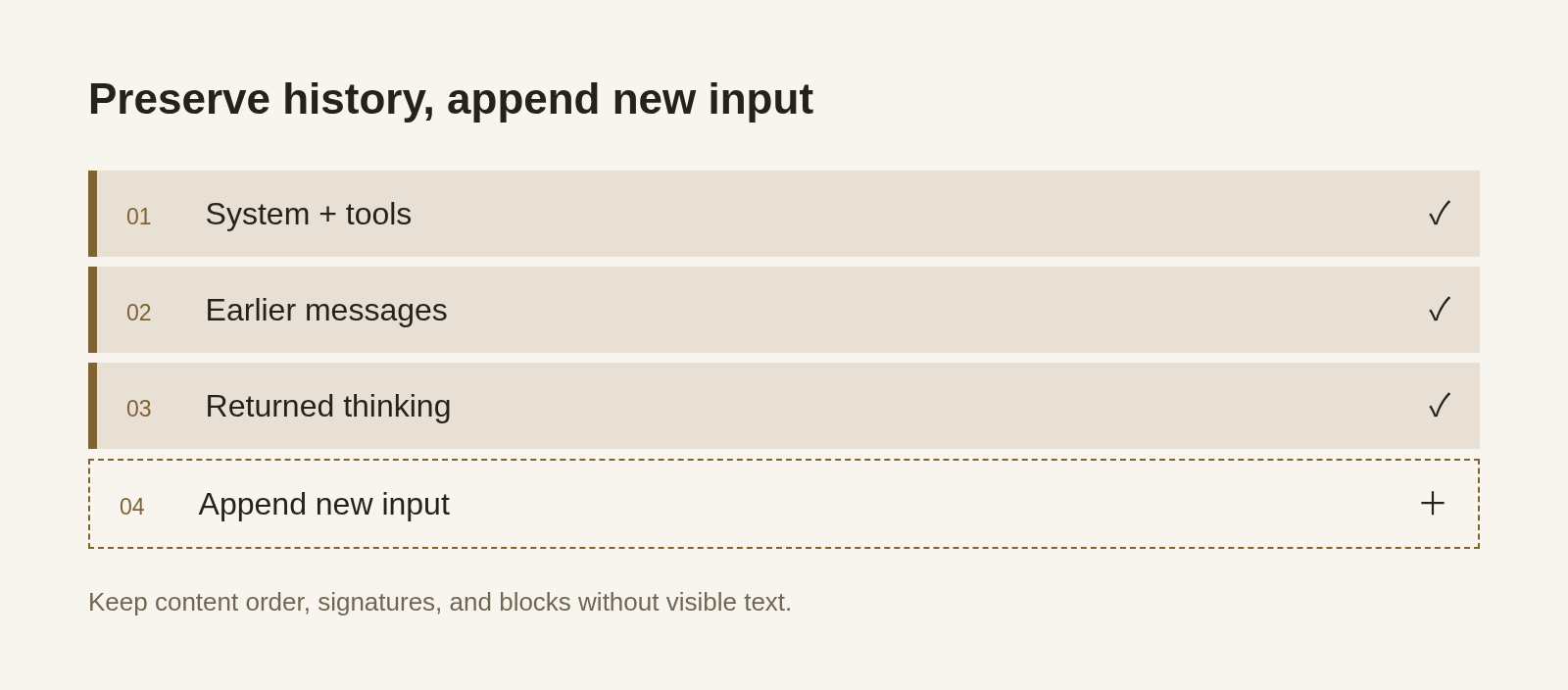
The preserved-thinking documentation requires sending assistant content arrays back as returned, in order, including thinking blocks, signatures, and blocks without visible text. Extracting only text loses reasoning the model could otherwise reuse.
Save the actual rendered system instructions, tool definitions, outgoing messages, and received assistant content. Append the next user message or tool result. Do not regenerate an earlier prefix from a new date, updated template, or current plugin list. On restart, check whether serialization drops empty fields, unknown blocks, or message order.
The checked prefix covers system, tools, and messages before the thinking block. Changing effort is not a thinking-prefix edit, but a top-level effort change restarts prompt caching. Supported per-message effort controls can preserve that cache. Thinking validity and cache reuse are separate checks.
Replace the history edits your harness makes
If each turn rebuilds the system prompt’s time or mode, freeze the initial system and append changes through supported mid-conversation system messages. If a tool connects later, use the supported tool_addition or tool_removal mechanism instead of rewriting the original tools array.
If the client shortens tool results, removes turns, or re-encodes earlier images, control their size before first submission. For later reduction, prefer supported server-side context editing or compaction. A client-written summary changes the history behind retained reasoning; signed thinking cannot simply be attached to the replacement summary as though the original prefix still existed.
Those alternatives have model, provider, and beta requirements. Verify support in the integration you use. For an entirely new task, a fresh conversation is often clearer than rewriting an old one.
Diagnose a 400 before retrying
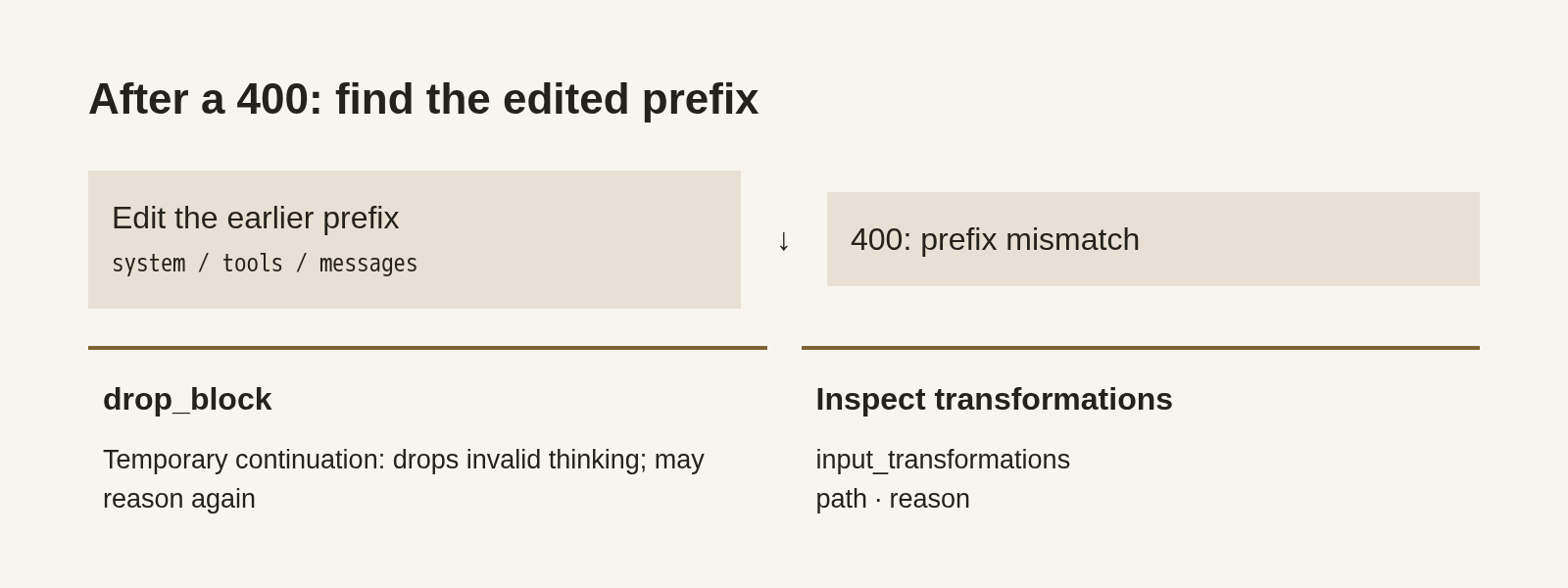
A prefix-mismatch error can say the block is bound to a different conversation. This differs from a tampered or invalid signature. Repeating the same body does not fix either condition.
For a prefix mismatch, the documented temporary drop_block strategy adds the thinking-binding-controls-2026-08-01 beta and sets block_binding.prefix_mismatch_behavior under adaptive thinking. Invalid reasoning and later affected blocks are dropped so the request can continue. Re-created reasoning can increase output tokens and latency.
response = client.beta.messages.create(
    model="claude-fable-5-2",
    max_tokens=16000,
    thinking={
        "type": "adaptive",
        "block_binding": {"prefix_mismatch_behavior": "drop_block"},
    },
    output_config={"effort": "high"},
    messages=messages,
    betas=["thinking-binding-controls-2026-08-01"],
)
print(response.input_transformations)
Here messages is the application’s saved real conversation history. Treat drop_block as a stopgap, not a permanent way to discard thinking every turn. Log transformation paths and reasons, then fix the system, tool, or message edit responsible.
Distinguish switching models from switching accounts
When switching models, keep sending full history. The API drops thinking the new model cannot read, generally without an error. Fable 5.2 thinking is also bound to the generating account; another unlinked account’s use can drop it. A 200 response does not establish that all reasoning survived.
A router or proxy should pass through unknown content blocks, beta headers, and block_binding, and return input_transformations. Avoid silently stripping thinking on retry or moving a mid-conversation system message into the top-level system field. The caller needs visibility into those changes.
Exercise the paths that reach production
Cover ordinary multi-turn work, long tool loops, a tool added mid-session, changed instructions, compaction, a model switch and return, and save/restart/resume. Use the explicit error strategy in tests to expose prefix edits. A session that never produced a thinking block cannot establish that thinking replay passed.
Review business correctness alongside process evidence: actual tool execution, complete history, dropped reasoning, total attempt cost, and elapsed time. Preserve reproducible request differences without logging API keys or private payloads.
You can build a migration-review workflow with Buda to collect sanitized request differences, compatibility checks, and outputs for the owner’s decision. The capability overview explains the release; integration acceptance determines whether long-running work can continue.
Practical questions
Why does the first call work and the second fail?
The first call has no earlier reasoning to validate. Compare system, tools, and shared message history between calls. Actual request values are more useful than a prompt template alone.
Does drop_block preserve the previous reasoning?
No. It removes invalid reasoning so the request can proceed. Inspect transformations and usage, repair the edit, then decide whether the stopgap is still needed.
Is changing the ID enough?
It may be enough for a fresh minimal request. Persistence, tools, compaction, routing, and recovery need their own checks; one successful response does not validate them.