Fable 5.2 vs Opus 5.5: when is the higher-priced model worth it?
Compare accepted results, effort settings, and the cost of reaching a usable answer.

Anthropic released Fable 5.2 on November 9, adding a new Claude model for demanding reasoning and long-running Agent tasks. The same company also offers Opus 5.5, which it still recommends as the starting point for most coding and knowledge work.
For someone already using Claude to write code or analyze information, that creates a practical question: if Opus already handles much of the work, what is Fable for? Should everyday jobs move to it, or should it take over only when a particular task becomes difficult?
Pricing makes the choice more interesting. Fable 5.2’s standard API rates are 20% below its predecessor’s, but still twice Opus 5.5’s input and output rates. Yet selected Anthropic evaluations report that Fable can approach Opus’s best score at a lower cost per task when the reasoning effort differs.
Those numbers describe different things: the price of a call, the computation spent on a task, and the share of results that pass review. Comparing them on the same real work is how to decide when Opus remains enough and when Fable deserves the handoff.
Separate token price from the cost of completion
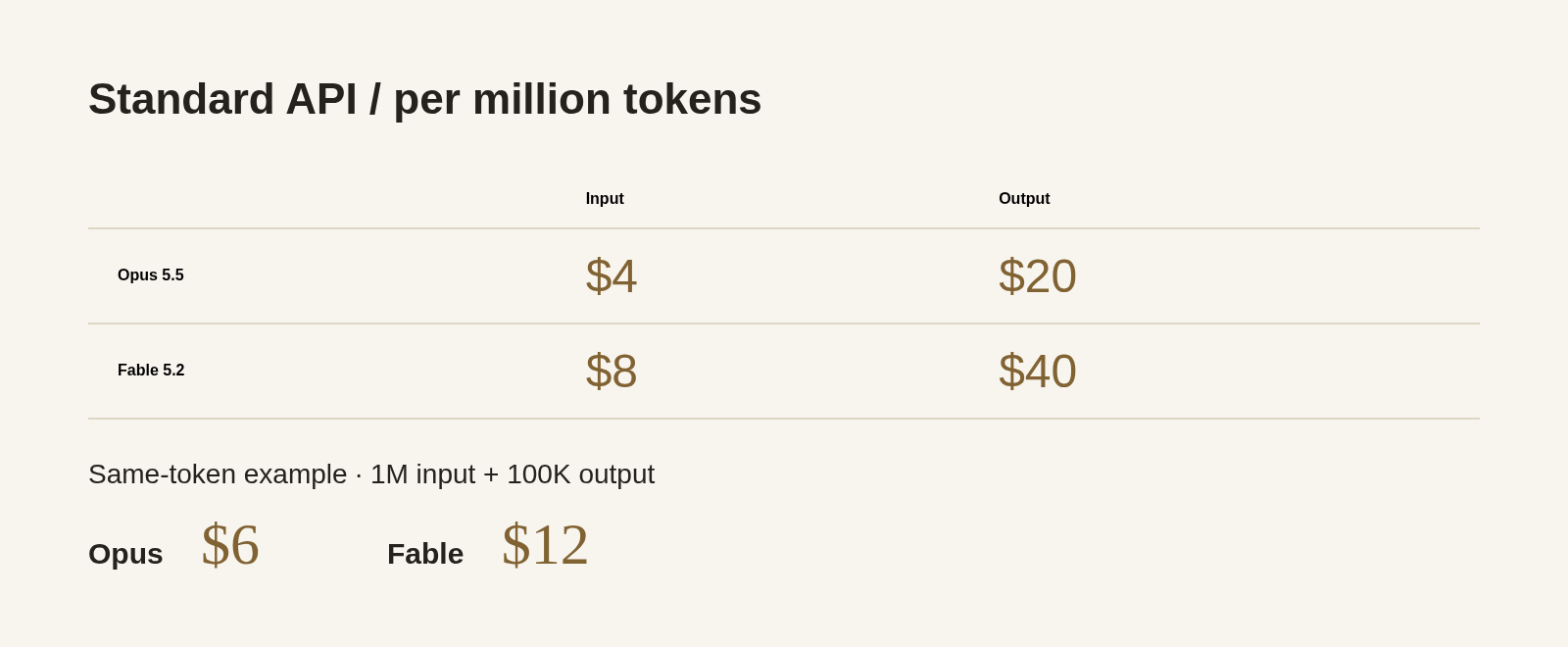
The model directory lists Fable 5.2 at $8 per million input tokens and $40 per million output tokens. Opus 5.5 is $4 and $20. An illustrative one million input tokens plus 100,000 output tokens costs $12 versus $6 before caching, tools, and other charges.
Equal tasks do not necessarily produce equal token use. A rejected patch may trigger diagnosis, another implementation, another test run, and human review. Compare the spend across all attempts with the number of accepted outcomes, then track review time and elapsed time separately. A higher unit price earns its place only when the result changes enough to justify it.
Comparable coding quality can use different effort budgets
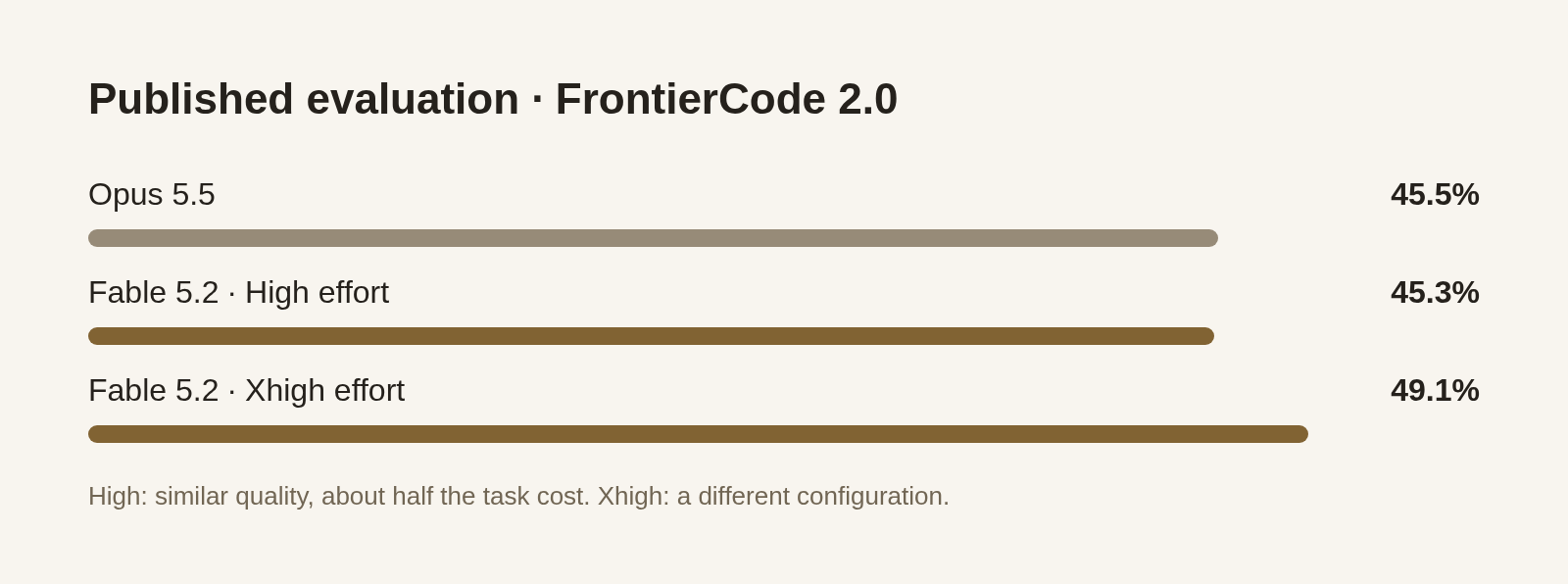
In Anthropic’s release evaluation, FrontierCode 2.0 measures whether code changes would be accepted by open-source maintainers. Fable 5.2 at High scores 45.3%, close to Opus 5.5’s best 45.5%, at roughly half the cost per task in that evaluation. Fable reaches 49.1% at Xhigh.
One setting seeks similar quality for less task spend. Another seeks a higher completion rate with additional computation. Do not attach High’s reported cost advantage to Xhigh’s score. These are publisher results under particular tools and evaluation conditions; reproduce the decision on your workload.
The same release reports a different tradeoff on WANDR: Fable at Medium matches Opus’s best score at about 40% of the task cost. That is a reason to test lower effort, rather than a forecast that every search job will cost 60% less.
Where the extra capability deserves a trial
Look for work whose main loss comes from sustained exploration or difficult judgment. A service migration must preserve behavior and dependencies, not merely translate syntax. Enterprise SQL must preserve aggregation grain, not merely execute without an error.
Oracle’s quoted test found that Fable produced the expected SQL result while two other models produced runnable SQL with totals five to eight times too large. The account does not identify a directly comparable Opus result. It illustrates the importance of business correctness, rather than establishing a head-to-head win over Opus. Useful acceptance checks include join cardinality, aggregation grain, and reconciliation against expected totals.
The Fermat formalization experiment provides a more direct comparison: around 1,000 agents, one run per model, and about 30 hours. Fable completed the formalization; Opus reached about 27%. This demonstrates a frontier research difference, rather than a concurrency level or budget that ordinary teams should copy.
Why Opus remains a sensible starting point
Anthropic still recommends Opus 5.5 for most coding and knowledge work. If requirements are clear and the process reliably meets acceptance criteria, a new model release alone is a weak reason to move everything. Missing access, inadequate source material, and undefined acceptance criteria require their own fixes.
Knowledge-work scores also preserve a real tradeoff. On AA-Briefcase, Fable scores 66.1% against Opus’s 61.2% on the rubric, but their Elo preference scores are 1785 and 1800. Completing a scoring rubric and producing the output readers prefer are different outcomes. Keep actual reader review for customer copy and management reports.
Run a comparison that can explain its result
Choose existing stable jobs and repeatedly failing jobs. Keep inputs, tools, permissions, context, and acceptance conditions the same. Use the current Opus configuration as the baseline and add Fable High; introduce Medium or Xhigh only where useful. Changing the model, instructions, and tools simultaneously makes attribution difficult.
For code, inspect tests, behavioral regressions, and the review decision. For analysis, inspect sources, calculation rules, and unresolved questions. Record acceptance, usage across every attempt, elapsed time, and rejection reasons. Savings on trivial tasks should not conceal failures on consequential ones.
If the advantage concentrates in one stage, upgrade that stage. A routine model can prepare material before Fable handles a bounded difficult question. Model switching still has historical-thinking compatibility rules; preserving the conversation does not guarantee every model can read every earlier thinking block.
Keep the evidence for the next decision
You can build this evaluation workflow with Buda: store identical inputs, both outputs, tests, and review decisions in an Agent’s Drive. Have the Agent organize differences while the accountable owner decides which stages warrant escalation.
The 5.2 upgrade overview covers the release. A lasting operating rule names the task, configuration, escalation trigger, and rejection condition. That is more reusable than choosing the most expensive model by instinct.
Practical questions
Is Fable always more expensive?
At equal standard API token volumes, its rates are twice Opus’s. Task cost depends on actual reasoning, retries, and acceptance. Selected evaluations show the opposite cost outcome, but do not establish a universal saving.
Should every task use max effort?
The effort guide recommends starting Fable’s API at High, trying Xhigh where you measure a gain, and reserving Max for ceiling measurements or rare jobs where time and tokens are secondary. Keep extra computation only when acceptance improves.
Which should write an ordinary report?
Start with Opus and the current acceptance standard. Fix missing information first. Compare Fable on identical material when the failure is a reasoning bottleneck such as contradictory documents or complex calculations.