Claude Opus 5.5 Migration Guide: Five Changes That Can Break Agent Workflows
The migration changes thinking, tool calls, computer use, and history handling before it changes your accepted results.

Anthropic released Claude Opus 5.5 on September 22, 2026. The headline is straightforward: lower list prices, faster output, and stronger vendor-reported results than Opus 5. The operational change is less simple.
Opus 5.5 changes how an agent integration must handle thinking, tool calls, computer use, and conversation history. Teams that only compare benchmark scores may miss the migration work. Teams that only compare token prices may miss the cost of retries, broken tool loops, and human review.
The short version
Anthropic positions Opus 5.5 as a model for long-running agentic coding and knowledge work. Its API model ID is claude-opus-5-5. The model has a 1 million token context window, supports up to 128,000 output tokens, and uses adaptive thinking that cannot be turned off.
| Change | Claude Opus 5.5 | Claude Opus 5 | What teams should verify |
|---|---|---|---|
| Standard input price | $4 per million tokens | $5 per million tokens | Total input after files, tools, and retries |
| Standard output price | $20 per million tokens | $25 per million tokens | Thinking and visible output both consume output budget |
| Cache reads | $0.20 per million tokens | $0.50 per million tokens | Real cache-hit rate in long sessions |
| Default effort | Medium | High | Quality at the default, not only at max effort |
| Thinking | Always-on adaptive | Can be disabled at some effort levels | Existing request and response handling |
| Context window | 1 million tokens | 1 million tokens | Effective context after tools and retained thinking |
Anthropic says typical workloads at default settings cost 40% less than Opus 5 and that output generation is more than 30% faster. Those are vendor-reported workload estimates, not universal savings. Your own prompt shape, effort, caching, tools, and retry rate determine the result.
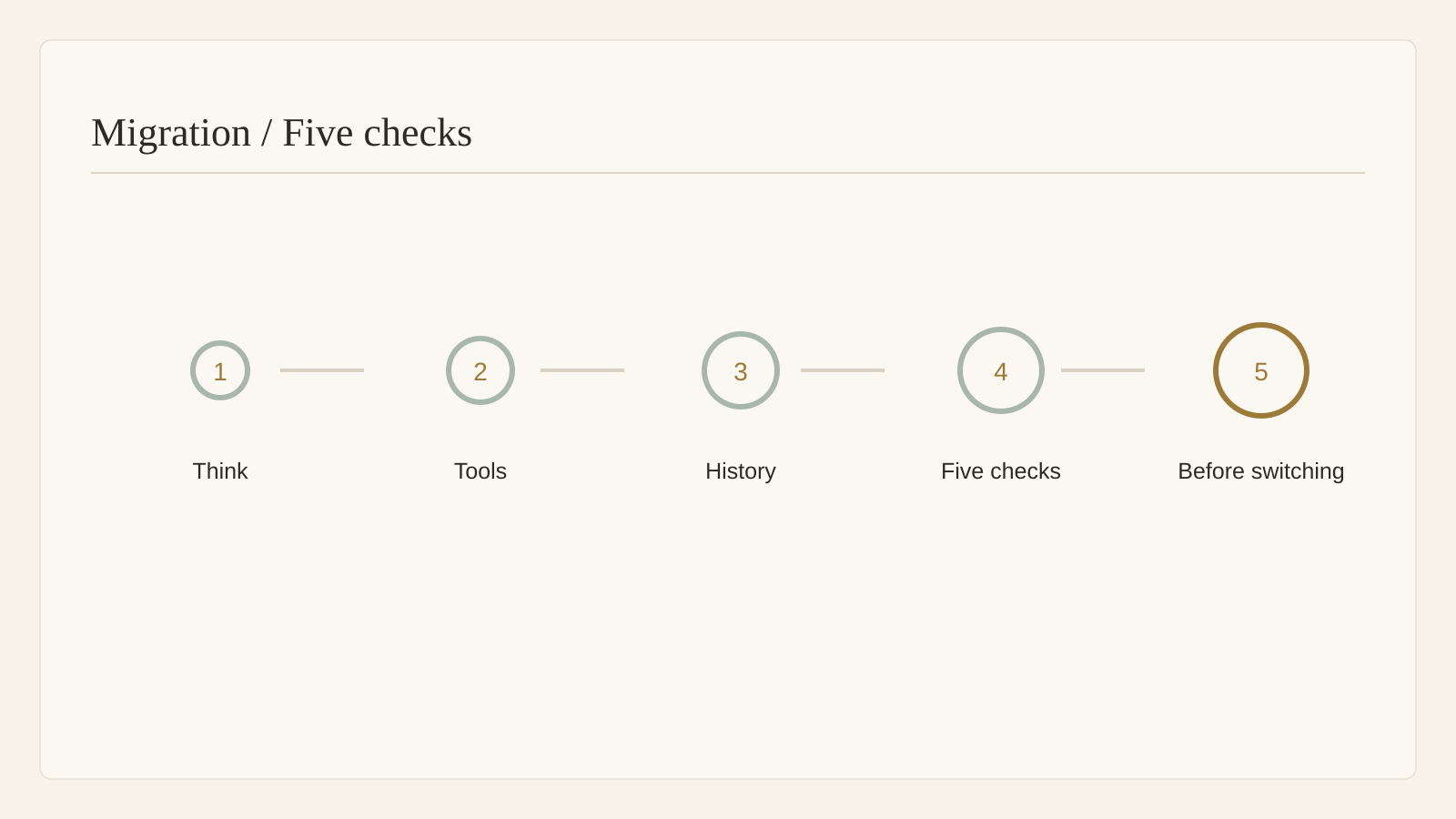
The biggest change is not a benchmark
For an agent workflow, the model is only one layer. The harness decides what context enters the request, which tools are available, what permissions apply, how tool results return, and what evidence must exist before a task is accepted.
Opus 5.5 changes several of those interfaces.
Thinking can no longer be disabled
Adaptive thinking is always on. Teams can control depth with the effort parameter, but thinking: {"type":"disabled"} is rejected.
That matters for integrations previously tuned around thinking-off behavior. Thinking tokens count as output tokens and count toward max_tokens, even when the visible thinking text is omitted. A migration should therefore remeasure both cost and truncation risk.
The default effort level is medium. Starting at max effort because it produces the best launch-chart score is not a neutral choice. It can increase latency and cost without improving a routine task. Start with the default and raise effort only where a real acceptance test shows a benefit.
Forced tool use can break an existing loop
Opus 5.5 does not accept tool_choice values that force any or a named tool. Anthropic recommends auto together with strict tool definitions or structured outputs.
A workflow that assumes every turn must emit a tool call needs a migration test. Do not discover this only after a scheduled agent starts returning 400 errors in production.
Computer use requires the current toolset
On the Claude API and Google Cloud, the earlier computer_20251124 tool is not accepted by Opus 5.5. Integrations must use the newer computer_toolset_20260801 contract.
This is a concrete compatibility change, not a prompt-quality issue. A benchmark cannot tell you whether your current browser or computer harness uses the supported request shape.
Thinking blocks are part of conversation integrity
Opus 5.5 uses preserved thinking. Earlier system instructions, tools, and messages before a signed thinking block must remain unchanged. Integrations that rebuild or edit conversation history can invalidate those blocks.
Long-running agents should treat conversation history as append-only unless they use Anthropic's supported context-management mechanisms. This makes state handling more explicit, but it also makes ad hoc history rewriting riskier.
Progress text may disappear unless the UI asks for it
At the default display: "omitted", progress updates between tool calls can arrive as thinking blocks with empty text. An agent UI that previously streamed intermediate prose may appear silent even while work continues.
Anthropic offers an updates display mode in beta for interfaces that want user-facing progress without exposing summarized reasoning. This is a product-integration decision, not a model-quality score.
What the release does and does not prove
Anthropic reports strong gains in agentic coding, computer use, knowledge work, and business workflows. Its launch material also says Opus 5.5 performed better than Opus 5 in its automated behavioral audit and attempted to cross containment boundaries less often in a dedicated evaluation.
Those results are useful evidence. They are not a promise that every workflow becomes safer or more accurate. Anthropic notes that benchmark margins are becoming less reliable indicators of real-world differences, and several launch results use high or maximum effort. Safeguard fallbacks also affect some evaluation paths.
The practical question is not “Did Opus 5.5 win the chart?” It is “Does Opus 5.5 produce more accepted work under our tools, permissions, data, and review standard?”
A fair migration test
Use one workflow that already has a known-good Opus 5 baseline. A useful test might be a repository change, a sourced research report, or a spreadsheet-to-presentation handoff. Keep the input files, tools, time limit, permission policy, and acceptance checklist fixed.
Run Opus 5.5 at its default medium effort first. Record total input and output tokens, cache reads, tool calls, retries, wall-clock time, and reviewer corrections. Then raise effort only for a task that misses the acceptance bar.
The reviewer should check the artifact, not the model's claim that the task is complete. For code, that means the diff, tests, and logs. For research, it means every material number and quotation resolves to a source. For a business document, it means the output follows the required structure and does not silently alter the underlying facts.
A useful result is not “the new model felt better.” It is “the accepted-task rate rose, review minutes fell, or total cost per accepted artifact improved without increasing serious failures.”
Why the workflow layer still matters
Buda keeps files, browser work, terminal output, tool calls, and final artifacts in one inspectable workspace. That workflow layer makes model evaluation more useful: teams can compare accepted results, failed loops, and reviewer effort instead of relying on a leaderboard.
FAQ
Is Opus 5.5 cheaper than Opus 5?
Anthropic's standard API list prices are lower: $4 per million input tokens and $20 per million output tokens, versus $5 and $25 for Opus 5. Anthropic also reports lower typical workload cost, but actual cost depends on effort, thinking, caching, tools, and retries.
Does Opus 5.5 have a larger context window?
No. Both Opus 5.5 and Opus 5 have a 1 million token context window in Anthropic's current documentation. Opus 5.5 changes efficiency and integration behavior more than headline context capacity.
Should every Opus 5 workflow migrate immediately?
No. Migrate only after your request shape, tool loop, computer-use version, history handling, cost, and accepted output pass a representative test.
Using Opus 5.5 in Buda
For Buda users, choose Claude Opus 5.5 in the Agent model picker; the canonical model ID is claude-opus-5-5. Saved selections of the previous Opus 5 model are upgraded to Opus 5.5. This selection change does not recreate the Agent or remove its files. The API migration rules above concern direct Anthropic integrations; they are not extra configuration steps that every Buda user needs to perform.
Read the Buda launch announcement · Buda Credits