Claude Opus 5.5 Pricing: Why $4/$20 Is Not the Cost of an Agent Task
Token prices are only one layer; effort, cache, retries, tools, and review determine the cost of completed work.

Claude Opus 5.5 Pricing: Why $4/$20 Is Not the Cost of an Agent Task
Anthropic lists Claude Opus 5.5 at $4 per million input tokens and $20 per million output tokens. Cache reads cost $0.20 per million tokens, five-minute cache writes cost $5, and one-hour cache writes cost $8. Those numbers are useful, but they do not answer the question most teams actually have: what will one completed Agent task cost?
A token rate is a meter. A finished task is a system. The system includes the prompt and retrieved context, hidden and visible reasoning, tool calls, retries, cache behavior, any applicable tool or regional charges, and the time a person spends reviewing the result. A model with a higher nominal rate can be cheaper if it finishes in fewer loops. A cheaper call can become expensive if the Agent repeatedly loses context or produces work that must be redone.
Start with the published rates, not a headline percentage
Anthropic says Opus 5.5 costs 40% less than Opus 5 on typical workloads at default settings, generates output more than 30% faster, and charges 20% less per input and output token. The 40% figure is not the same as the 20% rate reduction. Anthropic attributes the larger saving to fewer tokens and steps in its own tests. That is a vendor result, not a guarantee for every repository, research task, or tool harness.
Fast mode is a separate choice. Anthropic lists it at $8 per million input tokens and $40 per million output tokens for up to 2.5x speed. Batch processing discounts input and output by 50%. Neither option is automatically better: Fast mode buys latency, while Batch buys lower rates for work that can wait.
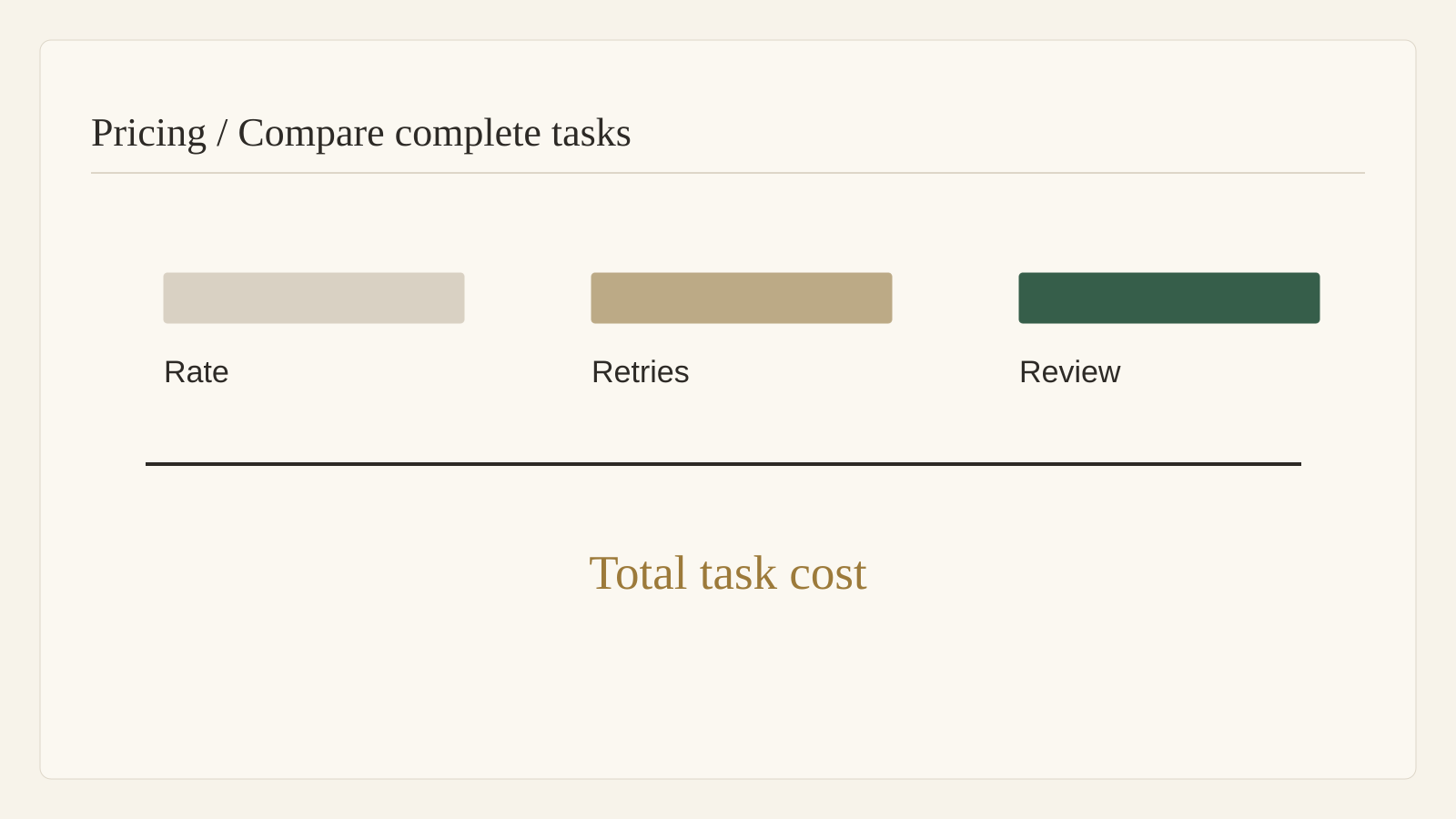
Five layers determine the cost of completed work
Input composition. A request can include system instructions, conversation history, retrieved documents, screenshots, tool schemas, and prior tool results. A 1M context window is capacity, not a reason to fill every request.
Output and thinking. Adaptive thinking is always on for Opus 5.5. Effort is the control. The default is medium, so teams should test low, medium, and higher settings against one acceptance rubric instead of assuming the maximum setting is always economical.
Cache design. Agentic coding often reuses stable instructions, repository context, and tool definitions. Anthropic says cache reads make up much of coding and Agent workload cost. A useful cache boundary can matter more than a small prompt edit; a bad boundary can cause the same context to be written repeatedly.
Loops and tools. A task can call shell, browser, search, computer-use, or third-party APIs many times. Provider token pricing does not include every external tool fee, sandbox minute, or paid API call. Count them separately.
Review and rework. A result that looks complete but fails tests or cites the wrong evidence has not reduced cost. Human review is part of the task economics, especially for production changes, financial decisions, and external communication.
Measure cost per accepted result
Use a fixed task set that reflects real work: one code migration, one investigation, one document-heavy analysis, and one cross-application workflow. Give each run the same files, permissions, tools, and acceptance criteria. Record input, cached input, output, calls, elapsed time, retries, test results, reviewer minutes, and whether the first submitted result was accepted.
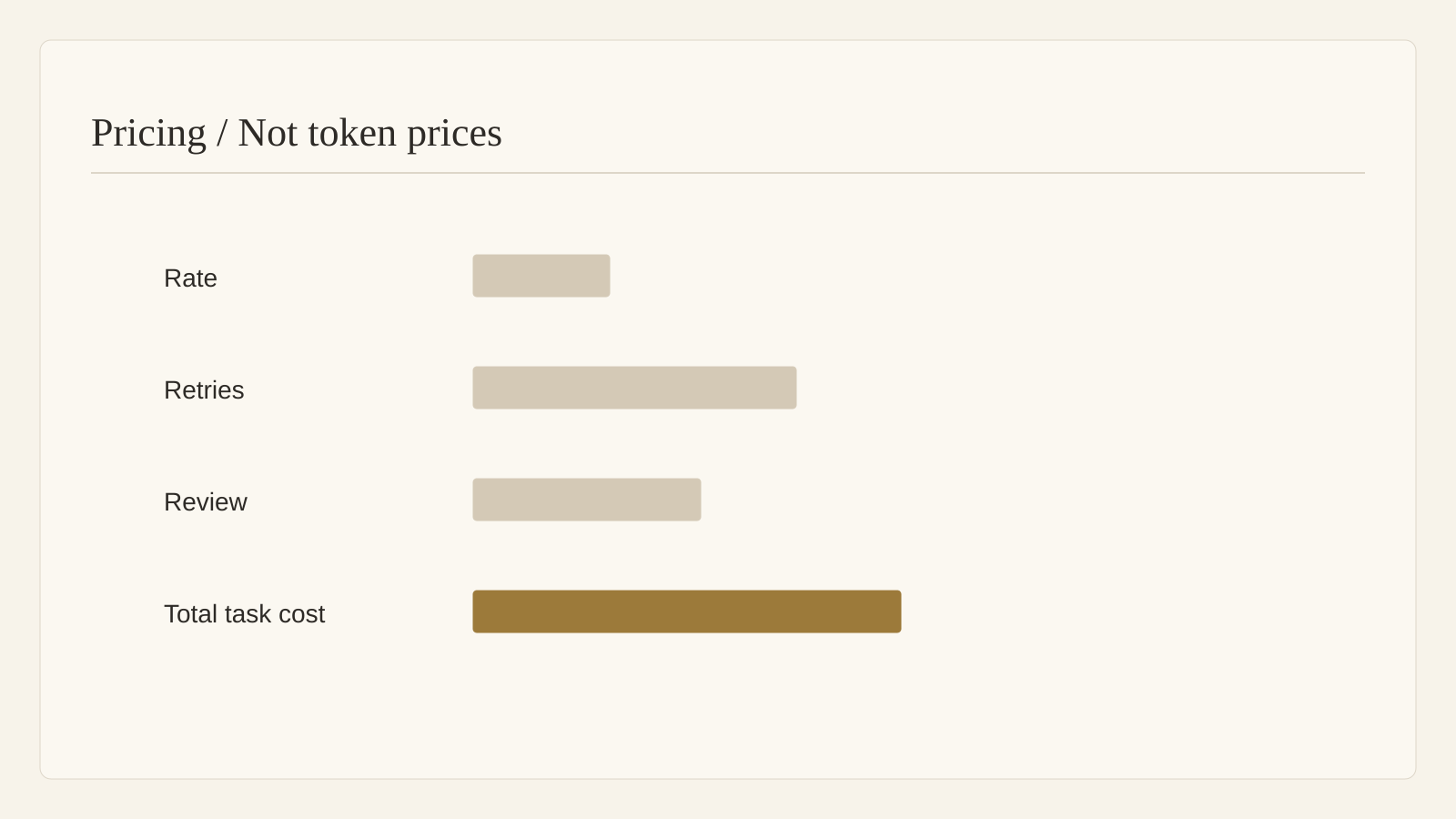
Then compare cost per accepted result, not cost per request. A practical denominator is the number of tasks that pass all required checks without hidden repair work. This also prevents a fast but incomplete run from looking efficient.
What this means for Buda
The dollar rates above are Anthropic API list prices. Use them as one input to a completed-task cost model, alongside tool fees, retries, elapsed time, and reviewer effort.
The useful Buda test is whether an Agent can finish the same observable workflow with fewer failed loops and less review. Buda can hold the files, tools, browser work, terminal output, and artifacts in one workspace so the comparison is based on completed work rather than model marketing.
A purchasing rule that survives price changes
Use low or medium effort for repeatable work whose acceptance tests are strong. Raise effort when the cost of a wrong answer or another failed loop is larger than the additional reasoning cost. Use caching when stable context genuinely repeats. Use Fast mode only when latency changes the business result. Re-run the scorecard whenever prompts, tools, retrieval, or the model version changes.
The durable metric is simple: total cost divided by accepted outcomes. Everything else is an input to that number.
A worked estimate, with the assumptions visible
Consider a hypothetical task with 600,000 uncached input tokens, 200,000 cached reads and 80,000 output tokens across all its attempts. At the standard Opus 5.5 rates listed above, the model portion would be $2.40 + $0.04 + $1.60 = $4.04. This is an illustration, not a measured Buda bill: it excludes cache writes, external APIs, any regional or tool charges, and review. Anthropic lists the full 1M context window for Opus 5.5 at standard token rates; this example does not assume a long-context surcharge. If two attempts are needed to obtain one accepted artifact, count both attempts in the numerator. If the numbers are recorded per request instead of across the entire task, the estimate will undercount.
Use this example as a worksheet rather than a forecast. Replace each component with the provider usage returned by the real task, check whether cached tokens were writes or reads, and keep paid tools and reviewer minutes separate. Also log the first-pass acceptance rate: a modest saving on one call means little when a task needs another full review cycle.
Buda Credits and access
Claude Opus 5.5 is available to Spaces with an active paid subscription. Purchasing extra Credits alone does not unlock this subscription model.
Buda displays a 1.3× multiplier relative to Claude Sonnet 5 at 1.0×. This is not a fixed charge per task: actual Credits depend on input, output, caching, tool calls, and minimum-charge rules. Anthropic API dollar prices are a separate pricing system.
Read the Buda launch announcement · Buda Credits