Claude Sonnet 5.5: Faster Everyday Work, with Opus for Sustained Judgment
Choose by task boundaries, iteration time, and accepted results—not a single benchmark ranking.

Claude Sonnet 5.5: Faster Everyday Work, with Opus for Sustained Judgment
Claude Sonnet 5.5 changes the case for a everyday work model. Anthropic’s September 28, 2026 release describes output generation more than 30% faster than Sonnet 5 and up to 30% lower cost per task in its tests. The API token prices have not fallen. The proposed benefit comes from doing the work with fewer tokens and less waiting.
That distinction matters for anyone choosing an Agent model. A bounded bug fix, a slide deck from approved materials, and an unresolved strategic question are different jobs. Sonnet 5.5 is presented as the faster complement to Opus 5.5, not a universal replacement for it. Start by defining the decision the model is allowed to make and the evidence a reviewer will accept.
A speed improvement matters most inside an iteration loop
Consider a weekly operating review. The input is a fixed set of approved financial tables and meeting notes; the output is a ten-slide draft following an existing template. The reviewer checks that every number matches its source, the narrative explains the changes, and no unresolved forecast becomes an asserted fact. Faster generation can shorten the wait between corrections without changing those acceptance rules.
Anthropic reports an internal experiment using a public company’s earnings materials, transcripts, and a slide template. Two experts judged the first ten-slide draft ready to send. That is a vendor-reported test, not a guarantee for every company’s deck. Use it to design a trial with your own materials and reviewers, rather than treating visual polish as evidence of factual accuracy.
Lower task cost does not mean a lower token price
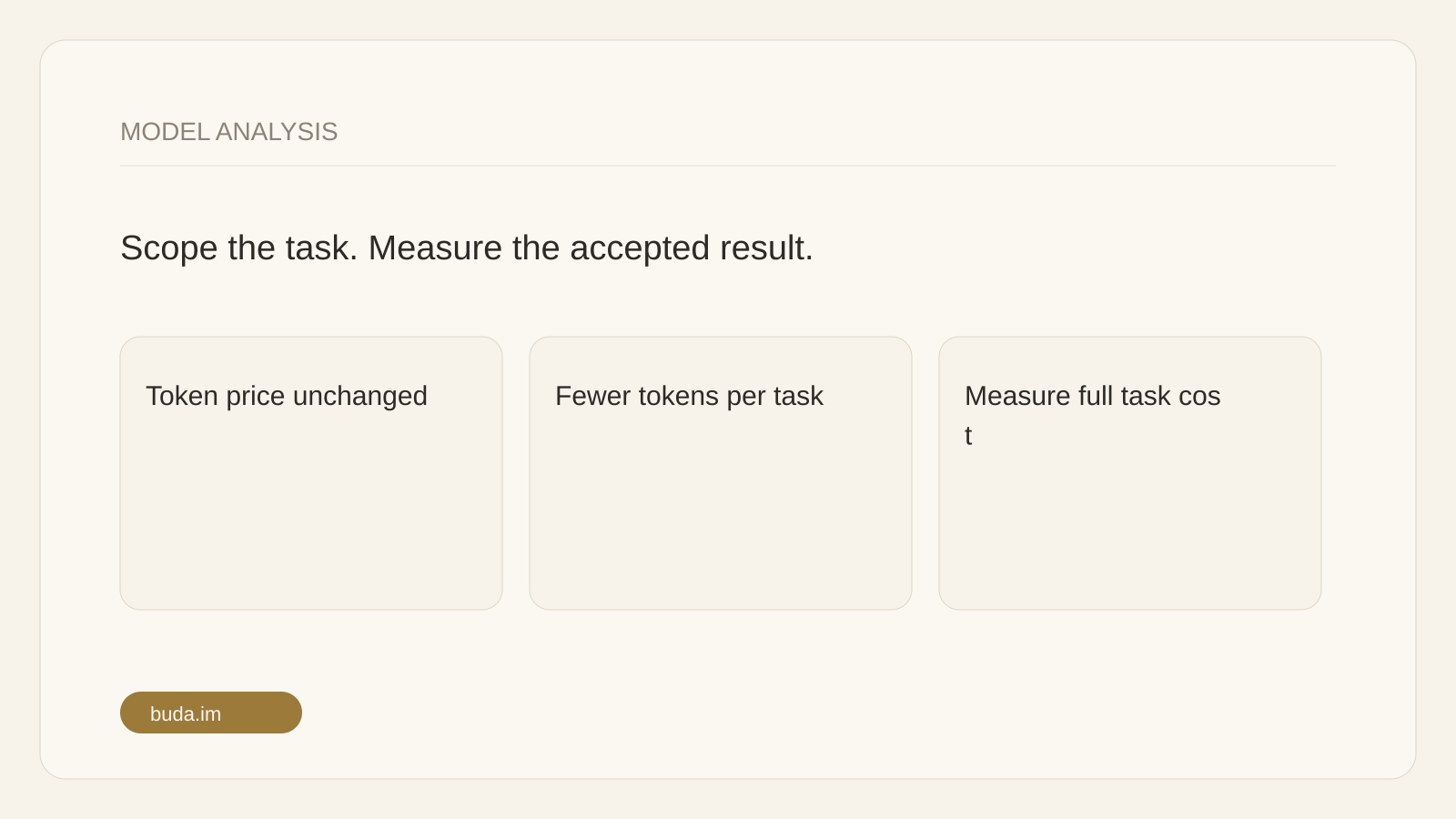
Anthropic lists Sonnet 5.5 at the same API rates as Sonnet 5: $2 per million input tokens, $10 per million output tokens, and $0.20 per million cache-read tokens. Its claim of up to 30% lower task cost is based on fewer tokens needed to complete work in its testing. It is a task-level observation with a ceiling, not a new price sheet or a promise of a 30% saving on every run.
A useful trial records input and output volume, tool calls, retries, total time, and reviewer corrections. Divide the full cost by accepted deliverables, not by started attempts. If an inexpensive draft takes three corrections and another model produces an acceptable result in one pass, the per-attempt comparison misses the actual decision. These upstream API rates do not establish Buda Credits or a Buda subscription price.
Use the scope of judgment to divide Sonnet and Opus work
A bounded task already has a destination: fix a reproducible bug without changing the public interface; turn approved data into a table; prepare a presentation against a supplied outline. The model can work quickly while a reviewer checks explicit tests. That is the strongest starting point for Sonnet 5.5.
A more open-ended task requires choosing the destination as well as executing it: resolve conflicting product evidence, decide between architectural approaches with unclear requirements, or build an argument across incomplete sources. Anthropic says Opus 5.5 remains stronger at complex, open-ended work requiring sustained judgment. A practical division is to settle ambiguous requirements and risk with the stronger reasoning path, then test bounded execution separately. This is a workflow recommendation, not a claim that either product automatically routes work this way.
Effort settings can change the comparison
The release shows accuracy-versus-cost curves at different effort levels. Sonnet 5.5 at lower effort often improves substantially on Sonnet 5; at higher effort it can approach Opus on some evaluations at similar task cost. Therefore, “Sonnet is cheaper” is not an adequate routing rule without an effort setting and quality threshold.
Anthropic’s defaults are Medium in Claude apps and Claude Code, and High on the Claude Platform. Those are upstream defaults, not a statement about settings exposed in Buda. The FrontierCode footnote is especially instructive: Sonnet’s Max score falls below Xhigh because some runs invoked additional review subagents, timed out, or made out-of-scope edits. More reasoning is not automatically better when the acceptance contract rewards a narrow, mergeable change.
A safer model still needs a task boundary
The System Card reports pre-deployment capability and risk evaluations; it is not a review of a company’s complete automation. Anthropic describes improved or matched alignment measures and acknowledges that evaluations cannot reveal every failure. Sonnet 5.5 also launches with cyber safeguards and fallbacks for high-risk requests, while routine software work remains supported.
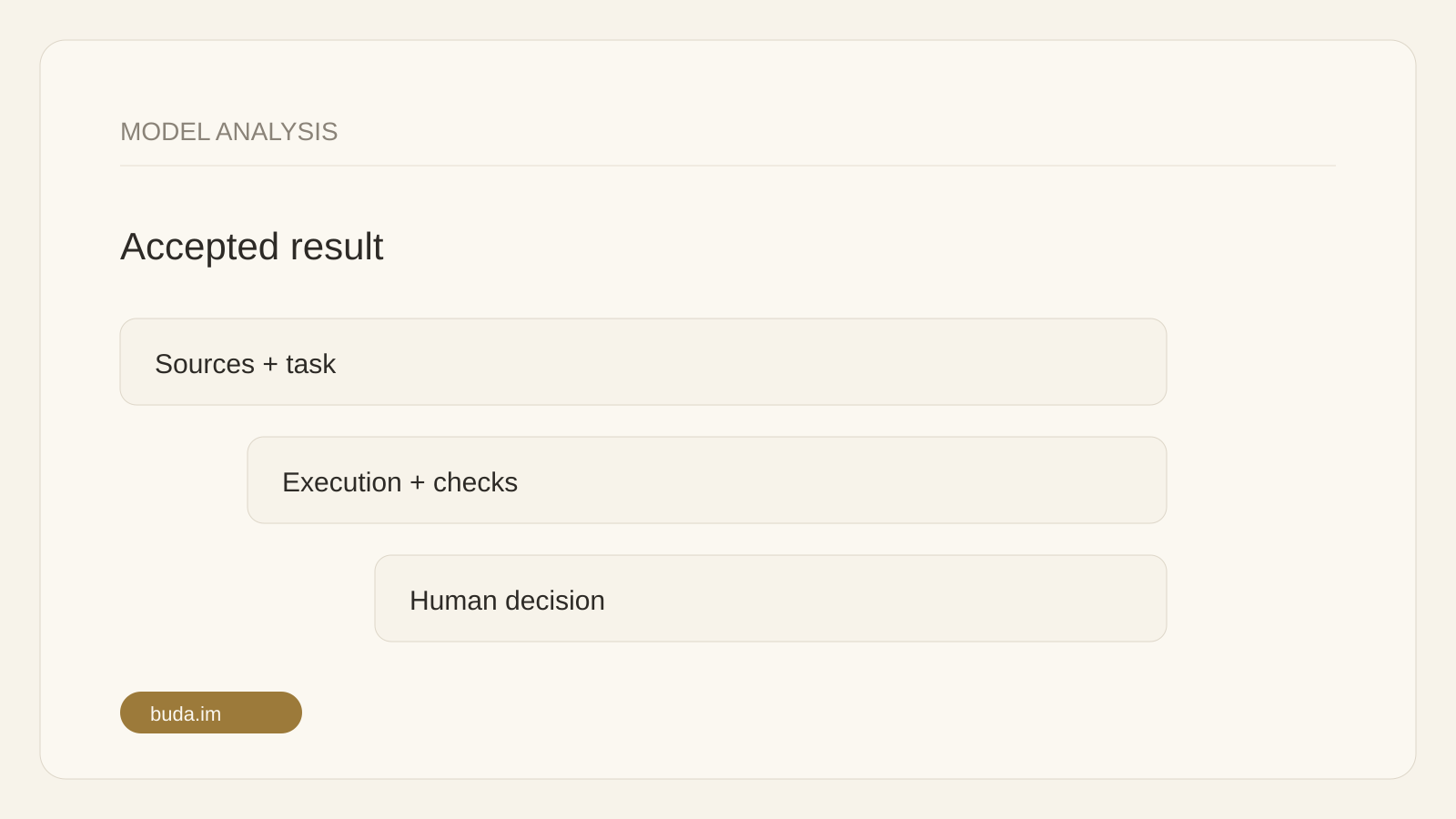
Keep the operational checks concrete. For a spreadsheet, reconcile totals and source cells. For code, inspect the diff and run the agreed tests. For a customer-facing draft, check claims before sending. Separate a model completing a draft from a person approving an external action. Faster output makes this separation more important, because a wrong result can travel through a workflow faster too.
Run a small selection test before changing the whole workflow
Choose three recurring tasks with stable inputs and an explicit acceptance checklist. Hold the instructions, permitted tools, source materials, and reviewer constant. Record time to accepted result, attempts, corrections, and the failure that would trigger escalation. Do not invent gains in advance; this is a test plan, not a measured Buda benchmark.
In a persistent Agent workspace, save the brief, evidence, and reviewer notes alongside the deliverable so a later session can inspect what happened. Buda provides files, terminal, browser, and Git in the Agent workspace. Those surfaces help organize the experiment; model selection should still follow observed results. For a reusable process, search and install a suitable Skill in Buda AI’s Marketplace, then add the team’s acceptance checklist. Keep model-release claims separate from the workflow’s actual outcome.
FAQ
Is Sonnet 5.5 cheaper per token than Sonnet 5?
No. Anthropic states the same API token prices. Its lower-cost claim concerns fewer tokens per task in its tests, with savings up to 30% rather than a fixed discount.
Should every Opus task move to Sonnet?
No. Use bounded everyday tasks as the first trial. Anthropic continues to position Opus 5.5 for complex, open-ended work requiring sustained judgment. Validate accepted-result cost and review effort for each task class.
Does a strong benchmark score eliminate human review?
No. Benchmarks test defined setups. A reviewer still checks source fidelity, scope, permissions, and the consequences of external actions.
What should be saved from a trial?
Save inputs, instructions, effort configuration when available, tool permissions, outputs, corrections, timing, and acceptance decisions. A final artifact without the record of how it was accepted is a weak basis for future routing.