Sonnet 5.5 can turn earnings materials into slides. How should teams review the files?
Use source, calculation, and narrative gates to decide whether a polished deliverable is ready for business use.

Anthropic describes an internal Sonnet 5.5 test that supplied a public company's quarterly earnings materials, call transcripts, and a slide template. The assignment was a ten-slide operating review. Two experts judged the first draft ready to send.
The deliverable was a working file, not just a chat answer. For teams, the next question is who checks the numbers, interpretations, and proposed actions after the deck opens and looks polished. The workflow below is a recommended acceptance design, not a reproduction of the experiment or a Buda measurement.
Commission three artifacts, not just a deck
Ask for an evidence ledger, a working spreadsheet, and the presentation. The ledger links material facts to a file, page or passage, reporting period, unit, and source wording. The spreadsheet preserves calculations and original values. The deck communicates the conclusion.
Without the first two, reviewers must reverse-engineer every number. Traceable artifacts reduce that burden and make next quarter's work easier to repeat.
Define the input boundary: quarter, currency, consolidation scope, template, permission to search, treatment of missing data, and which statements must remain recommendations rather than management commitments. Set this before production begins.
Gate one: identify facts and interpretations
Check every fact that changes the business conclusion, not only the opening slide. Revenue, profit, customer counts, strategic changes, and management commitments should point to a specific source location.
Label source statements, model inferences, and proposed actions separately. A statement that management expects demand to improve is not the same as an inference that stronger demand will offset higher costs. A citation to the first does not substantiate the second automatically.
If materials do not answer a question, record the gap. When supplemental search is allowed, preserve the new source and date; when it is not, do not fill current facts from training memory. Anthropic's prompting guide recommends searching for specifics that may have changed.
Gate two: inspect the calculation chain
Consider an illustrative—not real-company—example: revenue moves from 100 to 120, a 20% increase. Gross margin moves from 25% to 28%, a three-percentage-point change, not 3%. Deck values should come from the same working table instead of being retyped independently.
Check periods, currency, thousands versus millions, missing values treated as zero, and formulas covering newly added rows. Recompute material totals and ratios; inspect denominators, hidden filters, and excluded observations.
Open an Excel deliverable and recalculate it, checking formulas and references rather than cached display values alone. A CSV normally carries no recomputable formula model, so accompany it with calculation code or a method note. Independent checks on critical numbers are stronger than asking the same agent for verbal reassurance.
Gate three: align the story with the spreadsheet
A slide titled “Growth is improving” can contain correct arithmetic while concealing a low base or one-off revenue. Review titles, chart scales, negative trends, and the transition from evidence to suggested action.
Ask each slide to answer one question with one judgment and its evidence. Do not invent unsupported conclusions to reach ten slides. Identify unresolved decisions and alternatives rather than writing recommendations as approved plans.
Open the deck in the actual presentation environment. Font substitution, cropped charts, overflow, template errors, exposed notes, and confidential details are delivery failures too. Correct but unreadable numbers do not finish the job.
Work through one operating review across three files
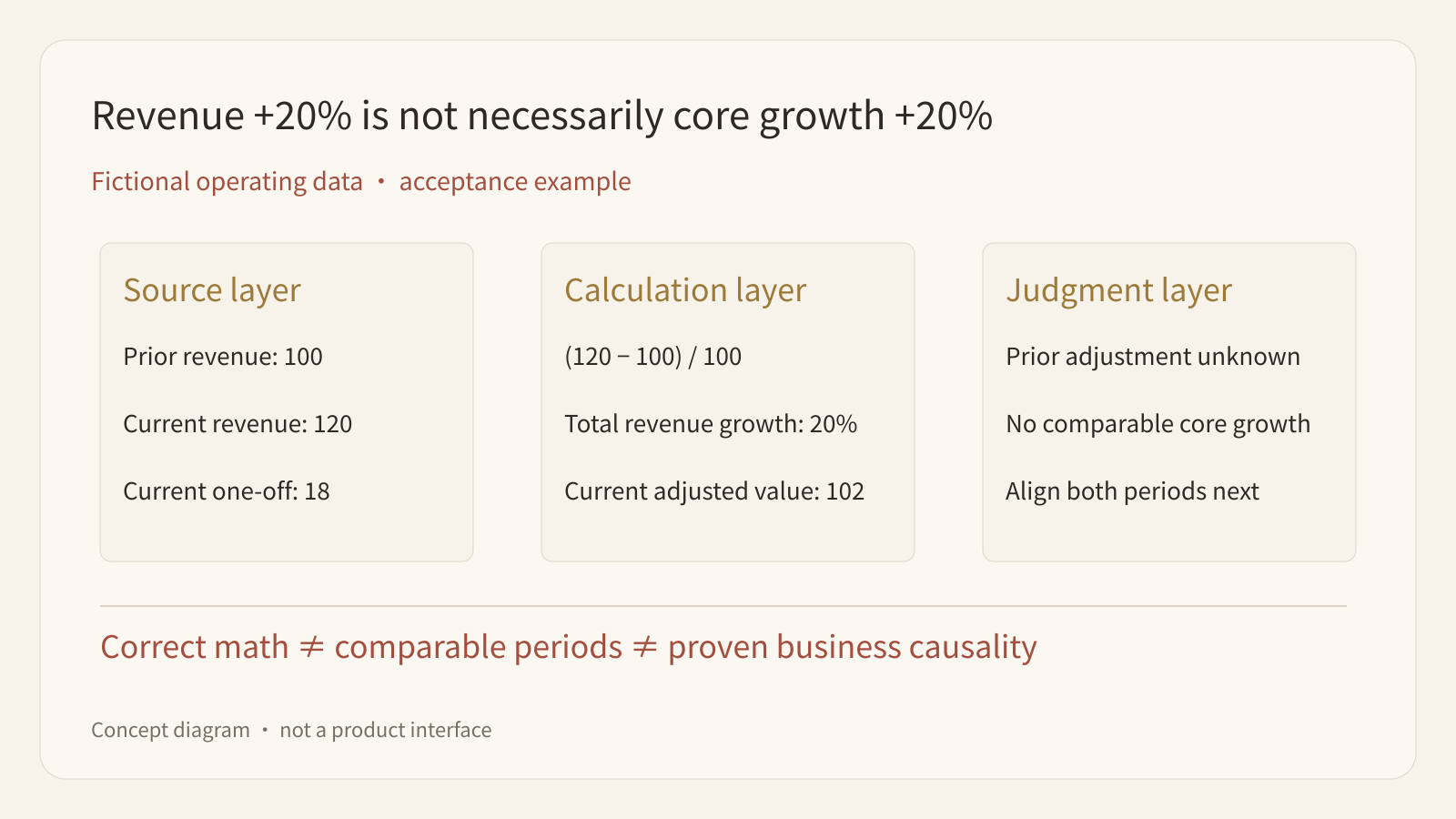
The company and numbers below are entirely fictional and illustrate acceptance, not investment analysis. Prior revenue is 100; current revenue is 120. Gross profit is 25 and 33.6 respectively. Current revenue includes a one-off item of 18. Inputs are a financial table, a management-call transcript and a slide template. The call says demand from new customers improved, without quantifying its contribution.
The evidence ledger first creates four records. Each includes the source file, location, period, unit and extracted value. Revenue 120 points to the current-period revenue row; the one-off 18 points to a note; improved demand points to the original transcript passage. The last item is a management statement, not a number that can participate in a calculation.
The workbook calculates before slides are written. Total revenue growth is (120-100)/100=20%. Current gross margin is 33.6/120=28%, up three percentage points from 25/100=25%. Subtracting the current one-off for observation gives 102, a current-period adjusted value only. Prior-period one-offs are unknown, so (102-100)/100=2% cannot be presented as comparable recurring growth.
The deck then organizes the judgment. A slide can say “Total revenue grew 20%; isolate one-off effects” and show 100→120 plus the current 18 component. It cannot say “Core business grew steadily by 20%.” The next slide can list missing evidence: prior one-offs, new-customer revenue contribution and next-quarter orders. Leaving a gap visible is better than presenting uncertainty as a fact.
A correct workbook answers the mathematical question. The business conclusion still depends on the denominator, adjustment policy and comparability of the evidence.
Follow an error's dependency path when returning work
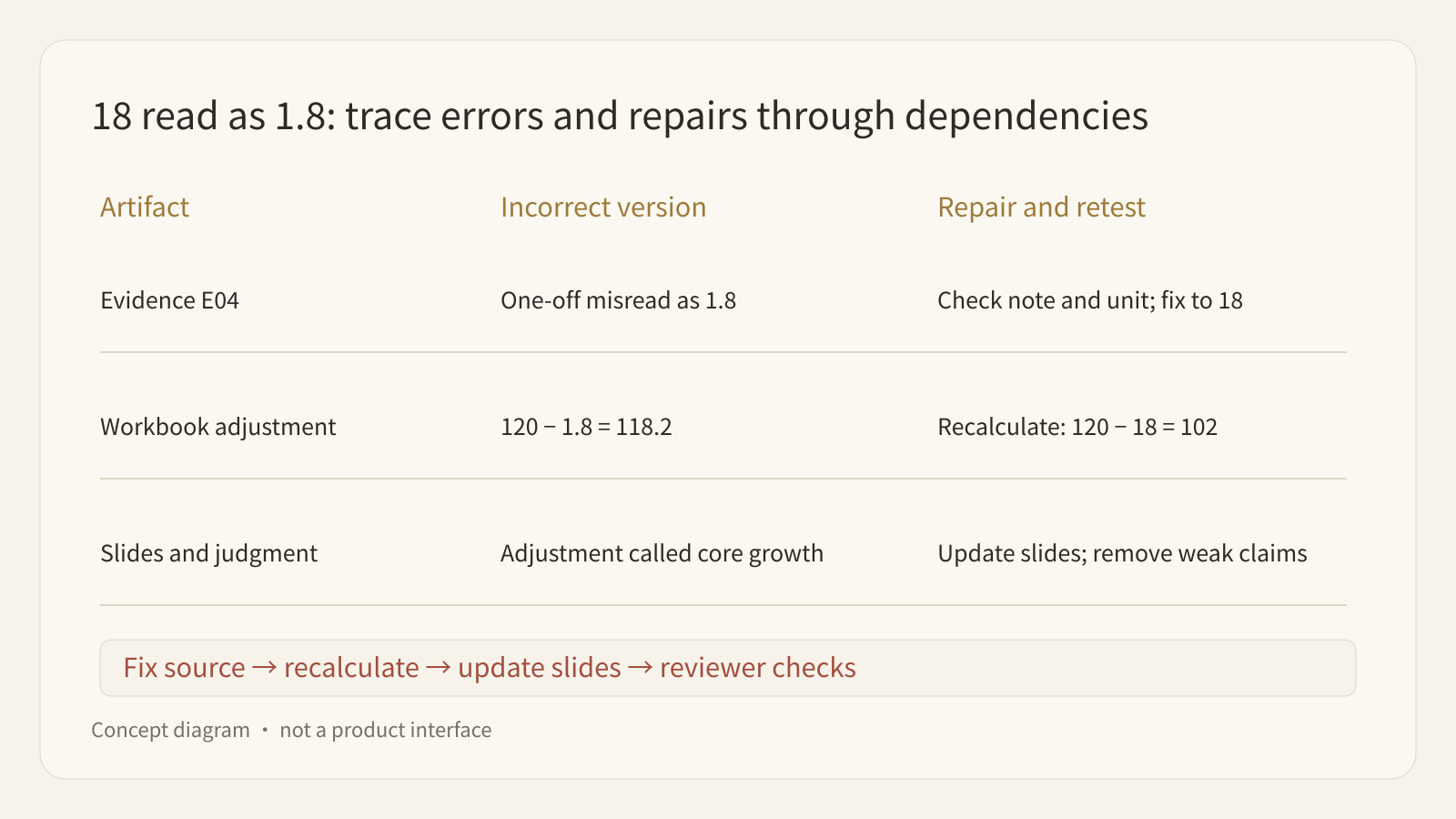
Suppose extraction misreads the one-off 18 as 1.8. Adjusted current revenue becomes 118.2, potentially exaggerating recurring performance in the slides. Editing only the final slide leaves the workbook wrong; regeneration can bring the error back.
A return note can be specific:
Check ledger E04 against the original note: 18 and 1.8 conflict. Confirm the unit and source, fix E04, recalculate dependent workbook adjustments and update every referencing slide. Total revenue and overall gross margin do not depend on this adjustment, but check that their slide descriptions were not changed incorrectly. Prior-period adjustment data is missing: retain that gap and do not generate a comparable growth rate.
The note identifies the source, affected dependencies and facts that must not be invented. The agent's repair report should list edits, recalculations, changed slides and unrun checks. The reviewer then samples source and dependencies rather than accepting “everything is fixed.”
Record who accepts which part before sending
| Review object | Acceptable evidence | Failure action |
|---|---|---|
| Key facts and units | Original location, extracted value and period | Return to ledger; pause dependent conclusions |
| Formulas and denominators | Independent recalculation and reference checks | Fix workbook and update dependent charts/slides |
| Adjusted metrics | Consistent periods and adjustment rules | Withhold comparable growth; mark the gap |
| Business judgments | Separate quotation, inference and recommendation | Revise titles; remove unsupported causality |
| Actual display | Target-device opening, no clipping or sensitive notes | Repair layout or remove sensitive content, then export |
| Final release | Reviewer, output version, unresolved items and use | Do not distribute a draft as approved |
Different people can own source review, formula checks and final release. Confirming a metric definition does not approve every recommendation. Approval for internal discussion does not imply approval for external distribution. Record the intended use.
For recurring work, standardize templates, field definitions and return notes before scaling execution. Batch production should not expand permission to fill missing facts. Earlier guidance and approval do not automatically become valid in the next quarter.
Return defects to a specific artifact
You can review the ledger and workbook before generating slides, or build a complete draft and gate it before circulation. Choose based on deadlines and rework cost, but preserve the same acceptance checks.
“Slide 4 uses the wrong period: fix cell C8 and synchronize slides 4 and 7” is actionable. “Be more rigorous” is not. After a fix, validate affected files and dependencies rather than rebuilding everything indiscriminately.
Preserve input and output versions, checks, reviewer, decision, and unresolved issues. A new reviewer or reporting period then has a clear record of confirmed definitions and facts that must be refreshed.
Give execution and trusted records separate homes
Buda carries agent execution, context, and reusable workflows. Package the input requirements, artifact contract, and acceptance checklist into a repeatable process. If using an installable Skill, search and install it in the Buda AI Marketplace, then adapt it to the team's assignment.
When verified metrics, definitions, or approved decisions need to become authoritative records, Busabase ChangeRequests can route changes through review and preserve the audit trail. This does not validate financial facts for the reviewer or automatically approve an entire generated deck.
As models produce more files, human work shifts toward choosing definitions, investigating anomalies, and judging actions. A sendable first draft is useful; an auditable process that can be corrected and reused is what belongs in everyday operations.
FAQ
Do two experts approving a draft remove the need for review?
No. That was one vendor-reported internal test, not a guarantee across finance workloads.
Can documents, spreadsheets, and slides share one checklist?
They can share source and version requirements, but each needs distinct checks: factual claims, calculations, and narrative or display.
Should automation come before acceptance criteria?
Define minimum acceptance and a return path first, then expand automation.
Is higher effort enough for dense charts?
Not necessarily. Anthropic's prompting tests highlight crop, zoom, and code tools as useful; input quality and tool design matter too.