Use Deep Research Skill to deliver a report people can verify
Define the decision, preserve evidence, and connect each important claim to the sources that support it.

A clear chat answer can start a market study or a technology comparison. Handing that research to a team takes more: readers need to understand the question, inspect the sources, identify disagreements, and see what remains uncertain before acting.
Deep Research Skill organizes that work into scoping, planning, retrieval, triangulation, synthesis, critique, and packaging. In Buda, an agent can follow the method while keeping the brief, report, and evidence files in Drive for human review.
Reserve it for questions that need several sources and perspectives. A straightforward lookup that takes one or two searches usually does not need the full research pipeline.
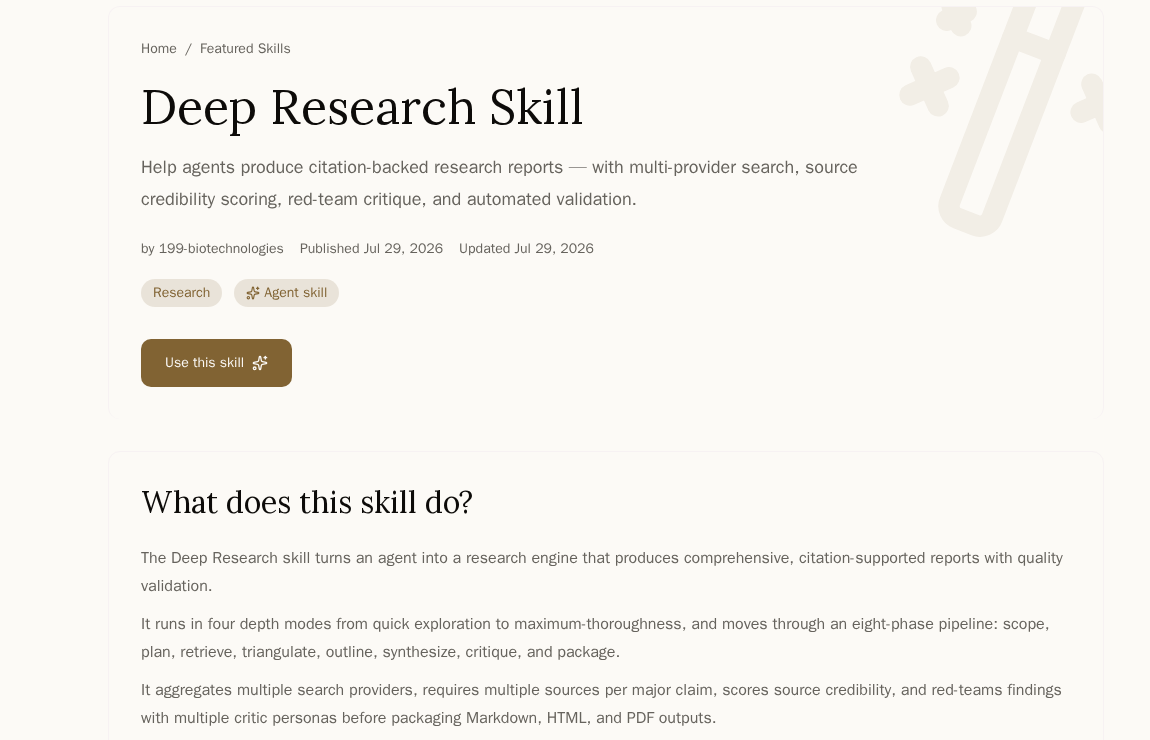
The live Deep Research introduction page and its use entrance. ↗ buda.im
Start with the decision the research must support
Replace “research this industry” with a bounded brief: the decision, intended reader, geography, date cutoff, alternatives, required comparison criteria, and exclusions. Supply existing material and ask the agent to separate supplied facts from items needing fresh verification.
An adaptable instruction is:
Use Deep Research in standard mode to compare these alternatives for our team. Confirm the use case, geography, date cutoff, required capabilities, and exclusions. Ask about missing critical constraints. Separate vendor claims, independent evidence, and analysis; retain counterevidence. Deliver Markdown plus the source, evidence, and claim files, and name the questions a decision owner must still resolve.
Add budget and organizational constraints when they matter. State what evidence could change the decision. This lets the outline follow the buying or operating question rather than the order in which pages were found.
Find the Skill and check the environment
Search for and install Deep Research in the Buda AI Marketplace. Open its catalog page to check provenance. The current entry offers Use from source with npx skills add 199-biotechnologies/claude-deep-research-skill -y -a universal. Have the agent follow the available path in its workspace, then confirm that it can read the installed Skill and its references.
The upstream README says basic usage needs no additional dependencies. Optional search-cli aggregates multiple search providers and requires separate installation and at least one provider key. Service access and cost depend on those providers. Keep keys in secure configuration, outside the brief.
PDF output has its own rendering requirements; upstream names WeasyPrint. Accept Markdown and evidence files as the core handoff first. When HTML or PDF is required, verify the environment, opening behavior, pagination, and links. Installing a method does not grant access to every search service it mentions.
Choose depth by the consequence of the decision
Quick covers scope, retrieval, and packaging for initial exploration. Standard adds planning, triangulation, and synthesis for most research questions. Deep and ultradeep include critique and refinement for decisions that warrant more scrutiny.
A mode name is not a reliability guarantee or a fixed delivery time. Scope, source availability, and tools determine the actual work. A bounded standard run followed by targeted additional searches is often easier to assess than an unlimited request for completeness.
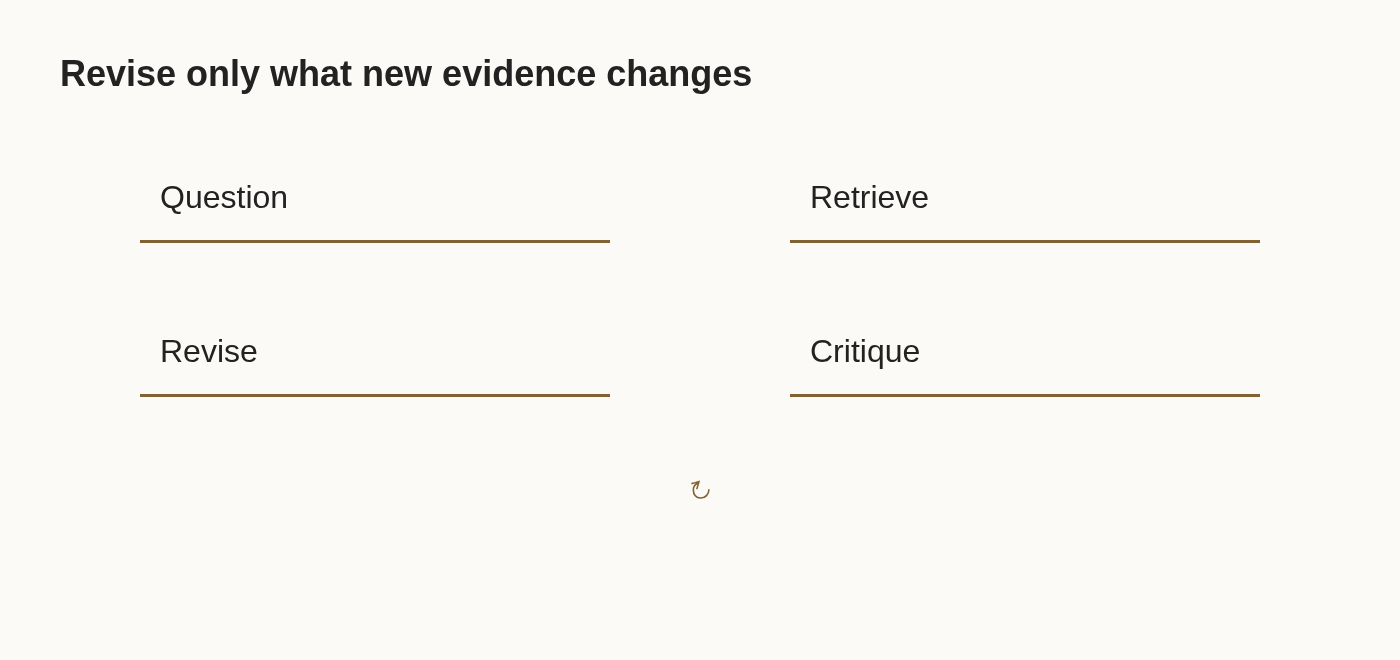
The Skill entry describes an evidence loop within each section: retrieve, persist evidence, refine the outline, draft, verify claims, and retrieve again where support is missing. Parallel search can investigate independent questions; final synthesis must reconcile their assumptions and dates.
Keep three verification files beside the report
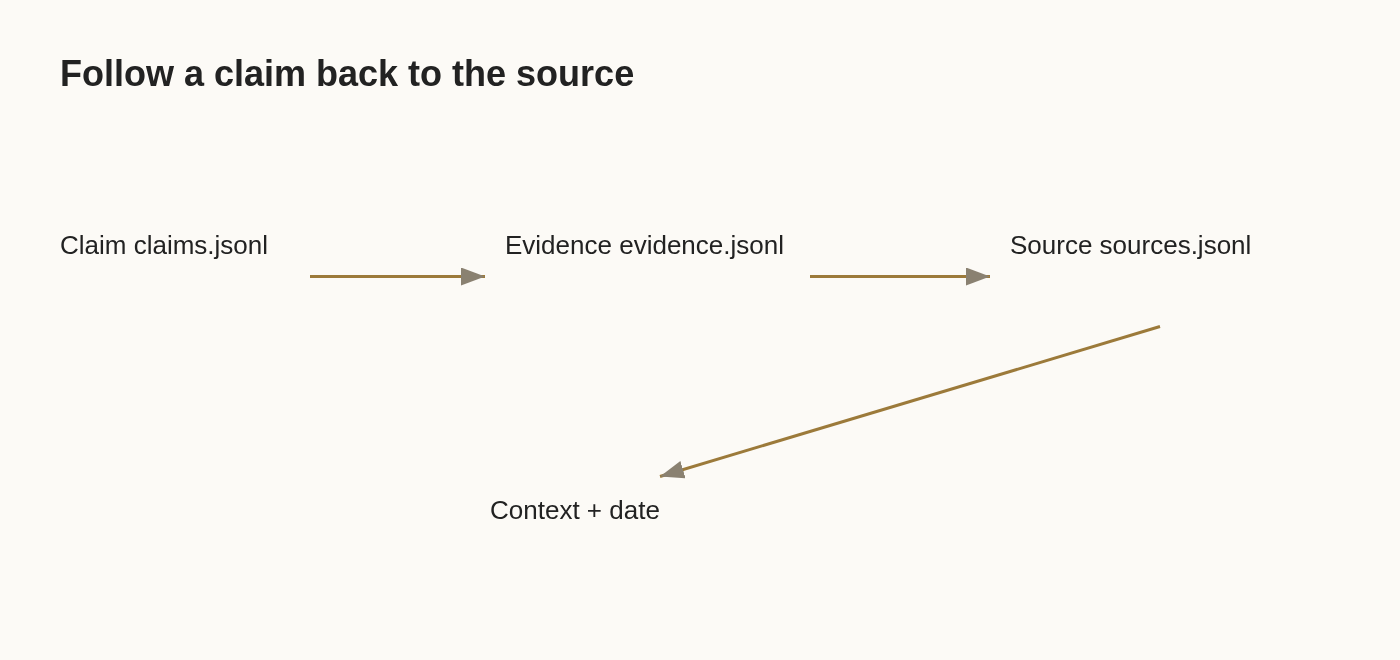
sources.jsonl registers stable source identities. evidence.jsonl preserves quotations and locators. claims.jsonl records atomic claims and their support status. Together they connect what was read, what the original actually said, and what the report asserts. run_manifest.json preserves the question, mode, assumptions, and provider configuration.
Several links can repeat one underlying announcement. Trace material to its original source before treating it as independent corroboration. Preserve contradictory findings and evidence gaps instead of filling a bibliography to meet a count.
A useful report distinguishes vendor statements, independently supported findings, and editorial inference. Missing evidence should narrow a conclusion or trigger further research. It should never be replaced with a plausible citation.
Review the claims that could change your action
Read the executive summary against the original brief. Pick the assertions that would change your decision and follow them through claims, evidence, and sources to the original passage. Check context, date, applicability, and whether the wording overreaches the evidence.
Upstream includes tools such as validate_report.py and verify_citations.py. Structure and citation checks are useful, but reachable URLs and valid citation syntax do not establish a fair comparison or a sound recommendation.
Request specific revisions: current pricing, independent counterevidence, or a narrower conclusion. Update the relevant claims and report sections while preserving the evidence chain so a new draft remains inspectable.
Resolve disagreements before collecting more sources
Cross-checking often reveals that apparently contradictory sources use different dates, regions, samples or product versions. Ask the agent to state the question and conditions each source actually addresses before searching again. More copies of the same claim can lengthen a report without resolving the disagreement.
For a purchasing decision, separate a vendor describing a capability from evidence that it applies under your required conditions. Read official capabilities and limitations, then use terms, documentation or independent material to fill the gap. If evidence remains missing, identify the condition that needs confirmation and which decision depends on it. A deeper mode cannot create unpublished information.
A useful revision request is: “Expand every assumption that changes the purchase decision. Retain version and date. Find independent support for vendor-only claims or narrow them. List the material our team still needs to provide.” This gives the agent a concrete improvement target.
Follow one consequential conclusion all the way back
Choose the executive-summary sentence most likely to change an action. Locate its atomic claim in claims.jsonl and inspect whether it is supported, contradicted or unresolved. Follow evidence.jsonl to the quotation and locator, then sources.jsonl to the original page. Check surrounding context, date, applicable version and whether a possibility became a promise in the report.
If a source cannot be opened, distinguish access restrictions, a changed page and an invalid source. A successful URL check does not establish semantic support. Retain obtainable originals and collection information; identify what cannot currently be rechecked. When a conclusion changes, update the affected evidence, claim and report passage together.
A practical handoff standard is that the original question is answered, consequential claims are traceable, significant counterevidence changes the analysis, and missing material has an explicit next action. Markdown, HTML and PDF are reading formats. The evidence chain is what lets another person inspect and revise the decision.
Hand over a research package someone can continue
Keep the brief, final Markdown, verification files, and run context together in Drive. Include limitations and next checks. If slides are needed afterward, approve the research conclusions before using the report as their input.
On the next run, reuse the accepted question and material, then investigate changed dates, unresolved disagreements, and new evidence. A useful handoff lets another reader understand the reasoning and decide what to verify next without repeating the entire search.
Continue with the Agent Workspace and the PPT Master tutorial when the accepted research needs a presentation.