Gemini 4 Carbon is publicly available: which access route should you choose?
Choose a paid API route or an eligible subscription before testing the work that exceeds your everyday model.

Google introduced Gemini 4 Carbon to a limited group of cybersecurity defenders before opening it to developers, enterprises and consumers on November 10, 2026. That change matters if you were waiting for a way to try its long-running coding and research capabilities outside the early program.
Public availability still has several entrances. A paid developer account, an Ultra subscription and a cybersecurity program serve different purposes. Choosing the right entrance comes before moving a production workflow.
Start with the account you actually need
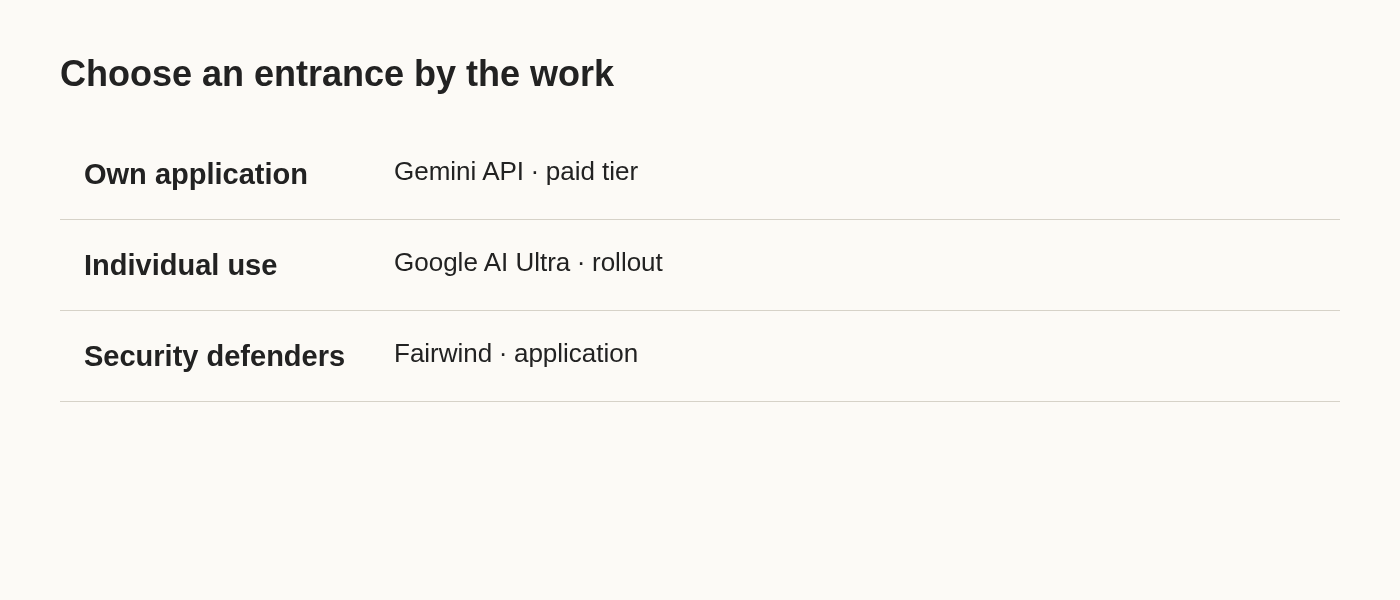
Google says developers can use Carbon through the Gemini API paid tier in AI Studio and Android Studio. This is the route for a team building its own application: the integration, credentials, billing and tool execution remain part of that application.
For individual subscribers, Carbon is rolling out to Google AI Ultra in the Gemini app, Google Antigravity and AI Mode in Search. A rollout announcement is a reason to check the model selector in the relevant account; it does not establish availability for a different subscription or region. An application subscription and API billing are separate purchasing decisions.
Enterprises have Gemini for business API or model-selector access, Antigravity and CodeMender routes. Security defenders still apply through Fairwind for Carbon for cyber. The scientific program offers selected participants six months of access, subject to eligibility, capacity and selection; it is not an unconditional free tier.
Read the price footnote before estimating a project
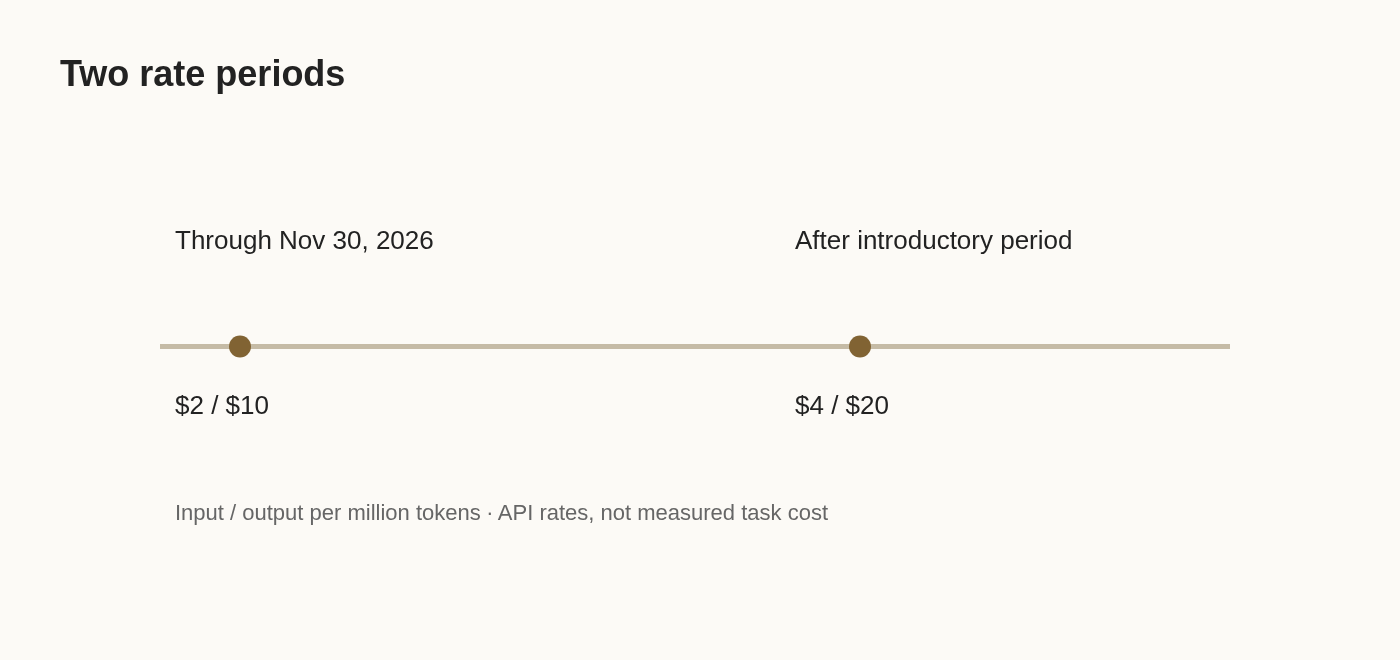
Google announces an introductory API price of $2 per million input tokens and $10 per million output tokens. The announcement explicitly ends that introductory period on November 30, 2026; afterward it lists $4 and $20 respectively for the public-access model.
For an illustrative one million input tokens and 100,000 output tokens, the simple uncached token subtotal is $3 during the introduction and $6 afterward. This is arithmetic, not a measured task cost. Repeated context, reasoning, tool calls, retries and service-specific billing can change a real bill. These are Google prices, not Buda Credits.
Keep Argon as a deliberate option
Google still recommends Argon for most software engineering and knowledge work. It describes Carbon as the option for difficult multistep debugging, architectural work and open-ended research, using more tokens for deeper exploration and verification.
A bounded change with a known test can stay on the everyday model. A root-cause investigation crossing several subsystems is a stronger candidate for a Carbon trial. Define the failure of the current approach first: missing dependencies, unsupported conclusions or repeated inability to complete a check. Model escalation then answers a real bottleneck.
A model does not supply an agent environment
Google is previewing /swarm in Antigravity. The announcement describes coordinated roles, isolated parallel workspaces and adversarial verifiers. It does not make that orchestration available through every Carbon entrance, nor does an API model call create it automatically.
Before a trial, identify who provides the browser, terminal, files and write permissions. For a code task, retain the starting revision, allowed directories, expected diff and test result. For research, retain original sources and distinguish retrieved evidence from inference. Stop when a required credential or authorization is missing rather than treating another model as a permission upgrade.
Decide whether you are testing a model or an entire product
Using Carbon in the Gemini app, changing a repository in Antigravity, and building an agent through the API supply different execution conditions. A chat entrance helps you inspect understanding and analysis. Repository work additionally needs file access, a working runtime and tests. With an API integration, your application supplies search, execution, storage and the controls around them.
This distinction changes the first experiment. A team with a reliable agent environment can hold its tools and acceptance criteria steady while trying Carbon on a known difficulty. A team without that environment should first choose an entrance capable of completing the work. Otherwise a missing tool can look like a reasoning failure. Access to the model, access to the material and authorization to act each need to be established.
Keep the trial smaller than an entire project migration. Preserve the existing approach and why it failed. For code, supply the original error, relevant modules, reproduction steps and interfaces that must remain compatible. For research, supply the decision, sources already reviewed and unresolved contradictions. These inputs make the result more useful than a generic request to demonstrate intelligence.
Look for a better outcome, not simply more exploration
For multistep debugging, inspect whether Carbon identifies a reproducible cause, explains rejected hypotheses and passes the previously failing check. A longer analysis log cannot replace those outcomes. In research, check whether additional work finds meaningful counterevidence, narrows an uncertain claim or materially changes a recommendation.
One allocation strategy is to keep the everyday model’s first attempt, then escalate the unresolved problem. Record artifacts and human corrections for both stages. The question is whether additional exploration reduces total rework. Bounded work with straightforward validation can remain on Argon while difficult investigations use Carbon; the routing rule should follow completed work.
Before production use, recheck whether the trial and production accounts have the same access, whether the budget remains acceptable after the introductory rate, and whether the new tool environment expands write permissions. Retain a way to resume the original task if the experiment fails. A useful model decision survives changes of account and environment because its conditions are recorded.
Make the first result inspectable
Give one difficult but bounded task, a time and spending limit, and a concrete acceptance condition. Ask for changed files or a source-linked report, failed checks and remaining uncertainty. Review the artifact before authorizing external writes.
You can build an execution-and-review workflow in Buda around shared inputs, retained artifacts and human decisions. Choose the model through a verified available route; keep account access and execution permissions explicit. The useful first outcome is a reproducible result and a decision about when Carbon earns its additional effort—not a blanket replacement of every existing model.