Gemini 4 Carbon vs Claude Fable 5.2: compare completed work, waiting and cost
A fair trial keeps inputs, permissions and acceptance fixed while recording each model’s actual configuration.

Google opened Gemini 4 Carbon more widely on November 10, one day after Anthropic released Claude Fable 5.2. Both vendors position these models for difficult work that takes exploration, tools and repeated verification. For a team with a stubborn migration or document-heavy investigation, the practical question is which one can deliver an acceptable result within the available time and budget.
The launch pages provide useful starting evidence. They do not provide a controlled comparison of your repository, tools and review standards. Start with a decision rule, then use the public claims to choose a trial.
Define a successful artifact before choosing a model
For a migration, success includes the allowed diff, compatibility checks, regression results and unresolved risks. For a research task, it includes source coverage, traceable claims and explicit missing evidence. Fix these conditions before seeing an answer so polished prose cannot quietly lower the acceptance threshold.
Keep the same input snapshot and permissions for both runs. Use isolated copies if code can change. Record the orchestrator, tool versions, network access and stop conditions. If one product supplies a richer environment, treat that as a product-level comparison and describe the difference.
What the two announcements actually support
Google positions Argon as the default for most engineering and knowledge work and Carbon for deeper multistep coding and research. It reports strong results on CursorBench, WANDR and AutomationBench, including lower cost per task under those evaluations. Those are attributed launch claims with particular task and harness conditions.
Anthropic likewise recommends Opus 5.5 for most everyday work, escalating to Fable for ambitious technical problems. Its FrontierCode result of 49.1% uses Xhigh effort; the High-effort result near Opus’s best score is a different configuration. Do not attach the better score to the cheaper configuration.
Fable’s Python-to-Rust example reports roughly 26 times faster startup for one migrated service. It motivates testing difficult migrations; it does not measure Fable’s generation speed or establish an advantage over Carbon on your task.
Compare API prices without confusing them with task cost
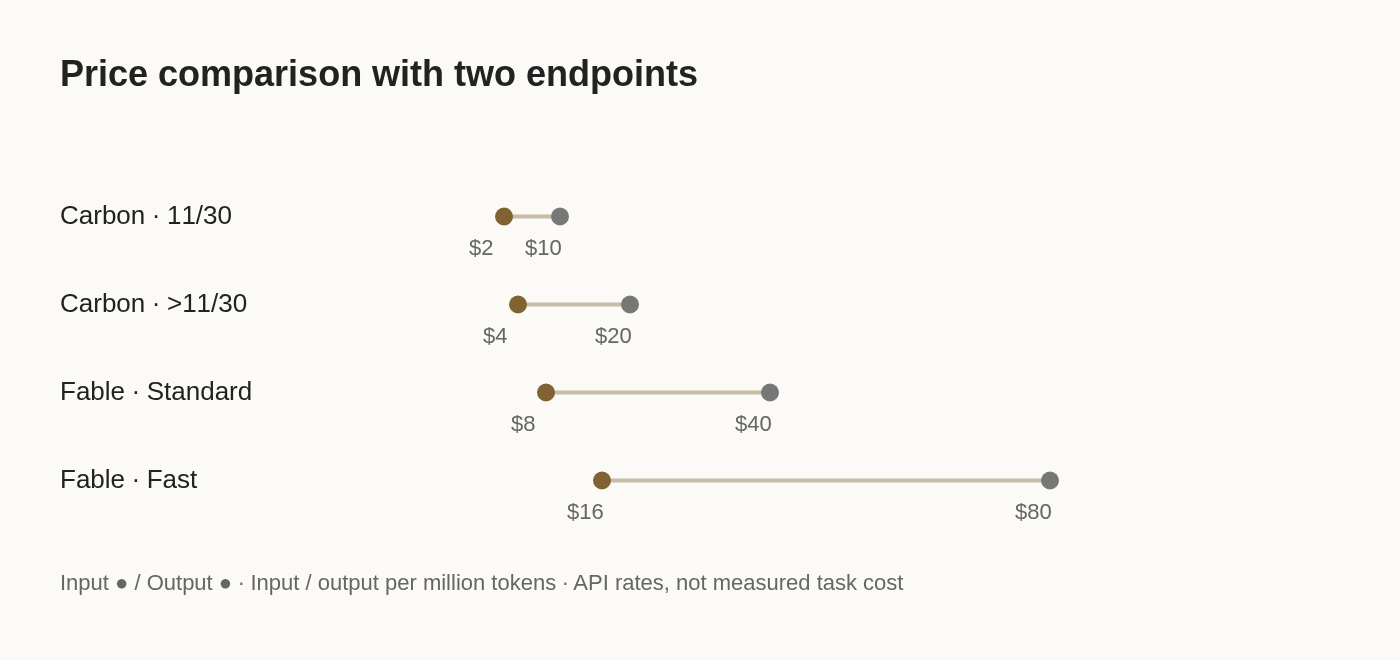
Carbon’s announced public API introductory rate is $2/$10 per million input/output tokens through November 30, then $4/$20. Fable 5.2 standard is $8/$40; optional fast mode is $16/$80. At a hypothetical one million input plus 100,000 output tokens, simple uncached subtotals are $3, $6, $12 and $24 respectively.
These equal-token calculations explain the rate cards only. A model consuming more tokens, repeating context or making more attempts can change the outcome. Log actual charged usage and distinguish tool or infrastructure costs. Buda credit multipliers are a separate price system and should not be inferred from upstream dollars.
Measure waiting at the task boundary
Fast token generation can leave tool waits and human correction unchanged. Record start to reviewable artifact, blocked time and correction time separately. A fast draft that fails acceptance is still unfinished work.
For Fable, retain effort and fast-mode settings alongside usage. For Carbon, retain the actual access route and available configuration. Google’s preview /swarm orchestration is not an intrinsic feature of every API call. Different agent counts or tool budgets must remain visible in the result.
Decompose the work to see where a model helps
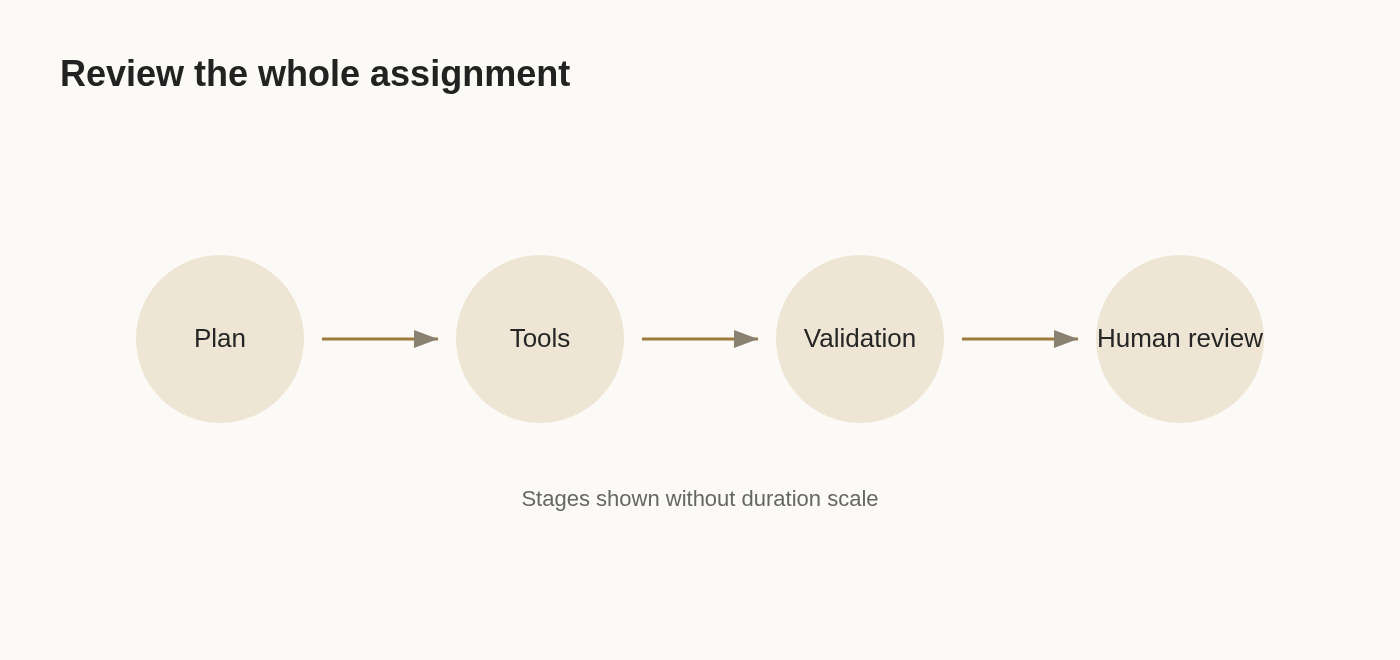
A long assignment combines understanding, planning, tool use, recovery and delivery. When total time differs, locate the difference. One run may propose a solution quickly and spend the rest repeatedly repairing tool failures. Another may explore longer before passing validation. Time to first output cannot distinguish these outcomes.
For migrations, review behavior preservation and maintainability together. Existing tests are a starting point; inspect interface constraints, error handling, dependency changes and special cases left behind. For research, review coverage of consequential questions, whether citations support the statements, and whether opposing evidence changes the conclusion. Fluent coverage is not a universal acceptance standard.
Start with two kinds of real backlog work: one with a clear reproduction and known tests, another requiring exploration before a route becomes clear. The first examines execution and validation; the second examines discovery of a workable solution. Record why a human intervened, including new materials, clarified goals, permissions and corrections. Hidden human effort would otherwise become part of the model’s apparent performance.
Include failed attempts in the completion cost
Equal-token arithmetic explains tariffs. Budget allocation needs all usage required to meet the same acceptance threshold: failed attempts, repeated context, corrections and another validation pass. Retain the spent amount and failed status when a run does not pass. A low bill without a deliverable is not completion, while a single failure does not establish a universal model weakness.
Fast mode helps only to the extent that generation latency is the bottleneck. If builds, external calls or review dominate, faster generation need not shorten total time proportionally. Compare actual waiting under the same model and comparable settings before valuing the premium. Record effort as well: the model name alone leaves out an important configuration.
The resulting policy can vary by task. Keep reliable everyday work on the existing approach; escalate difficult work when extra reasoning has shown reduced rework. If both pass, choose the result that fits the deadline, budget and maintenance needs. If each has limitations, retain those conditions instead of declaring a permanent winner.
Pick the next assignment from evidence
Prefer the run that meets the predetermined acceptance conditions with tolerable cost and delay. If neither passes, inspect whether the failure is missing access, an ambiguous objective, tool reliability or reasoning. Increasing the reasoning budget cannot repair an unavailable source or grant write authority.
Keep the accepted artifact, configuration, failed checks and reviewer decision together. In Buda, you can build a workflow that retains task inputs and outputs for this review; model access must still be verified for the chosen route. Use the result to allocate the next class of task, and rerun when the model, harness or task changes materially.