An RFP Has 80 Questions. Start with Evidence, Not a Sales Pitch
Turn approved product material into traceable answers and an owner-specific clarification queue without inventing commitments.

An RFP often looks like a writing deadline. The harder job is deciding which sentences the company can stand behind. A plausible answer to a nearby question is not proof that the requested capability exists.
Build a question-to-evidence matrix before polishing a proposal. Keep the customer's wording, mandatory requirements and response limits intact. The Agent can organize approved material, draft bounded answers and expose gaps; sales, product, security and legal owners decide the commitments.
Eight questions, not eight automatic yeses
The following miniature RFP and supplier documents are fictional teaching inputs, not Buda capabilities or a real customer submission. An 80-question questionnaire uses the same row-by-row method; eight is the sample size here.
Assume the customer supplied RFP-R1, section A, questions Q01–Q08. Each question has its original wording, a mandatory/optional flag and a response format. Q01–Q07 are mandatory; Q08 is optional. Q01, Q03 and Q04 require yes/no plus an explanation of at most 100 words. Other questions allow up to 150 words. Preserve those constraints even when the evidence does not permit yes or no.
Approved fictional sources: Product-P3, Commercial-C2 and Security-S1. Page references below are sample locators, not clickable product documents.
- Q01: Can administrators export CSV? Product-P3 p2 says, “Workspace administrators can export the current table as CSV.” Supported for that role and table only. It says nothing about scheduled exports, other formats or all historical records.
- Q02: Is SSO available without external configuration? Product-P3 p3 says, “SSO requires customer identity-provider configuration and administrator setup.” The prerequisite is supported, but the requested no-configuration condition is not. Draft that distinction; the product owner confirms the customer's configuration before a final answer.
- Q03: Is region Z available today? Product-P3 p4 says, “Region Z is under consideration; no availability date is committed.” This supports a current negative answer, not a claim of availability or a promised date. Preserve the quotation and ask the product owner whether any approved update exists.
- Q04: Is certification K held? No approved source addresses certification K. Record no evidence, not yes and not an invented no. Send the question to the security owner. Missing documentation is not proof that the certification does not exist.
- Q05: Supply a security review report. Security-S1 p1 says, “The report may be shared only after NDA execution and security approval.” Cite the sharing condition; do not attach the report or promise it is already approved. Legal and security must confirm authorization.
- Q06: Can standard users export CSV? Its wording resembles Q01, but the source mentions administrators only. Record needs confirmation and keep Q06 separate. Copying Q01's answer would erase the role difference.
- Q07: Include an on-premises maintenance schedule if on-premises delivery is selected. Commercial-C2 p1 says, “This offer is cloud-only.” If the customer confirms that the conditional question does not apply to this cloud-only offer, mark not applicable, with that condition and the confirmation. Until then, keep it pending, not silently skipped.
- Q08: Is a volume discount guaranteed? Commercial-C2 p2 says, “Discounts require case-specific commercial approval.” The approval rule is supported; the discount is not guaranteed. The account owner must obtain a decision rather than infer a rate.
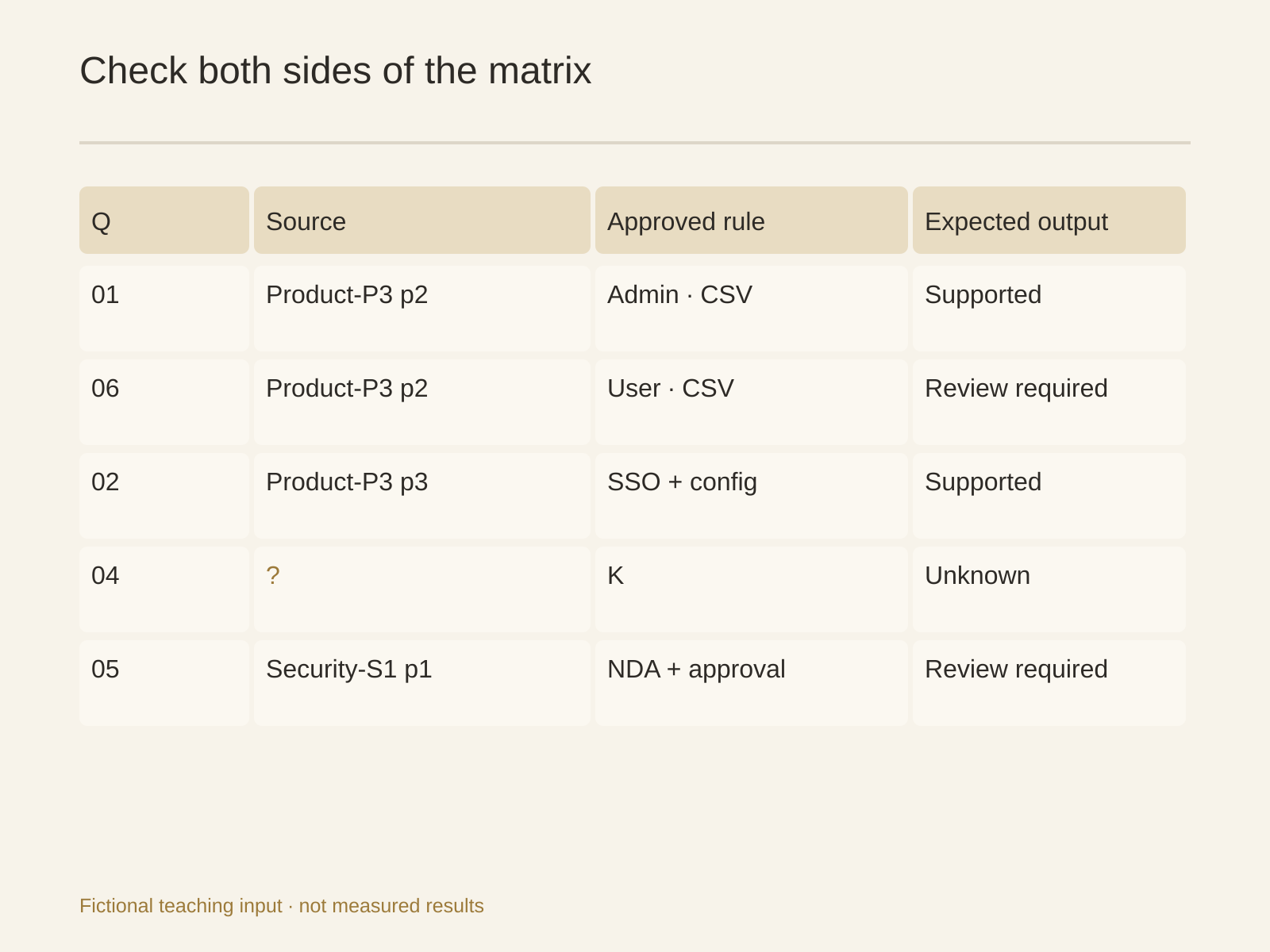
Make the answer auditable at sentence level
A row needs section, question-id, original requirement, mandatory flag, response format and word limit; source title, version and page; exact supporting sentence; proposed answer; unknowns, owner and review state. Include who approved the source and its effective date if available. Unknown values stay unknown, never a guessed date or owner.
Four evidence states are useful: supported, needs confirmation, no evidence, and not applicable. They describe whether a particular answer is supportable, not whether the bidder wins or whether a human has approved the submission. A supported sentence can still require security or commercial approval before disclosure.
For Q01, a safe draft is: “Workspace administrators can export the current table as CSV.” Expanding that to “Every user can automatically export all records in any format” adds several unsupported claims. Compare each clause, not just the paragraph's overall similarity to the source.
Read the matrix in both directions. Every mandatory question needs a row, including unanswered questions; every affirmative claim in an answer needs relevant evidence. A pile of approved documents does not mean all questions are covered. One relevant sentence does not support every row that mentions the same noun.
Ask Buda for a review packet, not a submission
Upload authorized copies into Drive. Specify the allowed files and their approved versions. A Session organizes the task; it is not a file-permission boundary. Do not provide confidential reports merely because the RFP requests them. The sales workflow is a useful starting point for research and proposal drafting, not a promise of an automatic tender system.
Use a bounded instruction such as:
Read only RFP-R1, Product-P3, Commercial-C2 and Security-S1. Preserve all Q01–Q08 requirements and limits. Draft only claims supported by the current approved sources. For each clause, give the source version, page and quotation. Preserve unresolved yes/no fields as unknown and list the responsible reviewer. Do not send, sign, quote a discount, attach restricted material or update CRM. Return drafts for review.
Request four proposed files: response-matrix.csv, answer-drafts.md, clarification-queue.md and version-diff.md. These are suggested output names, not built-in product controls. The clarification queue should say which exact evidence or decision each owner must provide, its requested deadline and which answer depends on it. An empty queue is not success if unknown rows were dropped.
Revisions invalidate dependencies, not just wording
Suppose fictional RFP-R2 changes Q01 from manual CSV export to daily automatic export, adds Q09 on audit retention and removes Q08. Preserve R1 and its answers. Record Q01 as changed, Q09 as new and Q08 as removed; the old CSV evidence no longer supports Q01's new automation requirement. Do not make the old approved answer look approved for R2.
If Security-S2 changes the permitted disclosure of a report, revisit the answers that depend on that source, including copied passages. An updated document does not mean every answer needs rewriting, but its affected dependencies need explicit review. The original response version, revised candidate, reason for change and reviewer decision must remain distinguishable.
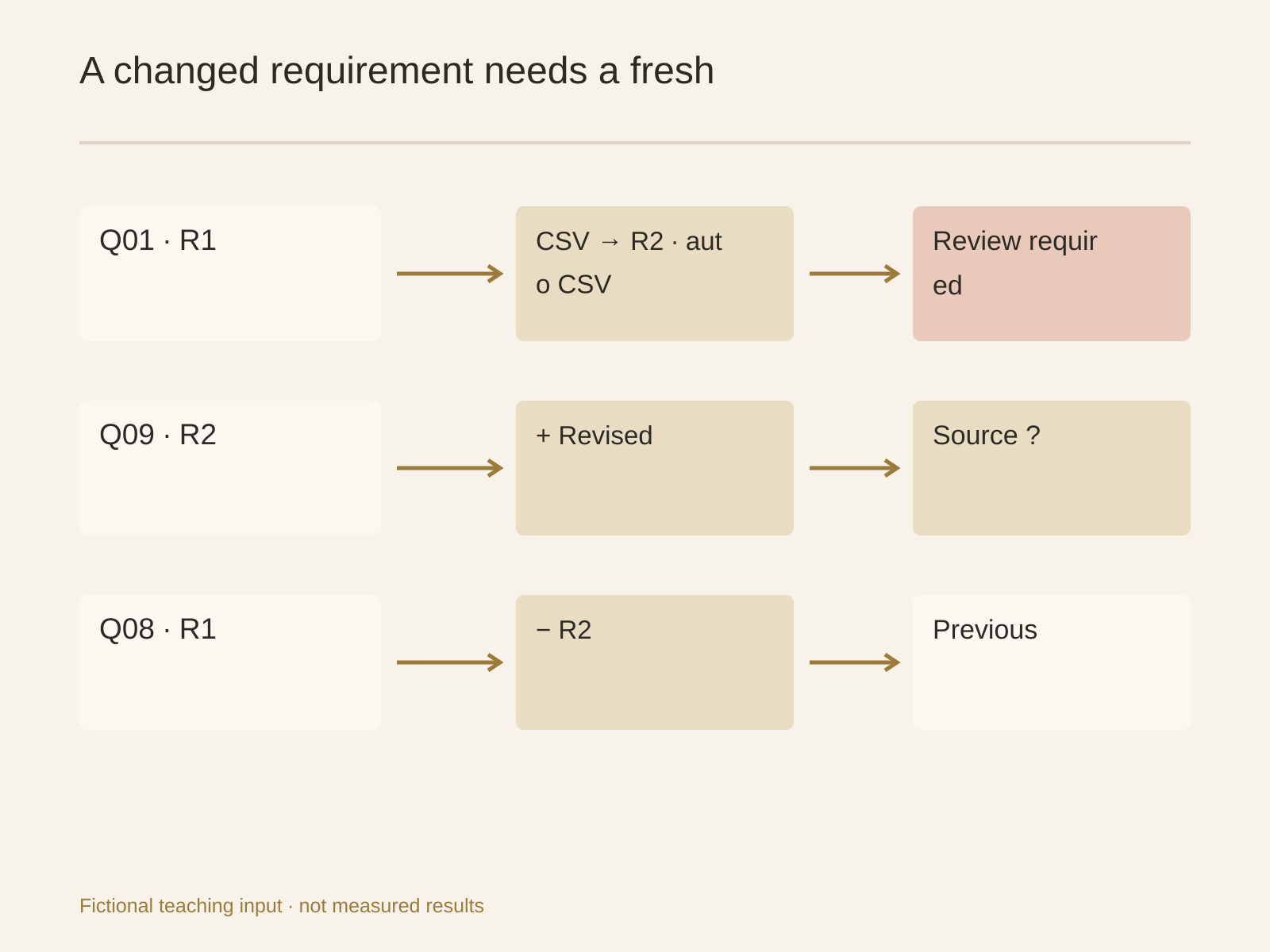
Before adopting the method, try these proposed, unexecuted checks on sanitized material: the no-source certification question must remain unknown; the user-role variation must not inherit the administrator answer; a planned feature must not become available; and the R2 change must invalidate the old Q01 match. Inspect both retained evidence and omissions rather than measuring success by document length.
What happens when the deadline arrives?
Give the owner a list of unanswered mandatory items, disclosure gates and commercial decisions before the deadline. The owner chooses whether to ask the buyer for clarification, submit a qualified response where permitted or decline to commit. The Agent must not make that decision by filling blanks with yes.
A repeatable, reviewed process can later become a Skill. Search the Buda AI Marketplace for a relevant Skill and inspect its instructions and permissions before installing; this does not assume a specific RFP Skill exists. Begin with one authorized questionnaire and review the packet before expanding the workflow.
No evidence for a mandatory yes/no question: what should the answer be?
Keep the proposed field unresolved and escalate to the named owner. If the form requires a final yes/no, a responsible human must choose the permitted qualified wording or contact the buyer; an Agent should not turn a form constraint into a factual claim.
Can repeated questions share an answer?
Only after checking role, scope, time and conditions. Q01 and Q06 are not equivalent. Reuse verified evidence references where appropriate, but preserve separate question IDs and customer-specific limits.
Which document version should be used?
Use the version designated as approved and effective by the responsible owner. A newer timestamp alone does not confer authority. Conflicting approved sources need an owner decision, not a silent “latest wins” rule.
Can the packet be sent automatically?
Not under this workflow. Final answers, restricted disclosures, pricing and submission all require separate authorization. workspace you can build with Buda helps organize execution and review; it does not replace those business decisions.