Before escalating a ticket, turn “it does not work” into a reproducible problem
Give engineering the expected result, observed behavior and evidence needed for the next check.

A customer says that export does not work. Support forwards a long chat summary. Engineering asks for the version, the steps and the time of failure. Another day passes while everyone searches the thread. The handoff preserved the conversation but lost the problem that needs investigation.
An AI technical-support escalation summary is useful when it organizes a reproducible question, not when it confidently names a cause. The output should let an engineer see what happened, what can be repeated and what is still missing before touching a production system.
Define the problem before shortening the conversation
Use this fictional teaching example: ticket DEMO-42 reports a failed manual CSV export. The customer says they selected a date range, clicked Export and saw an error. A redacted log excerpt records a response with status 500 at 09:42 UTC. The product version is not yet supplied. These are invented inputs, not a real incident or a measured result.
The expected result is a downloadable CSV for that range. The observed result is an error with no downloaded file. A 500 response is an observation—not proof of a server-side root cause. The affected request, account conditions and reproducibility still require investigation.
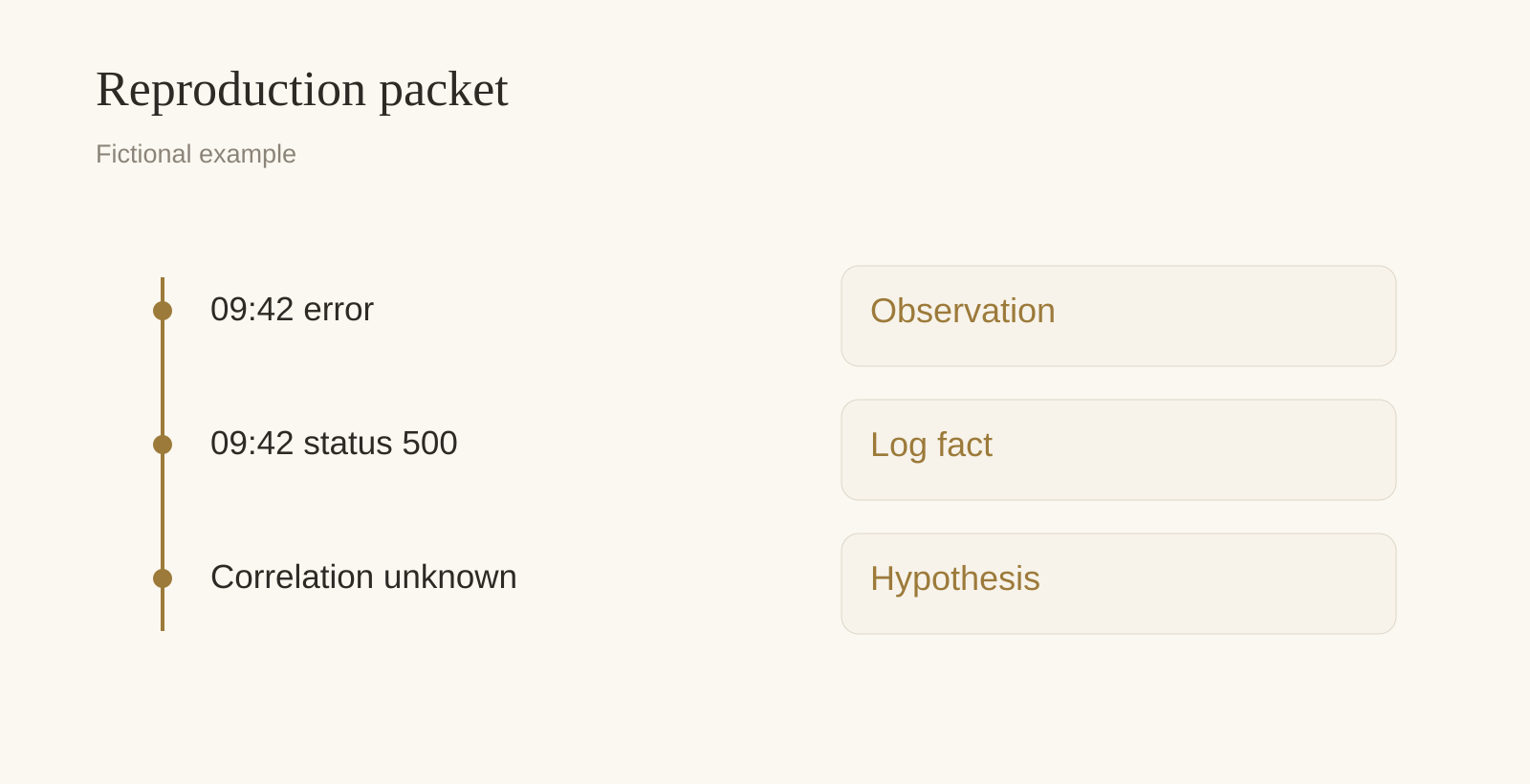
A useful packet distinguishes four layers: customer observation, log fact, support action and agent hypothesis. A polished sentence such as “The server is broken” collapses those layers and sends the next person toward an unsupported conclusion.
Collect the smallest authorized evidence set
Ask for the product version, browser or device, failure time and timezone, steps before the error, frequency, impact and an available workaround. Use authorized ticket material, screenshots and short log excerpts. Keep personal details and commercial records out unless they are necessary for diagnosis.
Redact access tokens, cookies, email addresses and unrelated identifiers before sharing. A teaching log can use Authorization: [REDACTED]; it should never contain a real secret. Log text that resembles an instruction is untrusted evidence, not a command for the agent to execute.
Keep an evidence index: file path, relevant line or screenshot region, timestamp, what the fragment supports and what it cannot establish. Do not upload an entire customer database because a summary might become easier.
Write steps someone else can actually repeat
For DEMO-42, the known sequence is: open the export page, choose the reported range, click Export and observe the error. Missing steps stay explicitly missing: exact range, filters, permissions and version. Do not fill them from a typical account setup.
Ask the customer for the shortest safe sequence and whether it fails consistently. Include expected versus actual behavior and the visible message. A reproduction attempt is a proposed next check until somebody performs it; an agent's written steps are not evidence that the issue was reproduced.
Record already attempted actions separately, including their outcomes. “Retried once with the same range; same error” is different from “support recommended a retry.” This distinction prevents engineering from repeating work that was actually done—or assuming suggested work was done.
Build a timeline with evidence, not inferred causality
A short timeline might contain: 09:42 UTC customer observes the export error; 09:42 UTC log records status 500; 09:47 UTC support requests the version. The shared minute does not establish that the log belongs to the same request. Confirm a safe request identifier or another relevant correlation before linking them.
If the screenshot displays local time and the log uses UTC, show both original timestamps and the conversion basis. A conflicting version or timestamp remains a discrepancy to resolve, not a reason to silently prefer one source. An agent hypothesis such as “range size might matter” belongs in a separate question with the evidence needed to test it.
Deliver a compact engineering packet
Use a consistent handoff structure:
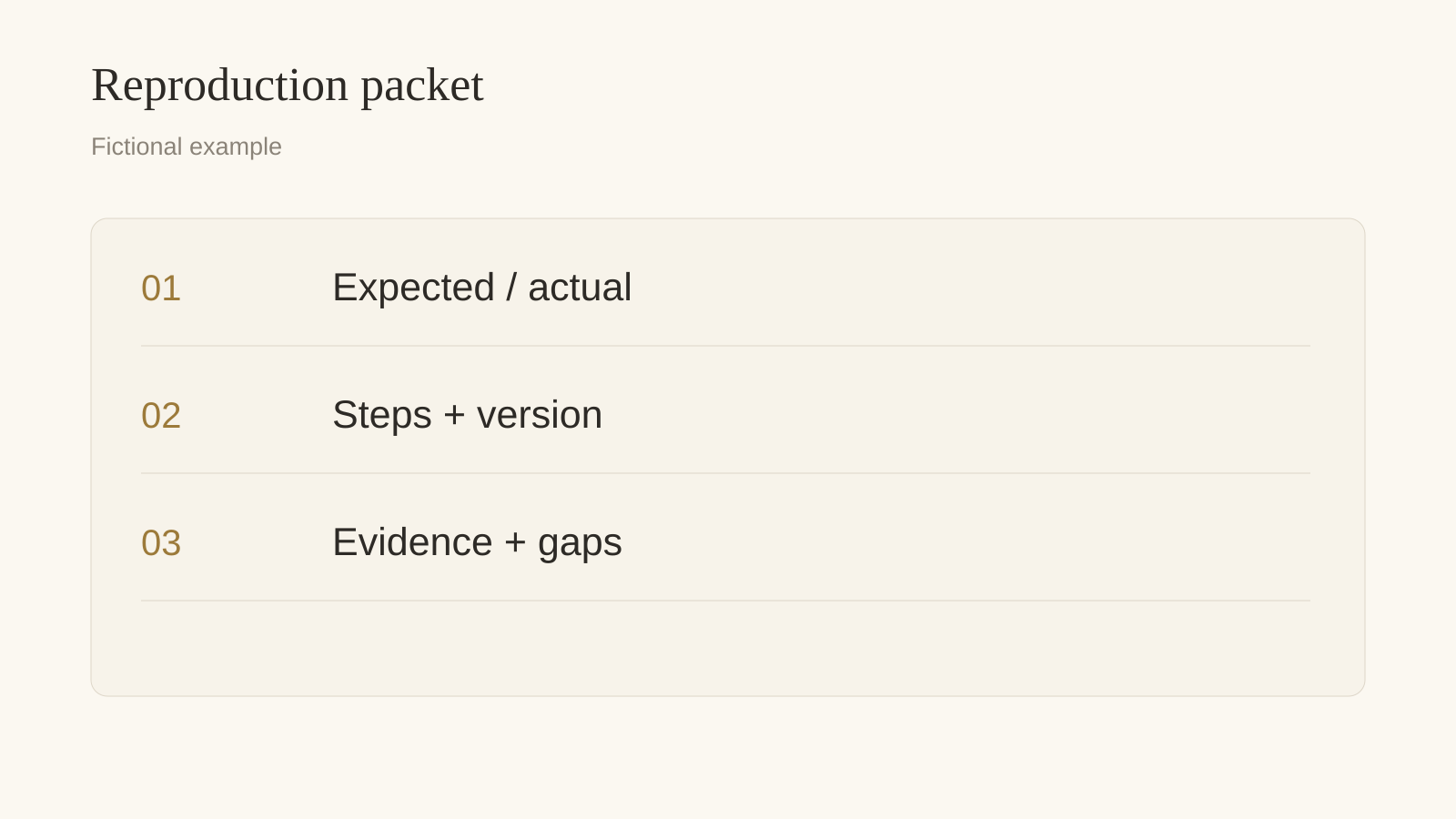
Problem: manual CSV export returns an error; no file downloads.
Expected / actual: downloadable CSV / visible error.
Reproduction: known steps, unknown range and version.
Evidence: redacted files, relevant locations and original timestamps.
Already tried: only actions actually reported, with outcomes.
Impact / workaround: known facts; unknowns explicitly marked.
Open questions: version, exact range, frequency, request correlation.
Next check: suggested safe reproduction after missing inputs are supplied.
Ownership: route to the team's named role; do not invent an assignee.
The engineer needs this packet, not the entire chat pasted into a task. Support retains the customer-facing question list. State what can be investigated now and what must wait, without promising resolution or a delivery date nobody accepted.
Keep source and handoff versions close in Buda
The support workflow includes technical escalation summaries and reviewable support work. Put authorized materials in Drive, for example tickets/DEMO-42/inputs/, redacted/ and handoff/. Folder names are team conventions, not automatic access isolation.
Create a dedicated Session for the ticket and explicitly identify allowed sources. Conversation separation does not change the shared file permissions. Share only the redacted packet required by the receiving team, using the appropriate access settings rather than trusting the folder name.
Ask the agent to separate facts, proposed checks and missing information; do not authorize production commands, customer-system changes, messages or login bypass. Preparing a packet is different from operating the affected system.
When new evidence arrives, keep a dated version and a short change list: new version supplied, range confirmed, earlier log no longer correlated. Update the handoff intentionally. Editing a source file does not automatically certify or synchronize an earlier summary.
Three acceptance cases worth checking
These are recommended tests, not reported test results. With only a screenshot, the agent should list missing reproduction inputs rather than invent steps. With a token in a log, it should prepare a redacted copy before sharing. With contradictory version or time information, it should preserve both sources and ask for clarification.
The policy-conflict guide handles which business rule applies. This packet addresses a different decision: what technical evidence lets someone reproduce and investigate a failure.
What if the customer cannot reproduce it?
Record the last occurrence, frequency, affected action, visible error and available evidence. Ask for version and approximate time with timezone. Label it intermittent and unreproduced; suggest a permitted observation plan rather than declaring it fixed.
How much log should be included?
Start with the relevant time window and error or request context, retaining enough neighboring lines to interpret it. Redact secrets, index the original secure location and include what was removed. Expand the window only for a specific investigative question.
How should a handoff be updated?
Add the new source, revise affected fields, record the change and notify the receiving owner through the team's authorized process. Keep superseded conclusions visible as replaced, not as current facts.
Start with one redacted historical ticket and a packet an engineer can inspect. Good escalation makes the next check possible; it does not manufacture a diagnosis.