Insights on the Agent Era: The Commoditization of Execution and the Rise of the One-Person Company
As AI agents automate enterprise workflows, pure execution becomes a commodity. Explore the future of corporate structures and why human accountability is the ultimate asset.
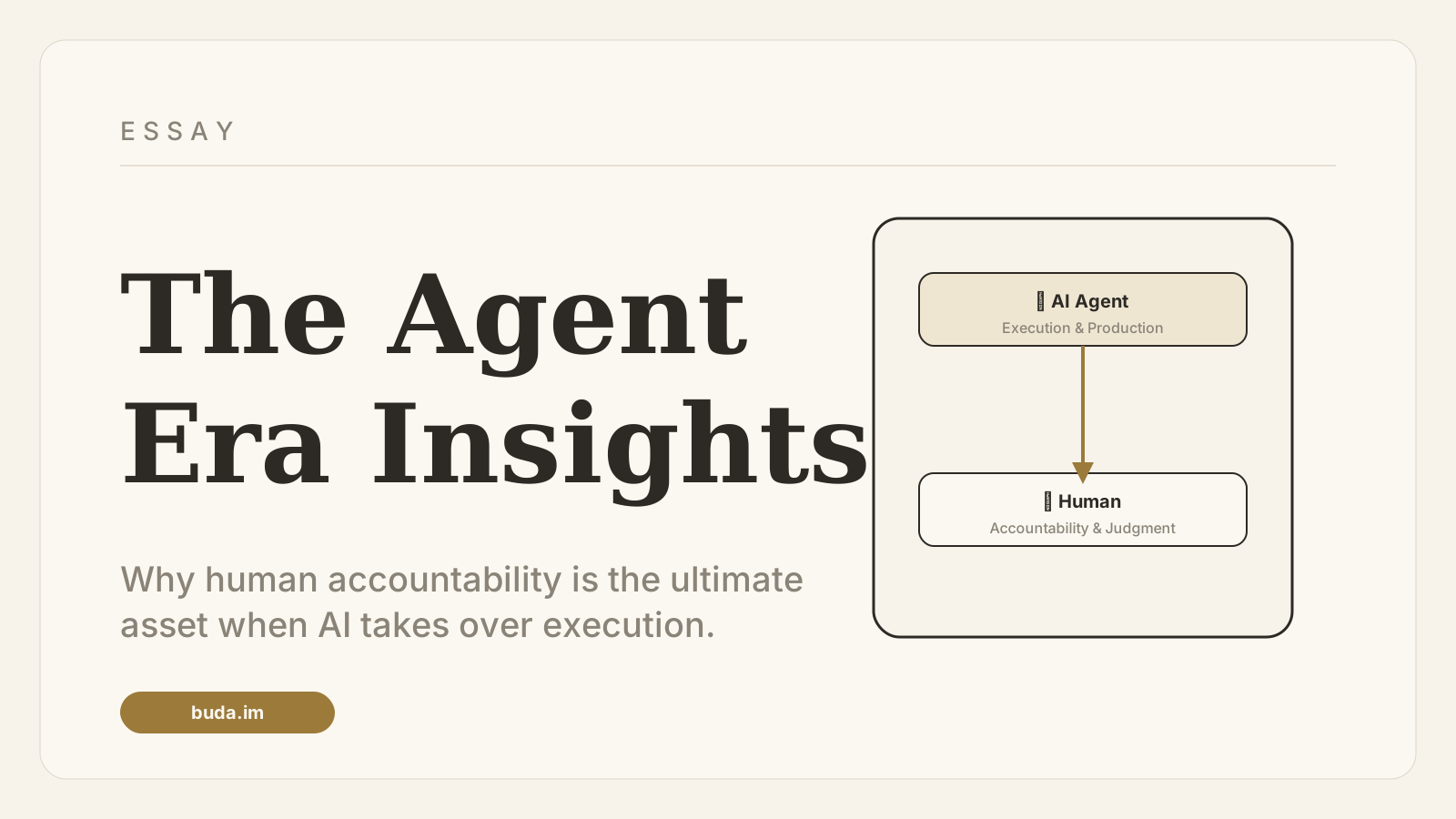
If AI can write flawless code, generate comprehensive marketing campaigns, and automatically balance financial ledgers, what exactly is the core competency of humans in a highly automated corporate future?
This is the central proposition that every enterprise and professional paying attention to AI trends must face. When AI agents compress hours of tedious workflows into a matter of minutes, many feel a sense of sheer skills anxiety. However, looking past the surface-level boost in execution, AI automation is fundamentally reshaping the power and accountability structures of modern enterprises.
The Commoditization of Execution and the Premium of "Accountability"
After evaluating the ability of AI to draft commercial contracts and code architectures in seconds, it's easy to reach a stark business conclusion: Pure execution work is rapidly becoming a cheap commodity.
Machines can tirelessly propose solutions, generate code, and draft contracts, but machines cannot assume business risk. They cannot sign their name on a financial audit, endorse a legally binding commercial contract, or make the final call during a complex market crisis.

This highlights the absolute core of human value in the AI era: Accountability.
As AI agents assume the role of the "ultimate executor," the focus of your future work will no longer be to personally "produce" the document. Instead, your job will be to act as a Reviewer—assuming the business judgment and risk associated with clicking the Approve button.
The Hollowing Out of the Traditional Corporate Pyramid
The separation of execution and accountability is directly causing a drastic shift in corporate organizational structures.

When enterprises realize that data entry, market research, basic coding, and cross-departmental distribution can all be handled automatically by a squad of AI agents at near-zero marginal cost, the massive junior and middle-management teams established merely to absorb inefficient execution will no longer be necessary.
We are witnessing the hollowing out of the traditional corporate pyramid. The bottom layer of manual execution is being rapidly replaced by agent matrices. The era of maintaining competitiveness simply by "getting the manual work done on time" is over.
Rebuilding the Future: Super Individuals and the "One-Person Company"
Faced with this structural transformation, shifting from an "executor" to an "AI manager" points to a highly actionable frontier for professionals:
1. Embrace the "One-Person Company (OPC)" Model With mature AI infrastructure, individuals no longer need to be cogs in a massive organization. As long as you possess deep Domain Knowledge and the ability to make decisions, you can deploy a 24/7 team of AI agents to handle design, code, content distribution, and data analysis. The future belongs to those who can direct AI to build super-workflows and forge their own commercial empires.
2. Deliver Un-Automated Commercial Empathy and Trust When technical execution becomes incredibly easy, genuine interpersonal connections, resource integration, and commercial trust will command a massive premium. The market will heavily reward those who can provide empathy, facilitate complex business consensus, and possess profound industry insight—core assets that algorithms cannot replicate.
You will never out-execute a cloud-deployed team of agents in speed and breadth. But machines cannot assume risk, nor can they build deep trust between humans.
Stop positioning yourself as a flawless execution tool, and start acting as the director of your own exclusive AI team. If you're ready to say goodbye to tedious repetitive labor and unlock true high-efficiency management and decision-making, visit buda.im to build your enterprise-grade agent workflows with Buda.