GitHub Copilot One-Click Fix for Failed Actions: The New AI Agent Workflow
GitHub Copilot can now fix failed GitHub Actions with one click. Here is what it means for CI automation, Copilot cloud agent, and human code review.
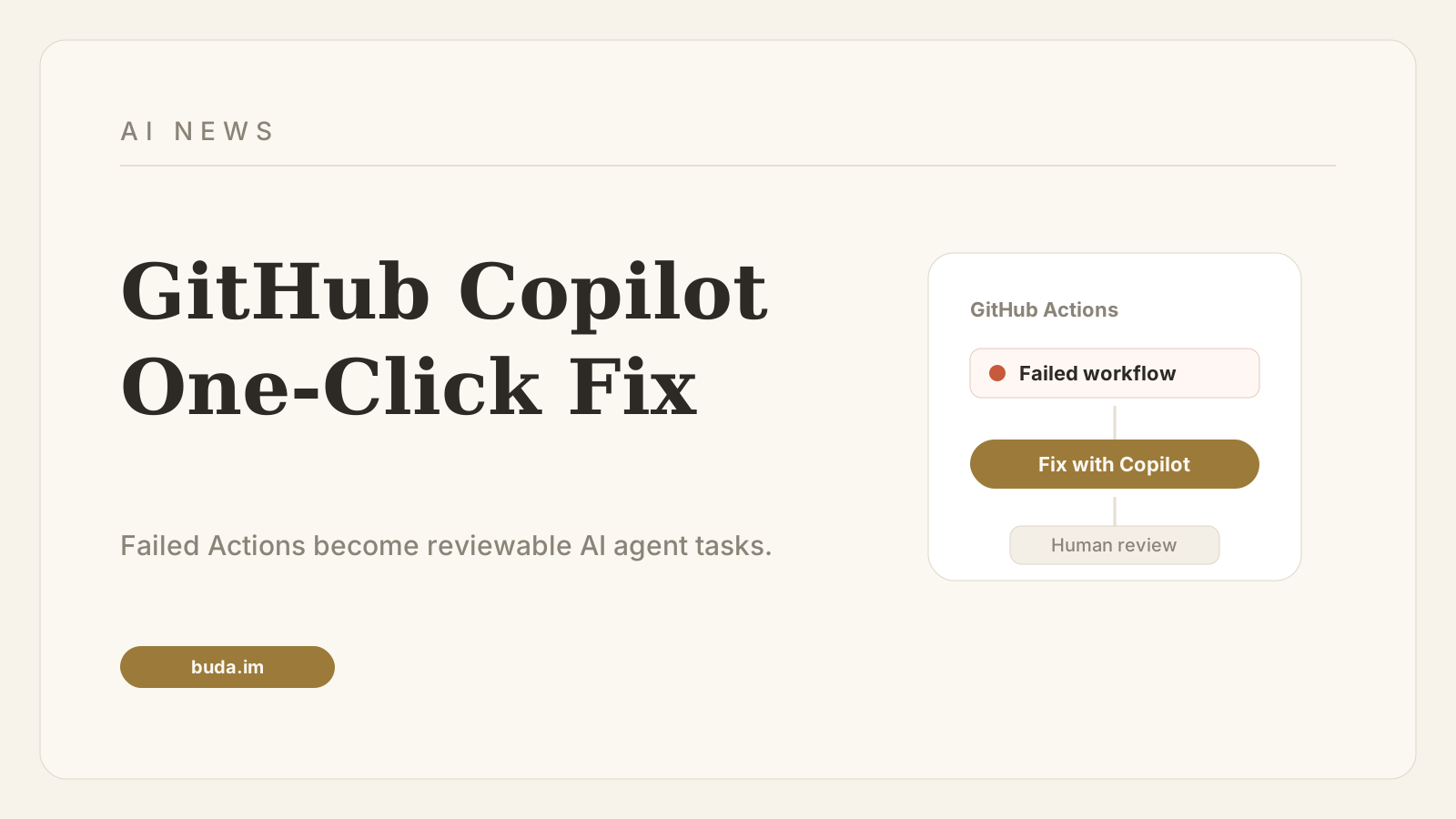
GitHub Copilot now has a one-click fix for failed GitHub Actions. For Copilot Business and Enterprise users, a failed workflow can become a task for Copilot cloud agent: investigate the logs, push a fix to the branch, and tag the human for review.
That is a very specific feature. It is also a signal.
CI failures are becoming AI agent tasks.
What happened
GitHub announced that when a GitHub Actions job fails, eligible users can click Fix with Copilot on the workflow run logs page. Copilot cloud agent then investigates the failure, works in its own cloud-based development environment, pushes a fix to the branch, and tags the user for review.
The key phrase is not “automatic fix.” The key phrase is “for review.” GitHub is not removing the human from the loop. It is turning a noisy, repetitive engineering chore into delegated work that still ends with human judgment.
Why it matters
Every engineering team knows this loop: a pull request fails CI, someone opens the Actions log, scrolls through noise, guesses the cause, pushes a small patch, waits again, and repeats.
It is important work, but much of it is mechanical. Reading logs, locating the likely file, applying a small compatibility fix, updating a test, or correcting a linter failure often does not require senior judgment at every step.
That makes failed GitHub Actions a natural entry point for AI agents. The task has a clear trigger, a narrow context, visible logs, a branch to modify, and a final review step.

The workflow shift
The old workflow was notification-first: CI fails, a developer gets interrupted, and the developer performs the repair manually.
The new workflow is delegation-first: CI fails, an agent investigates, proposes or pushes a fix, and the developer reviews the result.
This is not full autopilot. It is a clearer division of labor.
The agent handles the repetitive execution: logs, tests, patches, branch updates. The human owns the higher-order decisions: whether the fix is correct, whether the test should change, whether the patch hides a deeper problem, and whether the branch should merge.
That is the same pattern behind AI R&D automation. AI does not remove engineering judgment. It moves humans away from typing and toward review, prioritization, and system design.
What teams should do next
First, treat CI failures as structured work, not random interruptions. If a failure has logs, a branch, and a test command, it can often be handed to an agent before a human spends attention on it.
Second, keep the review boundary explicit. A one-click fix should not mean an unreviewed merge. The agent can create the patch, but humans should still inspect the diff and understand the risk.
Third, separate low-risk and high-risk failures. Linter failures, snapshot updates, dependency bumps, and simple test corrections are good candidates for agent repair. Security-sensitive changes, data migrations, production permissions, and architectural changes need tighter review.
Fourth, keep the execution environment isolated. The more agents interact with code, credentials, and CI systems, the more important sandboxing, logging, and permissions become. This connects directly to enterprise AI security.

How Buda fits
Buda is built for this kind of reviewable agent workflow.
An agent can inspect a repository, run terminal commands, test a failing path, produce artifacts, and keep the work visible inside an Agent Workspace. A human can review the output, redirect the task, or approve the next step.
With Automations, a team can trigger agents around recurring signals. With Channels, a reviewer can be notified where they already work. With Drive and Skills, the agent can carry team-specific context and repeat the same debugging playbook across tasks.
The point is not to replace the engineer. The point is to remove execution drag so engineers spend more time deciding what should ship.
For teams building larger agent systems, this is also part of agent workflow optimization: define the trigger, constrain the agent, preserve the evidence, and keep human review at the right checkpoint.
The takeaway
GitHub Copilot’s one-click fix for failed Actions is not just a convenience feature. It is a productized version of where engineering work is going.
CI failures will not disappear. But more of them will become delegated, reviewable agent tasks.
Build reviewable AI agent workflows with Buda at buda.im.