GPT-6 Astra’s 1.05M Context Window Is Not Memory
A practical architecture for context windows, Codex retrieval, persistent files, and decision records.

GPT-6 Astra’s 1.05M Context Window Is Not Memory
GPT-6 Astra accepts up to 1,050,000 tokens of context through the OpenAI API. That is enough room for a large repository, long research trail, or substantial document set. It is still not permanent memory.
OpenAI also introduced a separate Codex capability: Astra can keep notes across context windows and search earlier windows when the active window fills. That is a harness feature. It does not turn every old detail into a durable, governed record.
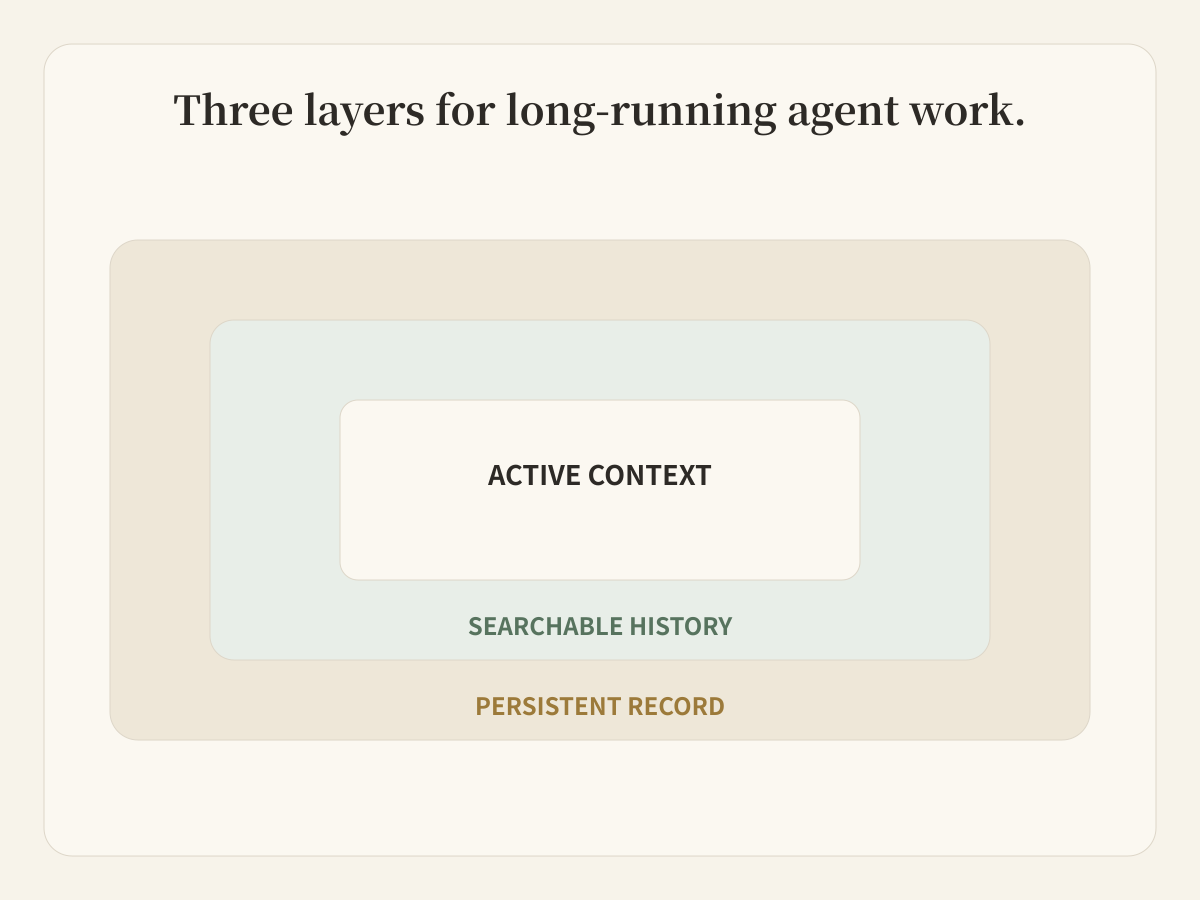
The useful architecture has three layers: active context, retrievable history, and persistent source of truth.
Layer 1: the context window is working attention
The model page lists a 1,050,000-token context window and 128,000 maximum output tokens. OpenAI reports 96.3% on its 8-needle MRCR test in the 512K–1M range. These are provider-reported model results, not a guarantee that every fact in a million-token prompt will be recalled correctly.
Large context reduces how aggressively teams must trim inputs. It does not solve stale instructions, contradictory versions, weak source labeling, or the cost of sending irrelevant material. Requests above 272K input tokens also use higher API pricing multipliers, so “put everything in the prompt” is not a free architecture.
Treat the window as working attention: enough material to reason over now, selected for the current task.
Layer 2: Codex can retrieve earlier windows
OpenAI says Codex historically compacted long sessions into summaries, which could omit why a fix failed or how a component behaved. With Astra, Codex can keep notes across windows and search earlier messages and tool outputs, including details not captured in those notes. At launch, this was experimental in config and planned to become the default for Astra.
This matters because searchable history is better than repeatedly compressing an entire project into one lossy summary. But retrieval still answers “what was said or observed before?” It does not answer “which decision is approved now?”
A previous test result may be obsolete. An earlier requirement may have been superseded. A retrieved message may record a proposal rather than an accepted decision.
Layer 3: persistent files carry authority
Long-running work needs durable objects outside the model window: the current brief, approved requirements, source files, decision log, test evidence, and final deliverable. Those objects need names, owners, dates, and review state.
Buda gives each Agent a persistent Drive and cloud computer, with files, browser, terminal, Git, Skills, Channels, and Automations available around the work. This is workspace persistence, not a claim that the model remembers perfectly. The human reviewer can inspect the actual artifact instead of trusting a reconstructed conversation.
| Question | Context window | Searchable history | Persistent record |
|---|---|---|---|
| What is it for? | Reason over selected material now | Recover earlier observations | Preserve accepted state |
| What can fail? | Attention, conflicts, cost | Retrieval miss, stale result | Bad ownership or review discipline |
| Best content | Current task packet | Prior messages and tool output | Briefs, sources, decisions, evidence |
| Who decides truth? | Model interprets | Harness retrieves | Named owner reviews |
Build a context packet, not a context dump
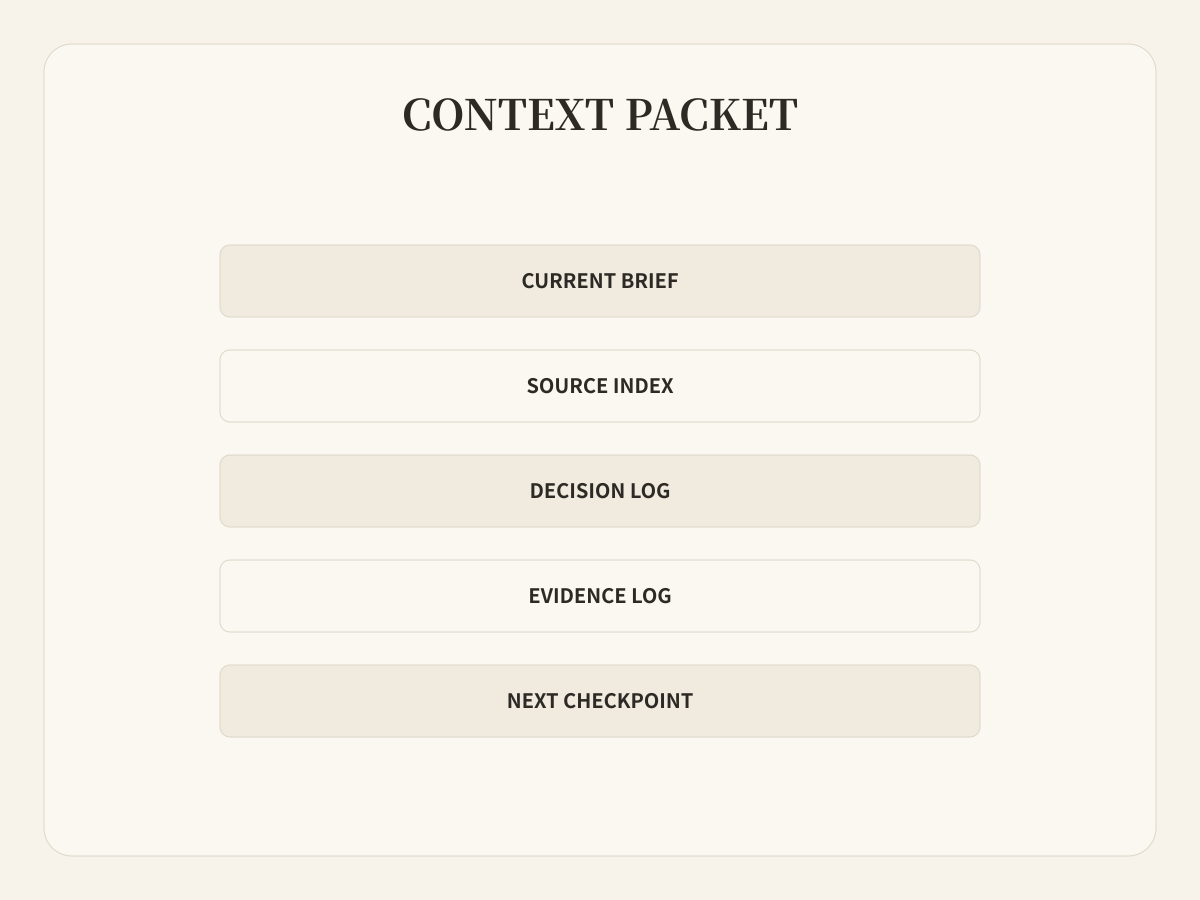
For a long task, give the Agent a small maintained packet:
- Current brief: objective, scope, constraints, and definition of done.
- Source index: authoritative files and links, with dates.
- Decision log: accepted choices, owner, and what they supersede.
- Evidence log: tests, screenshots, calculations, and known failures.
- Next checkpoint: what the Agent may continue and what requires review.
The active window can then contain the packet plus the material needed for the present step. Searchable history helps recover detail. Persistent files keep approved state stable.
When the million-token window is genuinely useful
Use the larger window when relationships across many files matter at once: repository-wide refactors, contract comparison, literature synthesis, multi-document investigations, or checking a deliverable against a large source set.
Do not use it to avoid information architecture. If the task runs for days, changes owners, or produces consequential decisions, the record must survive independently of a particular model call.
Four questions before a long-running Agent starts
- Which files are authoritative?
- Which earlier decisions are still active?
- What may be retrieved as background but not treated as approved?
- Which output requires a person to accept it?
GPT-6 Astra expands working attention. Codex improves continuity across windows. A persistent workspace preserves the work people are actually accountable for. Keep those three jobs separate.
See how Buda Agent Workspace keeps files and execution together