GPT-6 Astra Pricing Explained: Why $10/$50 Is Not the Cost of a Finished Task
Cache writes, long-input surcharges, processing modes, retries, tools, and review determine what accepted Agent work actually costs.

GPT-6 Astra Pricing Explained: Why $10/$50 Is Not the Cost of a Finished Task
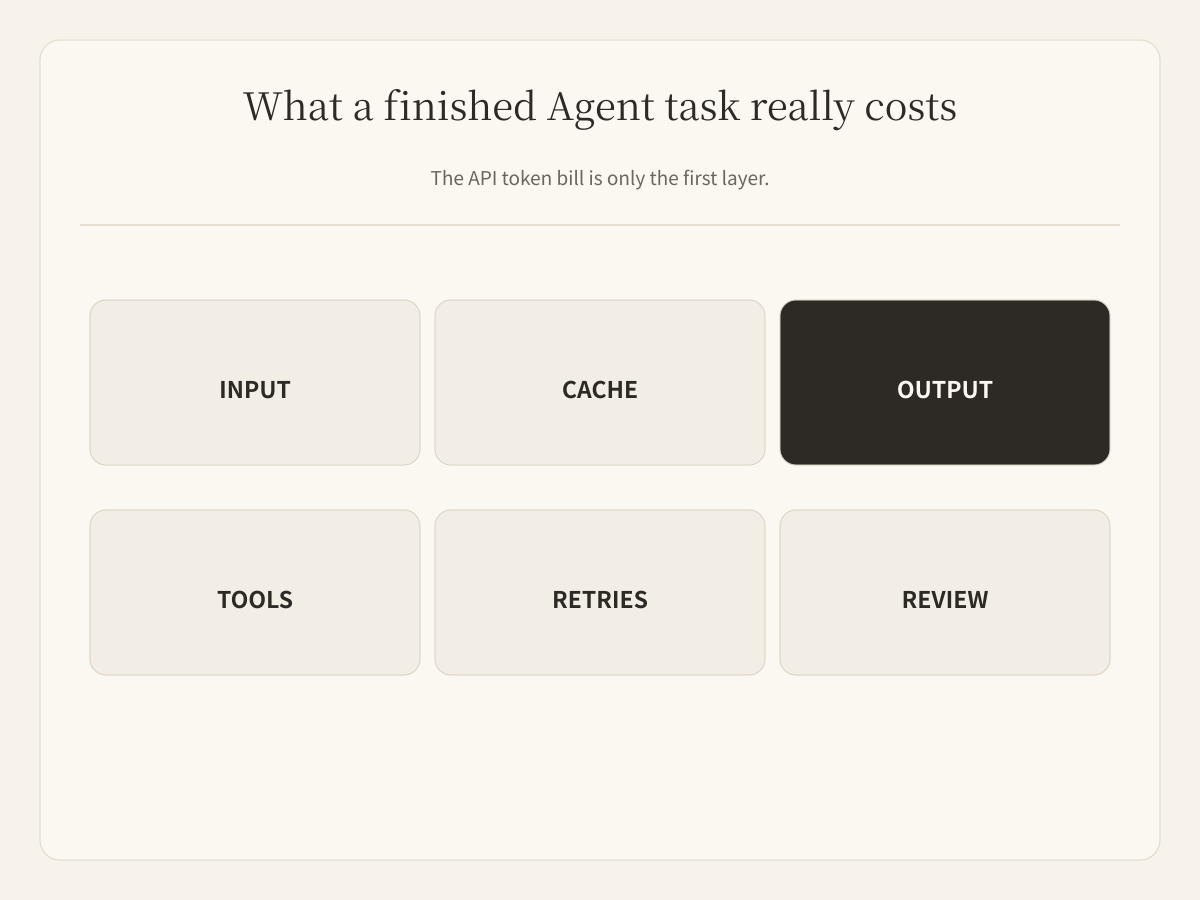
GPT-6 Astra's Standard API list price is $10 per million uncached input tokens and $50 per million output tokens. That is enough to price a token, but not enough to budget an Agent.
A finished task can include cache creation and reads, tool fees, reasoning and visible output, retries, long-input surcharges, and human review. The number that matters is therefore cost per accepted task, not cost per million tokens.
The Standard text-token formula
For a request with no more than 272,000 input tokens, the current upstream list prices are:
| Usage | Price per 1M tokens |
|---|---|
| Uncached input | $10.00 |
| Cached input | $1.00 |
| Cache write | $12.50 |
| Output | $50.00 |
A basic estimate is:
text cost = uncached input × $10/MTok + cached input × $1/MTok + cache writes × $12.50/MTok + output × $50/MTok
Use the categories reported by the API. Do not count one token as both uncached input and cache write unless the usage response bills both categories.
Tool-specific fees can be separate. Web search, computer use, and other hosted tools may add per-call or service charges, so they belong on another line of the budget.
Four bills that make the price concrete
The examples below use upstream list prices and exclude taxes, provider markups, regional processing, and tool fees.
1. A one-shot analysis: $0.40
A request uses 20,000 uncached input tokens and produces 4,000 output tokens:
- Input:
0.020 × $10 = $0.20 - Output:
0.004 × $50 = $0.20 - Total: $0.40
Output is five times the uncached input rate. Asking for shorter, structured deliverables can matter more than trimming a small prompt.
2. A reusable 100K prefix: $1.60 first, $0.45 later
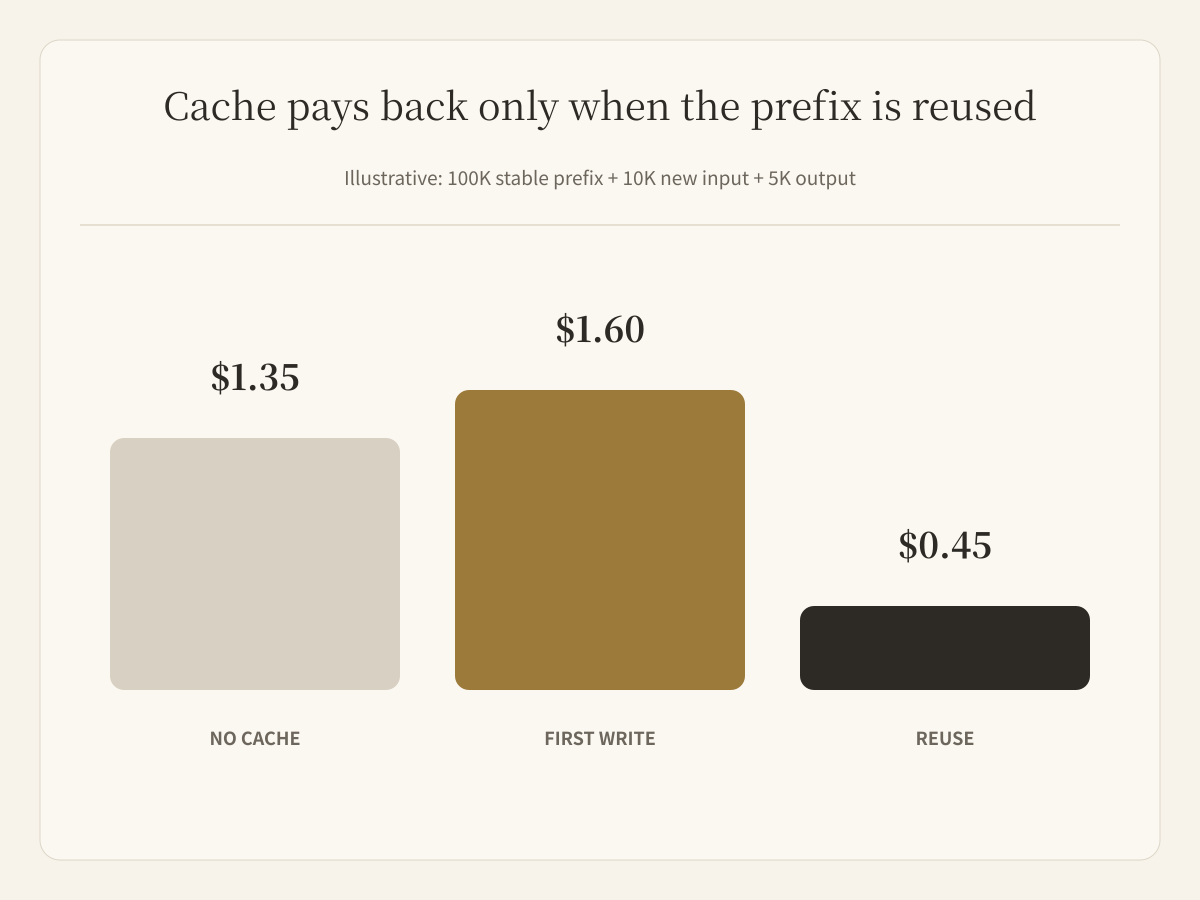
Suppose an Agent repeatedly uses 100,000 tokens of stable policy, repository context, and examples, adds 10,000 new input tokens, and produces 5,000 output tokens.
Without caching, each run is:
110K input ($1.10) + 5K output ($0.25) = $1.35
If the 100K prefix is written to cache, an illustrative first run is:
100K cache write ($1.25) + 10K input ($0.10) + 5K output ($0.25) = $1.60
A later cache hit is:
100K cached input ($0.10) + 10K input ($0.10) + 5K output ($0.25) = $0.45
The first run pays a premium; the next successful reuse saves $0.90 versus the uncached run. This only works when the prefix is eligible, stable, and actually reused.
3. A 300K input request: $7.50, not $4.00
Astra prices prompts above 272K input tokens at 2x input and cache rates and 1.5x output rates for the full request.
For 300,000 uncached input tokens and 20,000 output tokens:
- Input:
0.300 × $20 = $6.00 - Output:
0.020 × $75 = $1.50 - Total: $7.50
Multiplying the headline Standard rates would produce $4.00. The difference is $3.50 because crossing the threshold reprices the whole request, not only the tokens above 272K.
A 1.05M context window is a capacity limit, not a cost target. Retrieval and selective context remain budget controls.
4. Standard, Batch/Flex, and Fast: $1.35, $0.675, or $2.70
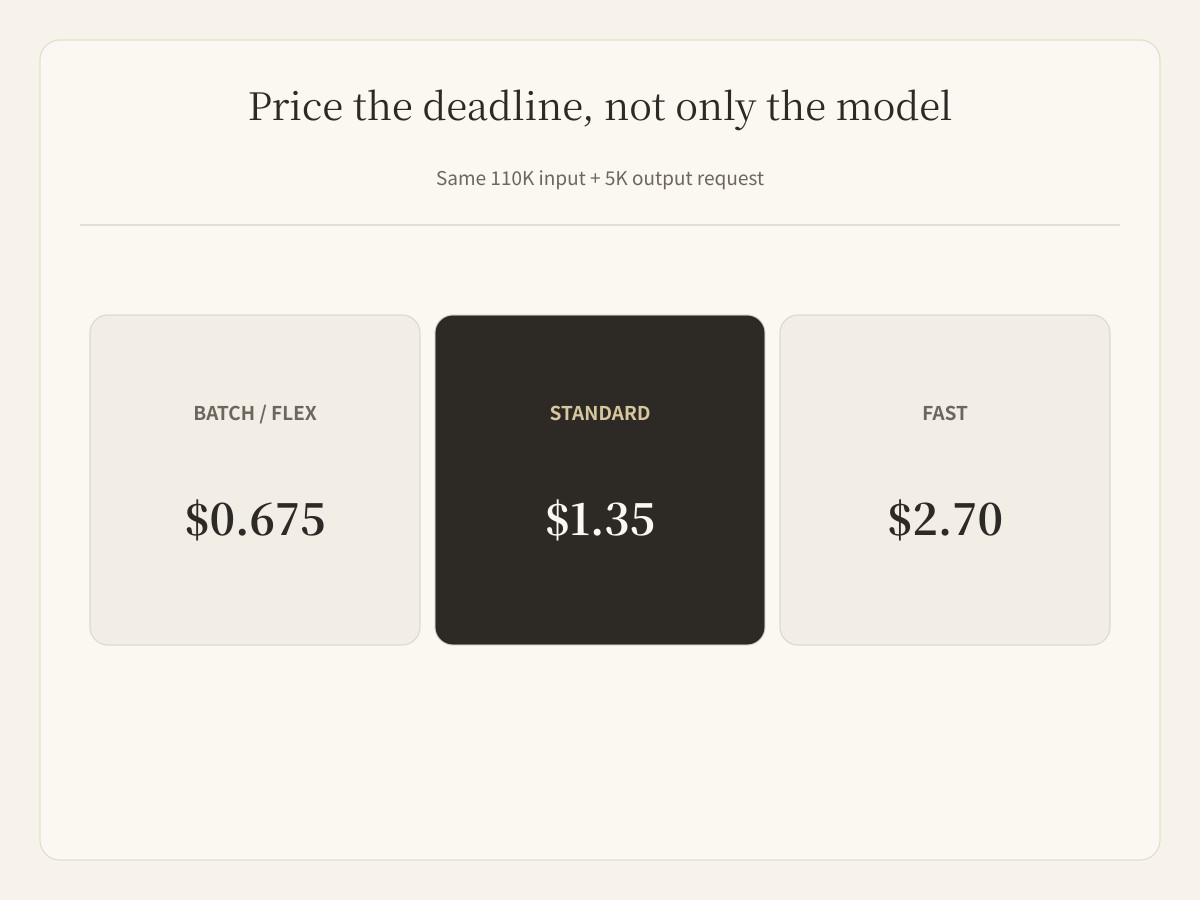
For the uncached 110K-input, 5K-output request above:
- Standard: $1.35
- Batch or Flex at 50% of Standard: $0.675
- Fast at 2x applicable rates: $2.70
The cheaper modes trade immediacy or predictability for price. Fast buys latency. Choose the mode from the deadline, not from model prestige.
Cost per accepted task changes the decision
A cheaper attempt is not cheaper work if it fails more often.
As a simple planning approximation:
expected model cost per accepted task = average attempt cost ÷ first-pass acceptance rate
A $0.40 attempt with an 80% acceptance rate has an expected model cost of $0.50 per accepted task. A $0.20 attempt with a 40% acceptance rate also reaches $0.50 before reviewer time is counted.
This formula assumes similar independent retries, so production telemetry should replace it. Still, it exposes the missing denominator: accepted work.
Track at least:
- model, effort, and processing mode;
- uncached input, cache reads, cache writes, reasoning, and output;
- tool calls and their fees;
- retries and fallback routes;
- first-pass acceptance;
- reviewer minutes and correction scope;
- total cost per accepted artifact.
OpenAI reports that Astra can use fewer tokens or less elapsed time on selected coding and computer-use tasks. Artificial Analysis also finds strong coding-agent token efficiency but reports Astra as 75% more expensive than GPT-5.6 Sol at maximum effort on its general Intelligence Index. Both can be true: task shape and harness determine whether efficiency offsets a higher token price.
Six ways to control the bill
Route premium models only to hard steps
Use Astra for the step where better reasoning or tool recovery changes acceptance. Extraction, classification, and formatting often belong on a cheaper route.
Bound the output
Specify the artifact, schema, length, and stopping condition. Output tokens have the highest text-token rate.
Stabilize reusable prefixes
Keep policy, examples, and invariant project context together so they can qualify for cache reuse. Avoid changing early prompt content unnecessarily.
Retrieve instead of filling the window
Send the files and excerpts needed for the current decision. A large context window does not remove relevance ranking.
Match processing mode to the deadline
Use Batch or Flex for deferrable work; reserve Fast for latency-sensitive steps where speed has business value.
Measure review and rework
A model that costs more per call can cost less per accepted deliverable if it avoids failed tool loops and reduces reviewer correction. Verify that with your own acceptance set.
What this means in Buda
These figures are OpenAI API list prices. They are not Buda Credits or a promise of what Buda will charge.
GPT-6 Astra is not yet available in Buda. When it launches, the model selector and public pricing page will show its availability and Credit multiplier. Actual Credits can depend on input, output, cache, tool usage, and minimum-charge rules.
For the release context, read GPT-6 Astra Is Here. For workload selection, read GPT-6 Astra vs Claude Fable 5.1. For current Buda model multipliers, use the public pricing page.
FAQ
How much does GPT-6 Astra cost per request?
There is no fixed request price. Multiply each reported usage category by its rate, apply the long-input rule when input exceeds 272K tokens, then add tool and infrastructure fees.
Is cached input always cheaper?
A cache read is cheaper than uncached input, but creating the cache costs more than one uncached read. Savings require a stable prefix and successful reuse.
Does the surcharge apply only above 272K tokens?
No. OpenAI states that prompts above 272K input tokens use 2x input/cache rates and 1.5x output rates for the full request.
Is Fast mode more cost-efficient?
Fast is a latency option priced at 2x the applicable rates. It is economical only when the time saved is worth the premium.
Is OpenAI's price the same as Buda Credits?
No. Upstream API pricing and Buda customer Credits are separate systems.