GPT-6 Astra vs Claude Fable 5.1: Which Model Fits Long-Running Agent Work?
Fable leads the independent intelligence index; Astra leads several tool-heavy tasks. The right choice depends on workload, harness, cache, and review cost.

GPT-6 Astra vs Claude Fable 5.1: Which Model Fits Long-Running Agent Work?
GPT-6 Astra and Claude Fable 5.1 arrive with almost identical headline specifications: roughly one million tokens of context, 128,000 maximum output tokens, and Standard upstream API pricing of $10 per million input tokens and $50 per million output tokens.
That does not make them interchangeable.
The short answer is: start with Fable 5.1 when the job is reasoning-heavy, research-heavy, or repeatedly reuses a large cached prefix. Test Astra when the agent must operate real software, recover through a long tool sequence, or produce finished artifacts. Then choose using accepted work from your own harness, not one public score.
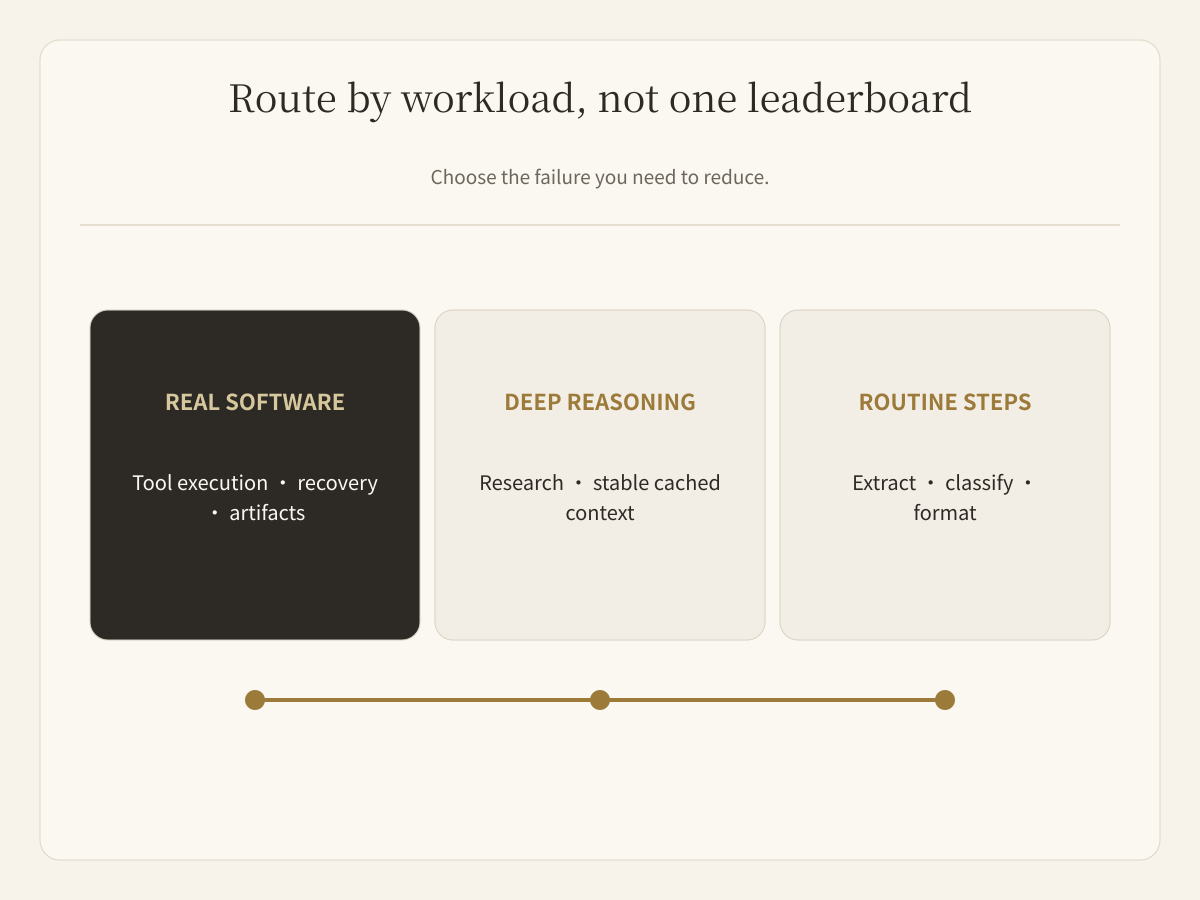
The independent result favors Fable 5.1 overall
Artificial Analysis currently gives Claude Fable 5.1 a score of 66 on its Intelligence Index, compared with 61 for GPT-6 Astra at maximum effort. Its Coding Agent Index also places Fable 5.1 at 70 and Astra at 67.
Those are useful independent signals because both models run inside the evaluator's own methodology. They do not prove Fable wins every task. The Fable configuration includes maximum effort and default fallback, while coding results use Claude Code and Codex as different agent harnesses. The score therefore measures a model-plus-runtime configuration, not an isolated model weight.
Artificial Analysis also reports a mixed Astra result: much better token efficiency than GPT-5.6 Sol, a strong cost frontier on coding tasks, but higher cost per general intelligence task because Astra's token price rose faster than its efficiency improved.
OpenAI's task table favors Astra in several tool-heavy areas
OpenAI's launch table reports Astra ahead of Fable 5.1 on several named tasks:
| Evaluation | GPT-6 Astra | Claude Fable 5.1 | Boundary |
|---|---|---|---|
| Terminal-Bench 4.0 | 57.9% | 55.8% | OpenAI table; terminal-agent setup matters |
| AutomationBench | 41.4% | 31.4% | SaaS workflow execution |
| BenchCAD | 95.9% | 84.3% | Claude score uses documented eval modifications |
| Terminal-Bench Science | 64.6% | 52.6% | Tool-driven scientific workflows |
| Artificial Analysis Intelligence Index | 61.2 | 65.7 | Independent index reproduced in OpenAI's table |
| Artificial Analysis Coding Agent Index | 67.0 | 67.2 | Essentially tied in OpenAI's snapshot |
This is not a contradiction. Astra can lead on computer operation, terminal work, and selected professional workflows while Fable leads a broader independent intelligence aggregate.
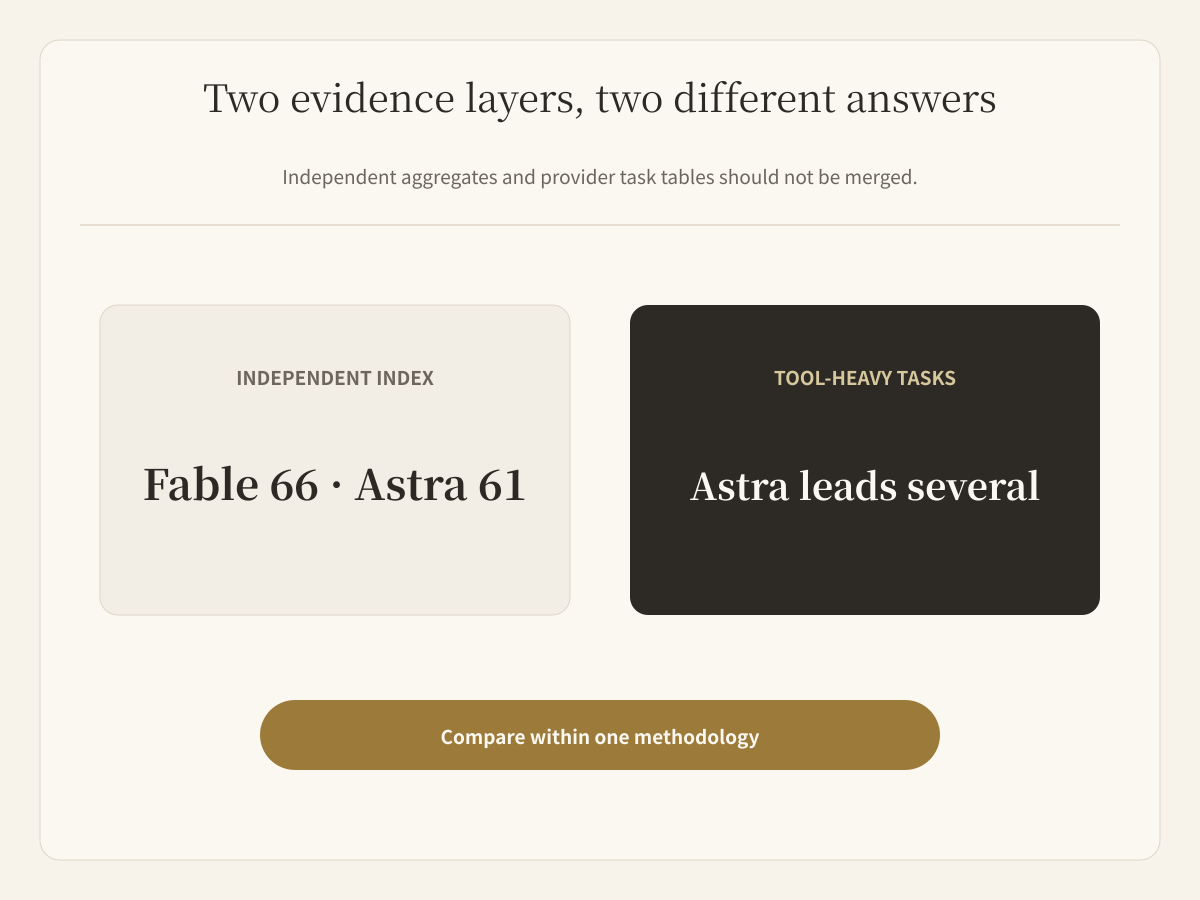
Specifications are similar; operating economics are not
Both models list about a one-million-token context window, 128K maximum output, and $10/$50 Standard input/output pricing.
The differences appear once a real session starts:
- Astra cached input is $1 per million tokens; Fable 5.1 cache reads are $0.25.
- Astra prices requests above 272K input tokens at 2x input/cache rates and 1.5x output for the full request.
- Both offer 50% Batch discounts; Astra also offers Flex at 50% and Fast at 2x applicable rates.
- Fable 5.1 uses always-on adaptive thinking and can change effort mid-conversation.
- Fable 5.1 default fallback changes the effective system being measured.
- Tool calls, retries, refusals, review, and rework can outweigh headline token price.
A million-token capacity is not a reason to send a million tokens every turn. Retrieval and stable cached prefixes still matter.
Choose by the failure you need to reduce
Test Astra first when
- the agent must navigate browsers or desktop software;
- the task mixes terminal work, files, websites, and verification;
- steering and recovery during long execution are recurring failure points;
- the deliverable is a document, spreadsheet, presentation, or working site;
- fewer tool-loop iterations could materially lower review time.
Test Fable 5.1 first when
- the work is dominated by difficult reasoning or multistep research;
- long sessions repeatedly reuse a stable, cacheable prefix;
- your existing Claude integration already handles preserved thinking correctly;
- the independent intelligence result matches the kinds of tasks you run;
- Claude Code or another Anthropic-native harness is already your operating environment.
Keep a cheaper model when
- the step is extraction, formatting, classification, or another easily checked transformation;
- a smaller model already passes the acceptance bar;
- the premium route would not reduce failure or reviewer effort.
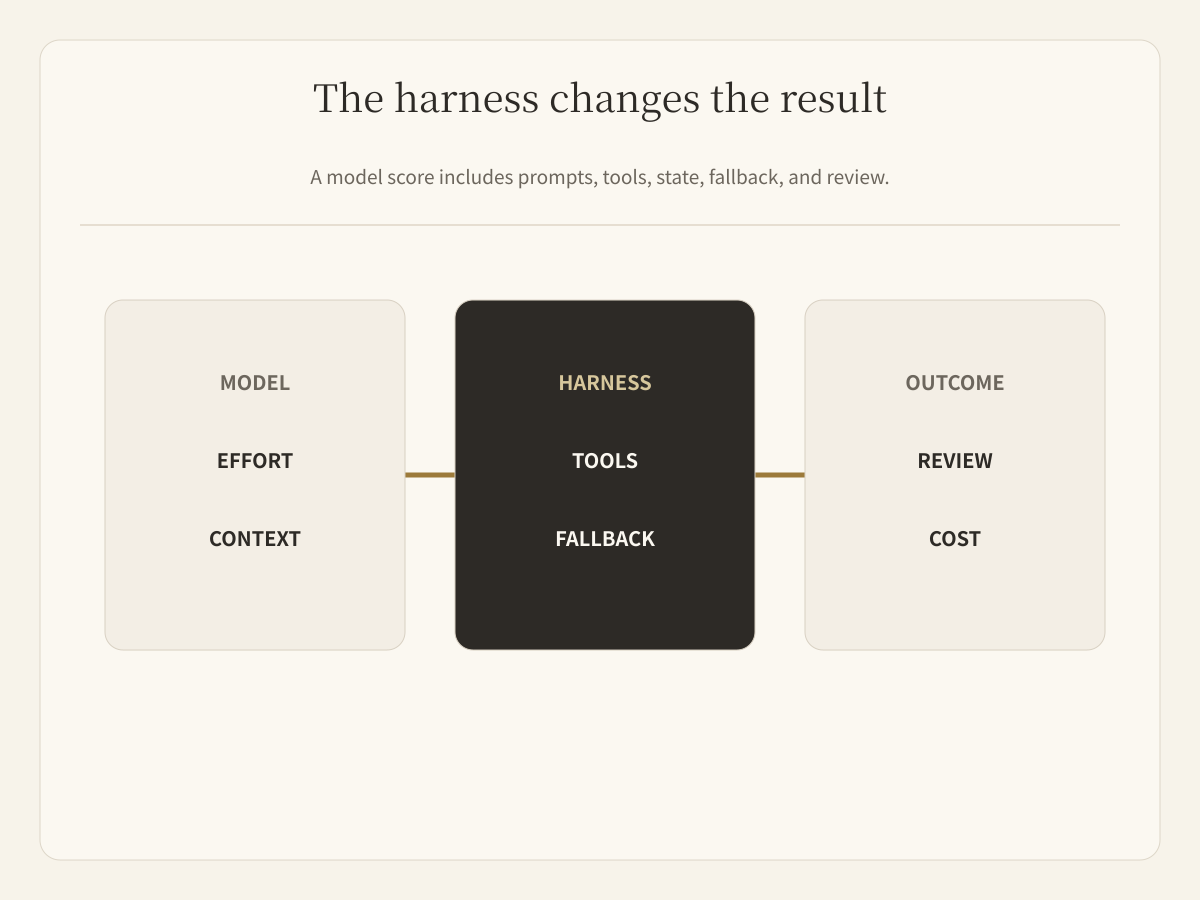
The harness can reverse the result
A model comparison that omits the harness is incomplete. Codex and Claude Code differ in prompts, tools, permissions, compaction, fallback, confirmation, and how they preserve state.
OpenAI's Astra launch combines model improvements with Codex changes, including searchable earlier context windows. Anthropic's Fable 5.1 has its own conversation rules: forced tool choice is unsupported, older models cannot read its thinking blocks, and editing earlier turns can invalidate those blocks.
Before switching production traffic, run both models through the same acceptance set and record:
- first-pass acceptance;
- tool success and recovery;
- elapsed time;
- input, cache, reasoning, and output usage;
- reviewer corrections;
- failures caused by the model versus the harness;
- total cost per accepted task.
Do not mix a model-only API test with a polished first-party agent product and call the result a model ranking.
What this means in Buda
A frontier model is one component of an Agent workspace. Teams still need persistent files, real tools, permission boundaries, visible execution, and human review.
GPT-6 Astra and Claude Fable 5.1 are not yet available in Buda. When they launch, availability and Credits will appear in Buda's model selector and public pricing page.
For the launch context, read GPT-6 Astra Is Here. For routing principles, read How to Choose the Right Model for Your AI Agents. The Fable migration details are in Claude Fable 5.1: What Changed.
FAQ
Is GPT-6 Astra better than Claude Fable 5.1?
Not across every workload. Fable 5.1 leads the current Artificial Analysis Intelligence Index. Astra leads several provider-reported computer-use, terminal, automation, and science tasks.
Which model is cheaper?
Their Standard input/output list prices match. Fable 5.1 has the lower cache-read price. Astra applies a surcharge above 272K input tokens and offers Fast, Batch, and Flex modes. Measure the whole accepted task.
Which has the larger context window?
Astra lists 1.05M tokens; Fable 5.1 lists 1M. The practical difference is usually smaller than retrieval quality, cache design, and how the harness preserves earlier decisions.
Can one benchmark decide the default model?
No. Use public benchmarks to choose candidates, then use a stable internal acceptance set to choose routes.