A Lead Scored 90. What Evidence Is Missing?
Separate rule matches from unknown inputs so sales can choose the next useful question.

A score helps only when the sales team can inspect how it was earned. Two leads can both display 90 while one has current evidence and the other is missing the facts needed for a buying conversation.
An AI lead-qualification workflow should first show the manager's criteria, each source and the missing fields. A match score describes a rule calculation. It does not estimate the probability of a sale.
Define qualification before counting points
The following eight leads and policy are fictional teaching inputs. Manager-approved ICP-R1 requires a business buyer, a supported service region, a relevant team workflow and a project horizon within six months. Region and business-buyer status are hard gates. A hard failure differs from an unknown gate; both remain explicit regardless of score.
The manager supplies an optional 100-point descriptive rubric: business buyer 30, supported region 30, relevant workflow 30, decision authority 10. Only an explicit affirmative earns points. Unknown contributes no confirmed points, but is recorded as unknown, not as a zero-valued fact or a failed criterion. Horizon and budget remain separate qualification fields and do not gain invented weights.
Eight inbound records, different next questions
Each row retains lead ID, account identity, source version, source time and the exact supporting passage. Snapshot cutoff: October 23, 2026, 10:00 Asia/Shanghai. Form dates below use that zone. Unknown budget or horizon stays unknown.
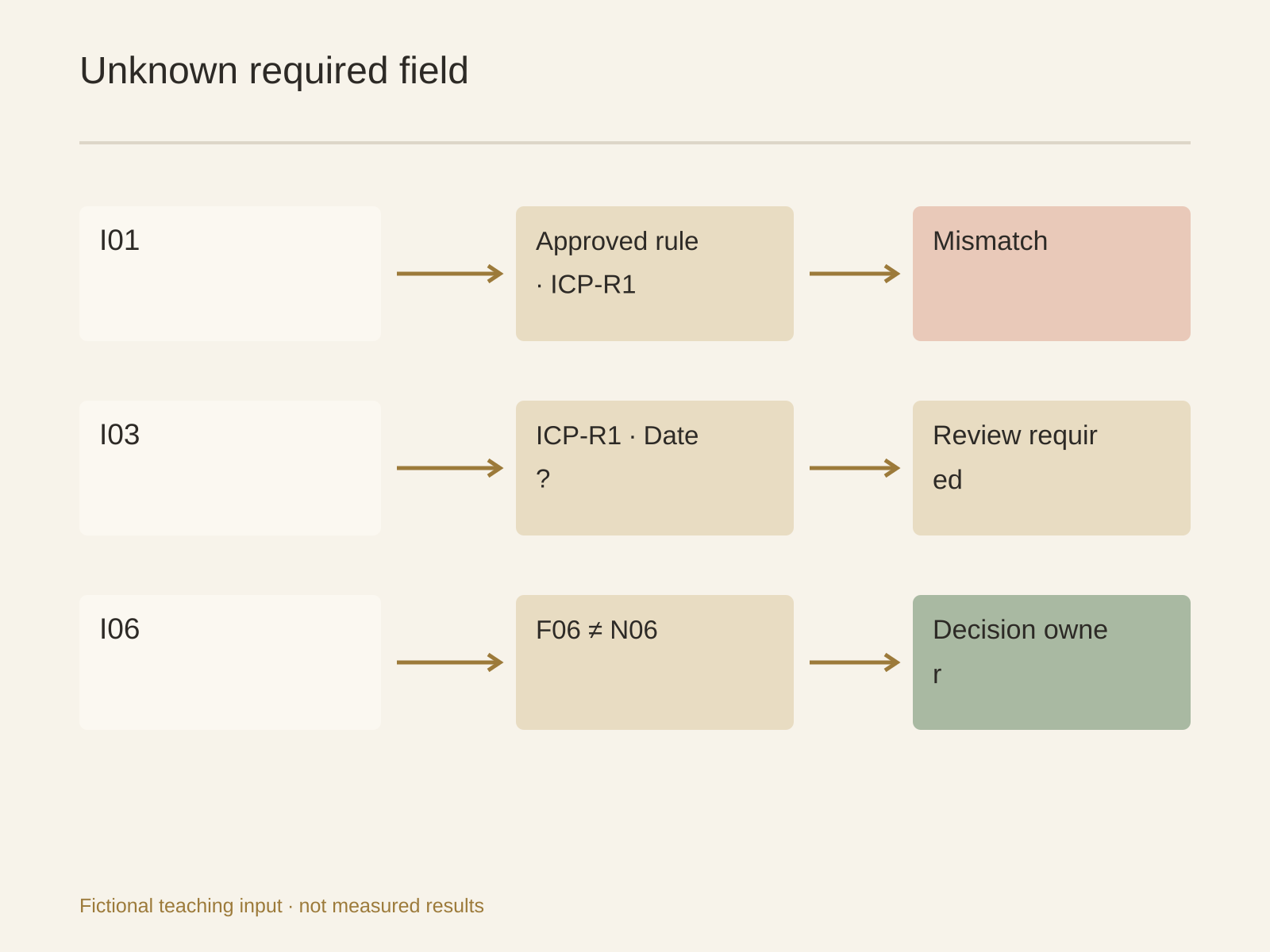
- I01: F01 October 22, a business in a region the policy explicitly excludes. Hard-gate mismatch; preserve the exclusion and ask the manager about any exception. Strong workflow fit cannot compensate.
- I02: F02 October 22 and approved confirmation N02 verify business, supported region, workflow and a three-month project. The contact is an evaluator, not a decision-maker. Result: matched, 90 confirmed points, 4/4 rubric fields known. No need to invent authority; next ask who approves the purchase. Budget is not supplied.
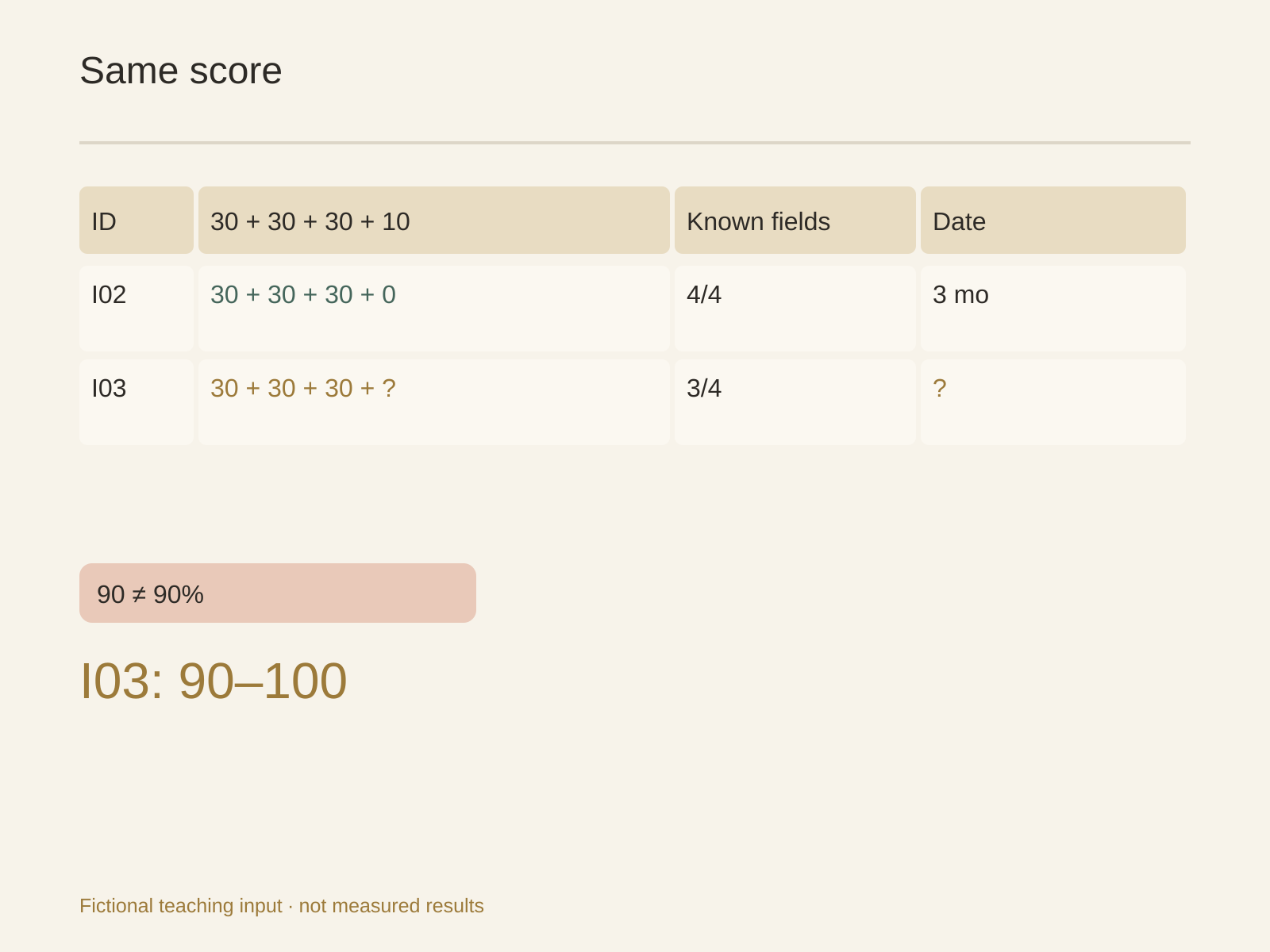
- I03: F03 October 22 verifies business, region and workflow; authority, project horizon and budget are absent. Result: pending confirmation, 90 confirmed points, 3/4 rubric fields known. The same points as I02, but horizon is a required unresolved condition.
- I04: two exports repeat I02's provider form event F02. Flag a duplicate input tied to the same stable event. Do not count it as another qualified lead or merge same-name contacts.
- I05: imported record F05 is dated October 1, 2025. Under the manager's explicit 90-day freshness rule, its buyer role and project horizon need renewed confirmation. Retain historical values; do not present them as current.
- I06: F06 October 22 says the contact is the purchasing approver, but an authorized same-day note N06 quotes “I am collecting information; procurement approves.” Preserve both and ask the owner to resolve authority. Do not silently choose the source with a later extraction timestamp.
- I07: F07 October 22 identifies a relevant business, supported region and a five-month project; the contact is a practitioner who can introduce procurement. Matched at 90 confirmed points, 4/4 known. A non-decision-maker can still be a valid contact.
- I08: F08 October 22 explicitly requests personal entertainment unrelated to the approved business workflow. Record the mismatch and reason; brand fame or polished writing does not repair relevance.
Read coverage beside the score
I02 and I03 both have 30+30+30=90 confirmed points. I02 has a known “not the decision-maker” for the fourth rubric field, while I03 has an unknown. Neither score is a 90% close probability. I03's possible rubric total is 90–100 pending authority, not a calibrated forecast. Its missing horizon also prevents a complete qualification decision under ICP-R1.
Coverage here means known rubric fields divided by four: I02=4/4, I03=3/4. It is not overall data completeness; budget and horizon are tracked separately. A large score cannot suppress a failed hard gate or an unresolved requirement. If no human-approved rubric exists, omit scores entirely and show rule-by-rule evidence.
Request qualification-evidence.csv with rule ID and wording, input value, source/version/date, quotation, fact/inference/unknown, match/mismatch/pending and reviewer. questions-to-confirm.md should contain the smallest useful next question, not a generic “research more.” For I03: “When would this project need to be in use?” A funding announcement cannot answer that customer-specific question.
Preserve conflict instead of smoothing the record
For I06, a newer approved clarification may resolve authority, but a date alone is not an authority rule. Preserve the old statement and the accepted correction with who decided. Public news can support a dated company fact; it cannot fill an absent budget, buying date or contact role by inference.
When ICP-R2 changes regions or requirements, reevaluate every dependent row from the saved input snapshot. When a form changes, recheck its affected facts and the resulting candidate. Keep rule version, input version, original score components, questions and review decision in change-notes.md. These are proposed artifacts, not an executable CRM patch or transaction lock.
Prepare the qualification packet in Buda
Use the sales workflow with authorized exports and current rules in Drive. The broader CRM automation guide explains surrounding record work. Start with files and named reviewers; a Session does not isolate file permissions, and no native CRM synchronization is assumed.
Read ICP-R1 and the authorized lead exports only. Evaluate each rule with a quotation, source date and unknown state. Keep hard failures separate from missing fields. Use only the manager-supplied weights; otherwise omit scoring. Show coverage next to points and list horizon and budget separately. Flag repeated events without merging identities. Return qualification-evidence.csv and questions-to-confirm.md. Do not contact leads, change stages, invent probability or update CRM.
Review a sanitized sample with an unknown horizon, excluded region, contradictory authority and duplicate input before repeating the workflow. These are proposed acceptance cases, not executed tests. Sales decides follow-up order, entry criteria and exceptions from the packet.
Search the Buda AI Marketplace for an appropriate Skill and inspect its instructions and permissions before installing. A reusable process can reduce repeated preparation, while its commercial decisions remain with the sales manager.
There is no formal ICP. Where should the team start?
Ask the manager to specify one supported buyer type, one relevant problem, supported regions, disqualifying conditions and what must be confirmed. Use a small reviewed sample without scores until those rules are accepted.
Should every lead without budget be rejected?
Only if the approved policy explicitly makes budget a requirement and defines how unknowns are handled. Keep unknown budget distinct from a confirmed amount below a threshold; ask a permitted discovery question.
Can news fill missing fields?
Use it as dated context with a citation. Ask the customer for budget, timing and decision process; do not convert company-level signals into personal buying intent.
What if self-report conflicts with another source?
Preserve both passages and their dates, name the disputed criterion and send one targeted clarification to the owner for review. Do not hide the disagreement inside a confident score.