Hiring and Funding Are Signals, Not Buying Intent: Prepare a Better Sales Brief
Separate public changes from business hypotheses before choosing how to open a conversation.

Before contacting a new account, a sales rep often checks its website, recent news, and job postings. What has changed? Who might own the relevant work? What would make a useful opening question? Research can accumulate quickly without answering the most practical question: why is this company worth a conversation now?
An AI agent can collect scattered information and organize it into a brief a rep can read before a call. Finding a news item, however, is not the same as finding a customer need. The useful handoff contains sourced facts, judgments that still need validation, and questions that help the customer explain their situation—not a pitch that pretends to know it already.
A hiring announcement is a starting point, not a sales verdict
A company has advertised several operations roles. A sales research agent reports that it is expanding and recommends pitching automation. The first statement may be supported by a job posting. The second still needs a conversation.
Hiring can mean growth, replacing departures, or building work in-house. Funding can support a new initiative or extend runway. A technology change can create an integration project or reduce the need for your service. A useful AI sales account research brief keeps these possibilities apart. Its job is to prepare a relevant discussion, not to pronounce a prospect ready to buy.
Give the research a boundary
Start with one company, its verified website, a recent time window, your ideal-customer criteria, and notes your team is permitted to use. Define the buyer problem your product actually addresses. Otherwise every public change can look like a lead.
Ask the agent to use public, accessible sources and authorized notes. Do not bypass a login, invent a contact, or treat a matching company name as an identity check. For each observation, retain the source URL, event date, collection date, and the relevant passage. A newly published recap of an old funding event does not make the event new.
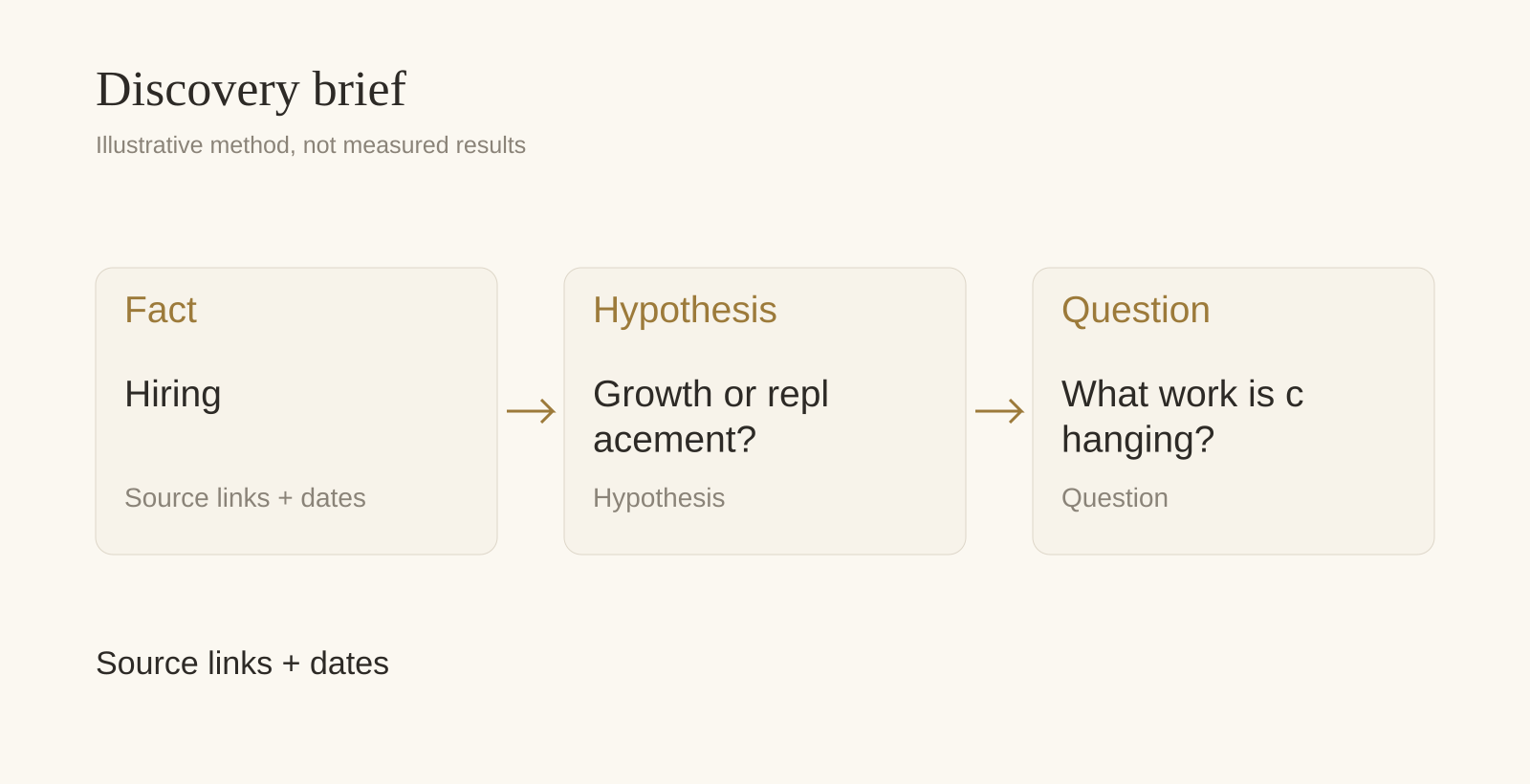
Make an evidence card before an opening message
Use six fields: observed fact; source and date; possible business consequence; competing explanation; relevant role if verified; and the question that remains unanswered. Include contrary evidence in the same card.
The following are fictional teaching examples, not researched accounts:
- Hiring: a company advertises three operations positions. Perhaps workload is rising; perhaps it is replacing a departing team. Ask: “Which parts of the operations workload are you hoping these roles will absorb?”
- Funding: a company announces a funding round. Perhaps a new market is planned; perhaps the capital is intended to strengthen existing operations. Ask: “Which operating priorities will change after this round?”
- Technology: an official engineering post describes a new data platform. Perhaps migration creates reporting work; perhaps existing reporting is already covered. Ask: “What remains manual after the platform change?”
None of these observations establishes budget, purchase timing, or a decision maker. If an official update says spending is being reduced, put that next to the expansion hypothesis rather than hiding it.
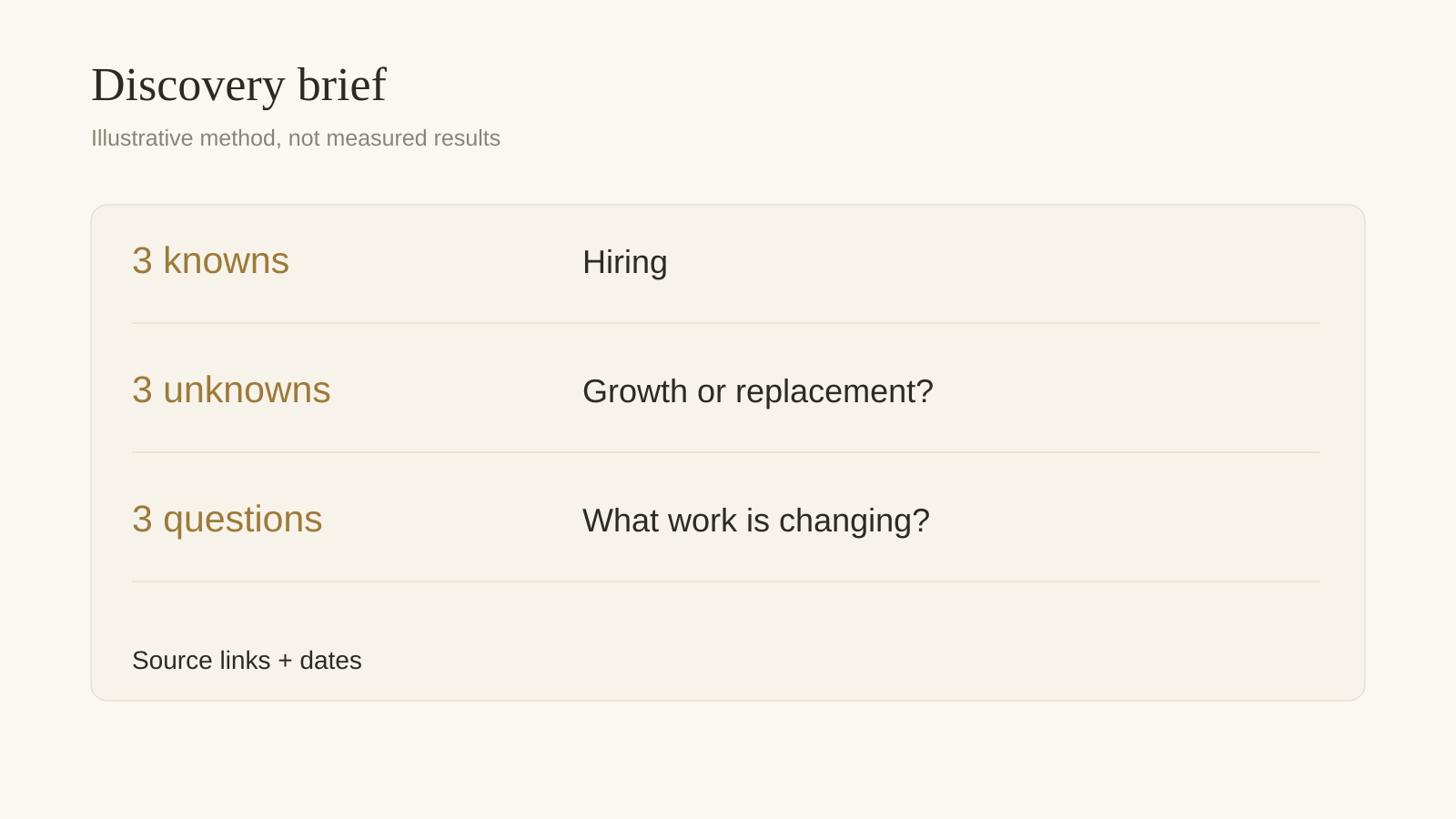
Turn research into one page a rep can use
The handoff should fit a real pre-call read: three verified observations, three important unknowns, three discovery questions, and two editable opening angles. Put source links beside observations; keep hypotheses visibly labeled.
For the fictional hiring case, one opening could be: “The operations hiring caught my attention. Is the team adding capacity for a new workload, or reorganizing existing work?” Another could focus on the role description: “The posting mentions weekly reporting. How does that process work today?” Neither pretends to know the customer is struggling.
Choose a conversation angle only when the source, relevance, and question form a coherent chain. If they do not, the correct output may be a brief saying there is not yet enough reason to contact the account.
Run account preparation in Buda
The sales workflow includes account research and reviewable preparation. The Agent Workspace brings Browser research and working files together. In Drive, save the source notes, evidence cards, and brief so they remain available after the conversation.
A practical folder structure is accounts/company-name/sources/, evidence.md, and dated briefs under briefs/. Keep the original snapshot and record what changed when you revisit the account. Persistent files are not a promise that every public source can be found or that an inference is correct.
A task you can adapt:
Research this verified company website using public accessible sources from the last 90 days and the authorized notes in the account folder. Compare observations with our ICP. For each signal, cite its URL and event date, label hypotheses, include contrary evidence, and leave unknown budget, contacts, and timing blank. Produce a one-page discovery brief. Do not send outreach or update CRM.
The broader CRM automation guide covers record maintenance. Keep that separate from deciding whether this research supports a useful conversation.
Check the brief before contacting anyone
Try four review cases before relying on the workflow: a dead source link, an old event republished recently, a similarly named company, and evidence that contradicts the attractive hypothesis. These are proposed checks, not completed test results.
For a dead link, look for an accessible original or remove the unsupported fact. For an old event, retain its original date. For an identity mismatch, stop until the company is resolved. For contrary evidence, revise the hypothesis and opening. The rep owns the final choice of whether, why, and whom to contact.
Questions before the next call
What if public information is sparse? Return a short brief stating what is verified and what is missing. Use authorized past conversation notes where available; otherwise prepare neutral discovery questions rather than fabricating personalization.
Does funding mean a buying opportunity? It is a reason to investigate operating priorities. Ask what changes and who owns that work before inferring a need for your product.
How should old research be updated? Create a dated revision, retain the previous brief, and list changed facts and affected questions. Do not silently carry an old assumption into a new opening.
Choose one account for your next call. Let the agent assemble a checkable brief, then decide whether the evidence earns a conversation.