The sales call is summarized. Why is nobody doing the next step?
Turn customer statements into accountable follow-up without turning suggestions into promises.

A sales meeting ends with a polished summary. The customer wanted pricing, someone suggested a demo, and the team agreed to keep talking. Two days later, nobody knows who should send what. The problem is not missing prose. It is a missing commitment record.
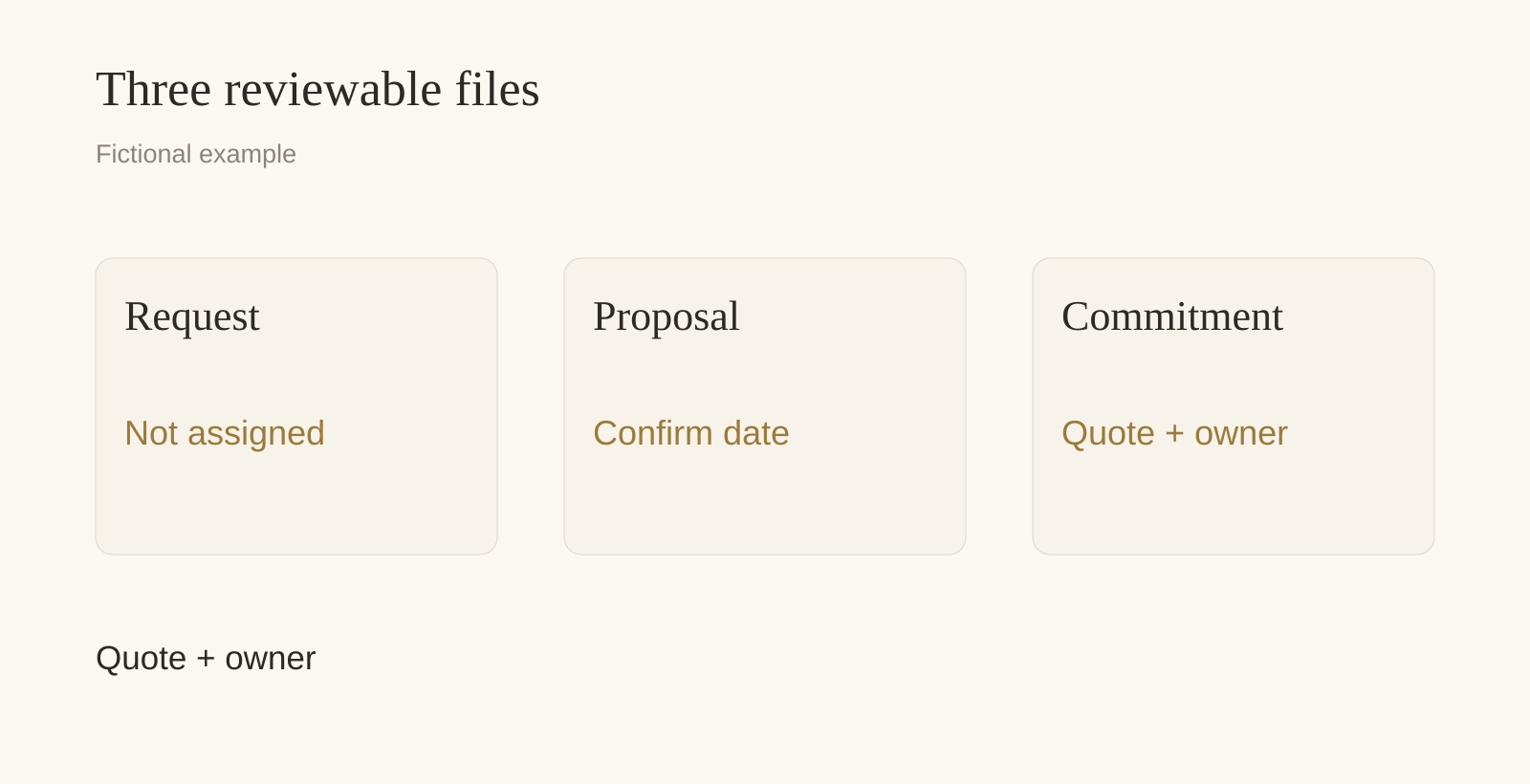
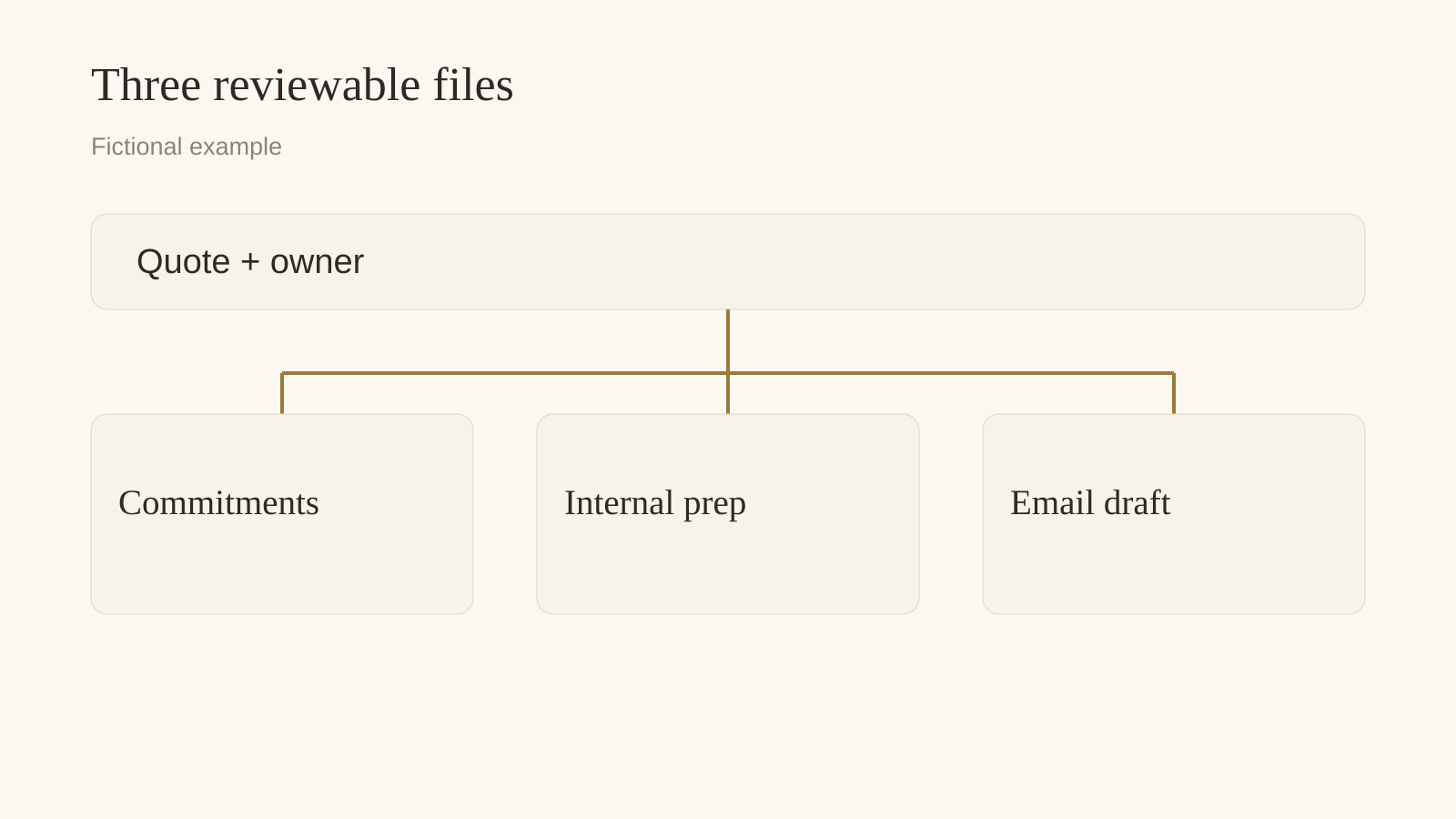
An AI sales meeting action-items workflow should produce three inspectable files: a commitment table, an internal preparation list and a customer email draft. Each serves a different reader. Start by recovering what people actually agreed to, before assigning work.
Six statements, three kinds of meaning
This fictional conversation illustrates the distinction; it is not a customer transcript. The meeting is October 13, 2026, at 10:00 in Asia/Shanghai. Maya is the customer; Leo is the seller.
| Source | Statement | Classification and handling |
|---|---|---|
| 01 Maya | “Can you send pricing?” | Request; no seller commitment yet. |
| 02 Leo | “I will send our standard price sheet tomorrow.” | Explicit seller commitment; October 14 in the meeting timezone. |
| 03 Maya | “Maybe we could do a demo next week.” | Suggestion; no booked demo or exact date. |
| 04 Leo | “I could bring our solution specialist.” | Proposed participant, not a confirmed attendee. |
| 05 Maya | “Please include the annual billing option.” | Requested content; not acceptance of a purchase or discount. |
| 06 Leo | “I will include it in that price sheet.” | Confirmed scope of Leo's existing task; do not create a second send. |
The grammatical difference matters. A question is not agreement, and “could” is not “will.” Preserve the quote and source location so a rep can check the interpretation in seconds. Keep the customer's request visible even when nobody has yet accepted responsibility.
Prepare the context that changes interpretation
Use authorized notes or a transcript from a recording obtained with permission. Provide the meeting date, timezone, participant identities, account context and existing follow-up list. Buda is not assumed to join or record meetings automatically; a supplied transcript is a writing input.
If two people are called Alex, identify them by company and role before extracting ownership. If notes say only “tomorrow,” the meeting's date and timezone are required. Retain the original phrase beside the normalized date. “Next week” remains a date range or a question, never an invented Monday deadline.
Separate product and pricing references from conversation evidence. A current price sheet can support preparation, but it cannot prove that a customer agreed to its terms.
Build a table that exposes missing decisions
Use columns for source location, original words, action, responsible party, original date phrase, normalized date and timezone, dependency, and unresolved question. Leo's row points to 02 and 06, names him as responsible for preparing the standard sheet, records “tomorrow,” and uses October 14, 2026, Asia/Shanghai. Annual billing is a requested inclusion; any commercial exception remains unapproved.
An absent owner stays blank with “confirm responsibility.” An absent deadline stays unconfirmed. Give those gaps their own list rather than burying them inside a smooth summary. The rep resolves ambiguity; the agent prepares the questions.
Separate preparation from customer delivery
“Send pricing” contains at least two steps. Internally, locate the approved version, verify the relevant product and currency, include the requested billing option, and flag missing conditions. Externally, prepare the email and attachment list for the rep to review. Finding a document does not authorize a discount or a customer send.
A faithful draft might say: “I will send the standard price sheet tomorrow, including the annual billing option. For the demo, which day next week works for you?” It must not say “Your demo is booked for Monday” or “We have agreed on annual billing.”
The internal task list can include checking price-sheet validity. The customer email does not need every internal preparation step. Both versions share the same commitment evidence, not identical wording.
Keep a dated account packet in Buda
The sales workflow supports context-heavy research, follow-up and proposal preparation with rep review. Use Drive for authorized source files and dated outputs. A Session gives a distinct conversation context; it is not a separate file-permission boundary.
For example, save accounts/demo/2026-10-13/commitments.md, internal-preparation.md and email-draft.md. This path is an organizational convention, not automatic access control. State which input files the agent may read, and omit unnecessary personal or commercial data.
Read the supplied call notes, participant list and approved pricing reference.
Classify each next-step statement as request, proposal or explicit commitment.
Preserve quotes, source locations and original date phrases.
Create commitments.md, internal-preparation.md and email-draft.md.
List unknown owners, dates and commercial terms separately.
Do not send messages, schedule a meeting or update CRM records.
At the next meeting, append a change comparison. If Maya withdraws the demo request, mark it withdrawn with the new source. Do not silently erase the history or infer renewed consent from an old conversation. Identify repeated notes by meeting identity and source position before creating another proposed task.
Check interpretation before connecting execution
These are suggested acceptance cases, not completed account tests: vague dates must remain questions; missing owners must remain unassigned; same-name participants require identity clarification; withdrawn commitments must be marked cancelled; repeated notes must not produce duplicate proposed actions. Review the quotes as well as the resulting table.
The CRM workflow overview covers broader record maintenance. Move a reviewed action into CRM only after the rep confirms responsibility, timing and allowed fields. Keep automated writing or sending as a separately configured workflow.
Can handwritten notes work?
Yes. Add the date, timezone and participant mapping, then mark which passages are direct quotes and which are the note-taker's summary. Do not invent verbatim quotes from paraphrases; ask the rep to verify disputed commitments.
How do you confirm a vague date?
Draft a specific question such as “Which day next week should we plan for?” Keep the proposed date out of confirmed commitments until the person responsible accepts it.
What should survive the next call?
The previous commitment record, new source passages, changed or withdrawn items and current open questions. Compare versions before generating follow-up; a past promise is not evidence of current consent.
Start with the next permitted set of call notes and three reviewable files. The rep should be able to see what was promised, what must be prepared and what still needs an answer—without rereading an entire meeting.